
The Faraday Museum is free, it is in the basement and on two floors of the Royal Institution at 21 Albemarle Street in Mayfair, and it opens Monday to Friday 9am to 5pm plus the first Saturday of each month, 1pm to 6pm. Allow an hour. The thing people come for is Michael Faraday's magnetic laboratory, rebuilt in the basement room where he worked.
The Royal Institution is a scientific charity founded in 1799. Its building has been the site of an improbable number of discoveries: nine chemical elements, the electric motor, the electric generator, the greenhouse effect, argon, the vacuum flask, X-ray crystallography. The museum is the Royal Institution's account of its own history, told through the apparatus that was actually used.
It is small. Three part-floors, not a wing. That is the point: you are in a working building in Mayfair, walking past the doors of the library and the lecture theatre, and the exhibits are in the corridors and rooms where the work happened. If you want a large free science museum with hands-on galleries, go to the Science Museum in South Kensington instead. If you want to stand where Faraday stood, come here.
The Faraday Museum at a glance
- Price
- Free, no booking
- Open
- Monday to Friday 9am to 5pm; the first Saturday of every month 1pm to 6pm (added from May 2026)
- Closed
- All English bank holidays, plus 1 October, 12 to 15 October, 12 November and 18 to 19 November 2026
- Address
- The Royal Institution, 21 Albemarle Street, London W1S 4BS; telephone 020 7409 2992
- Nearest station
- Green Park (Jubilee, Piccadilly and Victoria lines), about five minutes
- Building
- Grade I listed, list entry 1066521, first listed 24 February 1958
- How long
- 45 minutes to an hour and a half
The opening hours catch people out twice
The first trap is the weekend. For years this was a weekday-only museum, and plenty of listings still say so. Since May 2026 the Royal Institution has also opened on the first Saturday of every month, from 1pm to 6pm. Any other Saturday, and every Sunday, the door is shut.
The second trap is that this is a busy events venue as well as a museum. The Royal Institution's own advice is blunt: "There may be limited access to the building if private events are taking place. Please call ahead." On top of that it publishes a list of dates when it is closed to the public altogether, and in the autumn of 2026 that list is long: 1 October, 12 to 15 October, 12 November, and 18 to 19 November. Bank holidays are always out.
Telephone before you walk to Albemarle Street. The Royal Institution gives 020 7409 2992 for exactly this purpose. A five-minute call is cheaper than a wasted journey across Mayfair, and the published closure list does not always catch a private hire booked at short notice.
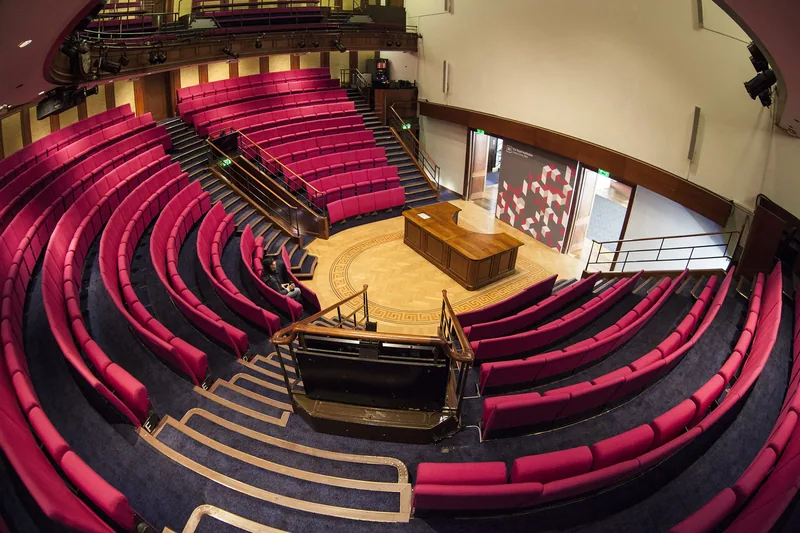
Photo: AnaConvTrans · CC BY-SA 4.0 · Wikimedia Commons · resized
The lower ground floor, and what the magnetic laboratory actually is
Go down first. The basement is where the Royal Institution's discoveries were made and it is where the museum puts its best material.
The room everyone photographs is described by the Royal Institution as "Faraday's magnetic laboratory displayed as it was in the 1850s". That wording matters, and it is more honest than the version you will read elsewhere. Faraday built the first electric motor in 1821 and the first electrical generator in 1831; the room you are looking at is a reconstruction of the same basement laboratory as it stood three decades later, near the end of his working life, with the bench, the bottles and the apparatus arranged as contemporary records show them. It is not a frozen moment from the day the motor was invented. It is the place, not the instant.
Directly opposite it, the museum puts a modern nanotechnology laboratory behind glass. The two rooms facing each other across a corridor is the single best piece of curating in the building.
The objects in the cases
The Royal Institution's own list of what survives from its experiments reads like a syllabus. Among the things on display or in the collection:
- Humphry Davy's apparatus from the discovery of nine chemical elements, and the miners' safety lamp he invented, which the museum fairly describes as the device that saved countless lives underground.
- Faraday's electrical equipment, including the first electrical transformer, and the apparatus from his work on the field theory of electromagnetism and on liquefying gases for cooling.
- Thomas Young's material on the wave theory of light.
- John Tyndall's radiant heat experiments, which is to say the discovery of the greenhouse effect. If you want one exhibit that explains why this basement matters in 2026, it is this one.
- Lord Rayleigh's discovery of argon, and James Dewar's liquefaction of hydrogen together with the Dewar flask, now sold in every shop as a thermos.
- The tube that explains why the sky is blue, which is how the Royal Institution labels it, and which is worth finding for the label alone.
- The Braggs' X-ray crystallography equipment, and George Porter's laser analysis of very fast reactions.
There is also a game: spot the ten elements first isolated in this building as they go past in a song. It works better with children than it sounds.
Ground floor: the cast
The ground floor is about people rather than machines. Faraday himself, a bookbinder's apprentice who got in through a lucky break and ended up one of the most important experimental scientists who ever lived. Humphry Davy, his employer, whom the Royal Institution's own display calls arrogant and charismatic in the same sentence. Ada Lovelace, mathematician and daughter of Byron. And the fourteen Nobel Prize winners who have worked in the building.
This is the floor to skip if you are short of time, and the floor to linger on if you brought a teenager who likes an argument about who deserves credit for what.
First floor: the theatre and the Christmas Lectures
The first floor is given over to the Royal Institution as a place of public talks, which is what it was set up to be. The displays here are paintings, film clips and props from the lecture theatre. The Royal Institution promises you will find out what a boomerang, a stuffed kangaroo and a saw have in common, and what happens when a lecturer has too much laughing gas.
The theatre itself is the semicircular room, dating from about 1800 with a gallery above, where the Christmas Lectures have been filmed for television since the 1930s. You cannot always get into it: it is in use most weeks. Both of the Royal Institution's tours include it when it is free.
The building: a Georgian terrace behind a screen of columns
The front of 21 Albemarle Street looks like a Victorian public building and is in fact a house of 1756. The statutory list entry, which puts it at Grade I, sets out the sequence: a brick terraced town house of three storeys and twelve bays, only one room deep, acquired for the Royal Institution in 1799; altered for the Institution by Thomas Webster with George Saunders advising; and then given "a commensurately grand front" in 1838 by Lewis Vulliamy, who regularised it to thirteen bays, rendered it, and ran a screen of giant engaged fluted Corinthian columns on low pedestals through all three storeys.
The list entry also names what is inside, which is unusual and useful: the mid-eighteenth-century stone staircase with its wrought-iron balustrade, surviving as far as the first floor; the semicircular lecture theatre of about 1800 with its gallery; the Conversation Room, described in the list as the Scientific Gentleman's Library; and "Faraday's magnetic laboratory". Further alterations were made in 1928 to 1930 by Rome Guthrie, and the plasterwork on the staircase walls and ceiling is from 1928. Number 20 next door, also Grade I in its own right, was absorbed into the Royal Institution in 1894 and contains a chimneypiece with a Wedgwood plaque brought here from Sir Joseph Banks's house at 32 Soho Square.
The two tours, and which is worth paying for
| Tour | Length | Price | What it covers |
|---|---|---|---|
| Welcome tour | About 45 minutes | Free for Royal Institution members; £10 plus booking fee otherwise, refundable if you join on the day | An introduction to the building and the charity, taking in the theatre, the Faraday laboratory and the library. Runs on set dates, booked in advance |
| Heritage tour | 1.5 to 2 hours | £15 per person for groups of ten or more; a flat £150 for smaller groups | Led by the Collections and Heritage team. Starts on the first floor, works down through the ground floor to the basement, and includes the theatre if it is not in use |
Prices read on rigb.org in September 2026. The heritage tour is not run at weekends, and not at all in December because the Christmas Lectures are being recorded. For a couple or a family, the flat £150 rate makes it a group activity rather than a day out; the Royal Institution says individuals can sometimes be added to an existing tour at the per-head rate but will not promise it. The welcome tour at £10 is the better bet, and the museum itself is free in any case.
Bags, lifts and the café
The visitor entrance on Albemarle Street has manual double doors and is step-free. There is a lift in the Atrium which reaches every public level and announces the floors, and all the public areas are wheelchair accessible; the theatre can take four wheelchair users. Accessible and standard toilets are on the ground floor by reception, with baby changing in the accessible toilet.
The cloakroom is small and unattended, and it is not optional: large bags and rucksacks have to go in it, and staff may ask you to leave a briefcase, a stick or an umbrella there too. Buggies can go in if there is room. Come with as little as you can. Our notes on left luggage in London cover what to do with a suitcase.
The Royal Institution's café is open Monday to Thursday, 9am to 3pm only, which is worth knowing if you are planning a Friday visit around lunch. It trades as Searcys@The Ri at 21 Albemarle Street and holds a food hygiene rating of 5, inspected in March 2025. For Blue Badge holders there are four bays on Mayfair Place and three on Cork Street; the building is inside the Congestion Charge zone, so see our guide to the Congestion Charge and ULEZ before driving.
Getting there, and what else is within ten minutes
Green Park is the nearest station, about five minutes away, on the Jubilee, Piccadilly and Victoria lines. Piccadilly Circus and Oxford Circus are both about ten minutes on foot. Buses 9, 14, 19, 22 and 38 run along Piccadilly past the end of Albemarle Street, and bicycle parking is round the corner on Bond Street.
Albemarle Street runs north from Piccadilly into the heart of Mayfair, so this is an easy museum to bolt on to something else. The Royal Academy of Arts is two minutes away through Burlington Arcade. Handel Hendrix House on Brook Street is about twelve minutes north, and the Wallace Collection about twenty. Berkeley Square is three streets west, and the shops of Bond Street start at the end of the road.
Because it is free, indoors and rarely crowded, this is a good half-hour to have in reserve. See our list of London's free museums and our suggestions for a rainy day in London. For another free museum with a single-minded collection in a building that is part of the exhibit, try the Bank of England Museum in the City, or, for more of this kind of thing, our round-up of London's best small museums. Aviation enthusiasts should note that the other great free technical collection in London, the RAF Museum, is a very different proposition: half a day in six hangars at Colindale.
Frequently asked questions
Is the Faraday Museum free?
Yes. Entry to the Faraday Museum at the Royal Institution is free and you do not need to book. The guided tours are charged separately: £10 for a 45-minute welcome tour if you are not a member, or £15 a head for a heritage tour in a group of ten or more.
Is the Faraday Museum open at weekends?
Only on the first Saturday of the month, from 1pm to 6pm, an arrangement introduced in May 2026. It is otherwise a Monday-to-Friday museum, 9am to 5pm, and it closes on every English bank holiday.
Can you see Faraday's laboratory?
Yes, it is the centrepiece of the lower ground floor. The Royal Institution presents it as the laboratory looked in the 1850s, using the same basement room in which Faraday worked. The first electric motor was built here in 1821, but the room as you see it is set up for the later part of his career.
How long does the Faraday Museum take?
Most people need about an hour: half of it in the basement, the rest on the ground and first floors. Forty-five minutes is enough if you go straight down to the laboratory and the apparatus. It is not a half-day museum.
Where is the Royal Institution?
At 21 Albemarle Street, London W1S 4BS, on the east side of the street between Piccadilly and Grafton Street. It is the building with the screen of tall fluted columns across the front, added by Lewis Vulliamy in 1838.
Sources
- The Royal Institution - Visit: opening times, planned closures and accessibility (checked September 2026)
- The Royal Institution - Faraday Museum: floor-by-floor contents and object collections (checked September 2026)
- The Royal Institution - Book a 45 minute welcome tour (checked September 2026)
- The Royal Institution - Book a heritage tour (checked September 2026)
- Historic England - No 21 (The Royal Institution), list entry 1066521, Grade I (Internet Archive copy, 19 April 2023) (checked September 2026)
- Historic England - No 20 (part of Royal Institution), list entry 1066520, Grade I (Internet Archive copy, 25 September 2026) (checked September 2026)
- Food Standards Agency - food hygiene rating for Searcys@The Ri, 21 Albemarle Street W1S 4BS (checked September 2026)