
Kensal Green Cemetery in west London is free to walk into every day, and it is where Isambard Kingdom Brunel, his father Marc, William Makepeace Thackeray and Anthony Trollope are buried. The catacombs are seen only on the Friends' Sunday afternoon tour (£12, November 2026), and even then it is the smaller set under the Dissenters' Chapel: the great catacombs under the Anglican Chapel are closed.
It opened in 1833 as London's first commercial cemetery, the oldest of the ring of seven Victorian burial grounds now called the Magnificent Seven, and it covers 72 acres between Harrow Road and the Grand Union Canal. Our overview of London's Magnificent Seven cemeteries has its opening-hours table and compares it with the other six. This page is about what is underground, who is buried where, and how to make the visit work.
It is also a working cemetery. The General Cemetery Company, which has run it since the beginning, still holds funerals here daily, and families visit graves. Keep to the paths and give any funeral a wide berth.
Kensal Green Cemetery at a glance
- Entry
- Free, daily
- West Gate (Harrow Road, opposite Hazel Road)
- Winter (from the date the clocks go back): Monday to Saturday 9am to 5pm, Sunday 10am to 5pm. Summer: closes at 6pm. Bank holidays 10am to 1.30pm
- East Gate (near Ladbroke Grove)
- Pedestrians only, locked at 4.30pm daily and 1pm on bank holidays
- Friends' guided tour
- 2pm, about two hours. £12, or £10 for students, over-65s and English Heritage members (November 2026)
- Tour days
- Every Sunday from March to the end of October; the first and third Sundays from November to February
- Dogs
- Not allowed
- Nearest station
- Kensal Green (Bakerloo line and London Overground), not step-free
Two sets of catacombs, and the one you can reach
The catacombs are the reason the cemetery's chapels look the way they do. Both stand on top of burial vaults, and the bigger set, under the Anglican Chapel in the middle of the grounds, is listed at Grade I along with the chapel and its colonnades. Historic England's description is precise: a central spine corridor with six corridors off each side, vaulted brick walls and ceilings, York stone floors and shelves, and compartments for coffins, some sealed behind marble and others behind cast-iron grilles. Each corridor ends in a semicircular ventilation shaft.
In the middle of the spine corridor stands a hydraulic catafalque, a lift that lowered coffins from the chapel floor into the vaults during the funeral service. The listing records that it was restored in 1995-97. You will not see it on a public visit. The General Cemetery Company says the Anglican Chapel is currently closed to the public while it seeks funding to refurbish it, and the Friends say the catacombs beneath it are not available for health and safety reasons.
What the Friends' tours visit instead are the smaller catacombs under the Dissenters' Chapel, at the eastern end, and even those depend on the day. The Friends' own wording is that a visit to the Dissenters' catacombs, and tea and biscuits, may be offered at the end of the tour, depending on availability. If going underground is the point of your trip, ask when you book.
Kensal Green's famous catacomb is closed. The vaults under the Anglican Chapel, with the coffin lift you may have read about, are shut. A Sunday tour may take you into the smaller vaults under the Dissenters' Chapel, but that is not guaranteed. Brompton Cemetery also opens its catacombs, on three tour days a year.
The Sunday tour: when, where and how to book
The Friends of Kensal Green Cemetery, a charity founded in 1989, run the only regular public tours. They start at 2pm on the steps of the Anglican Chapel, which is at least ten minutes' walk from either gate, so allow for it. Tours last about two hours, go out in all weathers and usually finish at the Dissenters' Chapel, which the Friends restored and now use as their base.
Book online in advance. Online booking closes just after midnight on the day, and although you can pay on the day, the Friends say a tour may not run at all if nobody has booked. Groups are kept to about 20. There is no standard script, so two tours on successive Sundays can cover quite different graves.
For two adults the Sunday tour costs £24, or £20 if both qualify for the concession (November 2026). The Friends recommend sensible shoes; the paths are uneven and the tour keeps to the safer ones, but anyone who struggles on rough ground should think twice.
Brunel, Thackeray, Trollope and the people they came for
Kensal Green became fashionable because of two royal burials: Prince Augustus Frederick, Duke of Sussex, a son of George III, in 1843, and his sister Princess Sophia in 1848. Her monument is listed at Grade II*. From the duke's funeral until that of his nephew the Duke of Cambridge in 1904, the Friends call it the most fashionable cemetery in England, and they count some 650 titled people and over 550 entries in the Dictionary of National Biography among its dead.
The engineers are the names most visitors look for. Sir Marc Isambard Brunel, who built the first tunnel under the Thames, was buried here in 1849, and his son Isambard Kingdom Brunel, of the Great Western Railway and the SS Great Britain, ten years later. The Brunel Museum at Rotherhithe tells their story at the tunnel itself. Charles Babbage, the mathematician who designed the first mechanical computers, is here too.
The writers include Thackeray, author of Vanity Fair, Anthony Trollope and Wilkie Collins, who wrote The Woman in White and The Moonstone. Charles Dickens's young sister-in-law Mary Scott Hogarth, whose death in 1837 affected him deeply, is buried here; the Charles Dickens Museum is in the house where she died.
Then there are the performers and the oddities: the tightrope walker Blondin, who crossed the Niagara gorge on a rope; the circus rider Andrew Ducrow, whose tomb is one of the most extravagant in the grounds; and Dr James Barry, an Army surgeon found after death in 1865 to have been born female. The Friends sell a Concise Guide with a map of more than 50 of the best-known graves, which is the practical way to find them in 72 acres.
Two chapels, two kinds of Christian
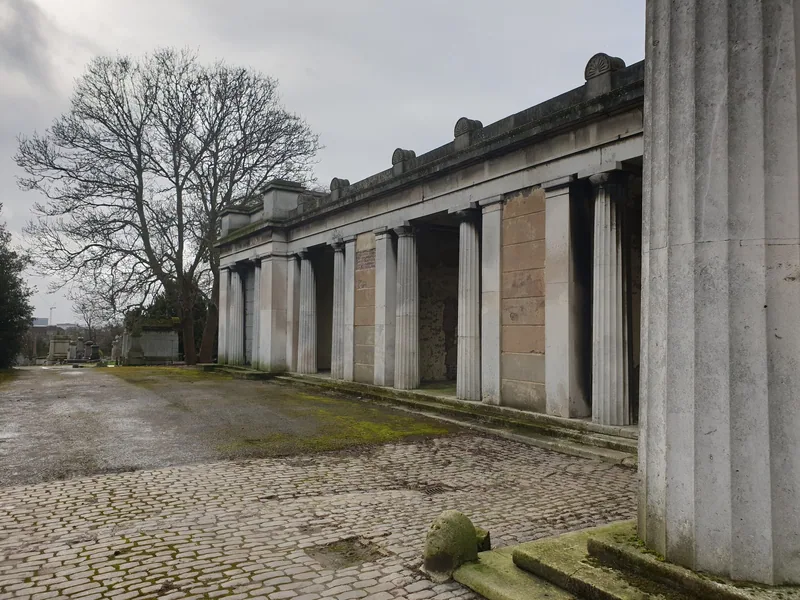
The layout still shows a division that mattered in 1833. The ground was split between a consecrated Anglican section and an unconsecrated one for Dissenters, the Protestants outside the Church of England, and each had its own chapel. The architect John Griffith used the Doric order of Greek architecture for the Anglicans and the Ionic for the Nonconformists, so the two chapels are a matched pair with different columns.
The plan was not the first choice. A design competition was won by Henry Edward Kendall with a Gothic scheme, but the company's chairman preferred the Greek Revival, and Griffith's drawings were built instead. The Anglican Chapel was damaged by bombing in 1940 and restored in 1954. The Friends say the cemetery now holds more than 150 listed buildings and monuments; the separate cemetery at Abney Park, which had no Anglican section at all, is covered on our Abney Park page.
Which gate to use, and why the names differ
Two organisations describe the gates in two ways, and it confuses people. The General Cemetery Company calls them the West Gate and the East Gate. The Friends call the same two the Top Gate and the Main Gate.
- West Gate, or Top Gate, on Harrow Road just west of Kensal Green station, opposite Hazel Road. Cars and pedestrians. The opening hours in the box above are for this gate. It also leads to St Mary's, the separate Roman Catholic cemetery next door.
- East Gate, or Main Gate, the monumental arch near the junction of Harrow Road and Ladbroke Grove. Pedestrians only, locked at 4.30pm, and home to the company's office.
- A door on Ladbroke Grove, beside the Dissenters' Chapel, opens only for Friends' events.
Nobody enters from the canal. The cemetery's southern wall runs along the Paddington Arm of the Grand Union without a gap; our towpath guide to the Paddington Arm explains how to leave the water and walk round to Harrow Road.
Getting there by Tube, Overground and bus
Kensal Green station is served by both the Bakerloo line and the Lioness line of the London Overground, and the West Gate is a short walk west along Harrow Road. The station has no step-free access, so wheelchair users are better served by bus; our guide to step-free travel in London explains how to plan around stations like this.
Bus 18, between Euston and Wembley, stops at both main gates. The 52 and 316 stop at Kilburn Lane for the East Gate, and the 23, 70, 295 and 452 serve Ladbroke Grove by the big Sainsbury's, a short walk from the East Gate. An adult bus fare is £1.85 (November 2026). Ladbroke Grove station, on the Hammersmith & City and Circle lines, lies further south across the canal, on the edge of Notting Hill.
Kensal Green closes in a gale, not in the rain. The company closes the cemetery without notice when winds of 45 to 55mph or more are forecast, because of the old trees above the monuments. A grey, still day is a good day to come; a stormy one is not.
Finding a particular grave
The company is blunt about this: with more than 65,000 graves in 72 acres, you are unlikely to find one by walking in and looking. Its burial records, apart from very recent ones, are held on the Deceased Online website, where a basic entry is free and the grave number costs a small fee. You then need the office's map to locate it.
The office is open from 9am to 4.30pm, Monday to Friday, and closed at weekends and on bank holidays, which is worth knowing if you planned a Sunday visit around a family grave. The telephone number is 020 8969 0152.
Photographs, and the building site across the canal
Still photography for personal use is allowed throughout the cemetery, provided you behave respectfully. Filming, recording for social media or podcasts, commercial shoots and photography with models all need formal permission from the General Cemetery Company. Do not photograph mourners or recent graves.
The view south is about to change. The gasworks land across the canal, known as Kensal Canalside, is being redeveloped for housing, and in November 2025 the Royal Borough of Kensington and Chelsea approved the largest part of the scheme, including towers of up to 29 storeys. The Friends have campaigned about the effect on the cemetery's setting. Inside the walls, the landscape of avenues and monuments is unchanged.
To add another cemetery to the day, Brompton Cemetery opens earlier and is managed by The Royal Parks, while Highgate Cemetery in north London is the one of the seven that charges admission.
Frequently asked questions
Is Kensal Green Cemetery free to visit?
Yes. Entry is free every day during opening hours, which in winter run from 9am to 5pm Monday to Saturday and 10am to 5pm on Sunday at the West Gate. Only the Friends' guided tours cost money: £12 a person, or £10 for students, over-65s and English Heritage members (November 2026).
Can you go into the catacombs at Kensal Green?
Only on a Friends' tour, and only the smaller catacombs under the Dissenters' Chapel. The main catacombs beneath the Anglican Chapel are closed for health and safety reasons, and the chapel itself is closed while the cemetery company seeks funding to refurbish it. Even the Dissenters' catacombs are offered only when available.
Where is Isambard Kingdom Brunel buried?
In Kensal Green Cemetery, in the family grave with his father, Sir Marc Isambard Brunel. Isambard Kingdom Brunel died in 1859 and Sir Marc in 1849. The Friends' Concise Guide, sold to visitors, includes a map that shows how to find them.
Are dogs allowed in Kensal Green Cemetery?
No. The General Cemetery Company asks visitors not to bring dogs, to protect the graves and the wildlife. If you are walking a dog along the Paddington Arm towpath next to the cemetery, Brompton Cemetery is the nearer alternative that allows dogs on a lead.
When are the Kensal Green Cemetery tours?
The Friends run tours at 2pm every Sunday from March to the end of October, and on the first and third Sundays of the month from November to February. They start from the steps of the Anglican Chapel and last about two hours. Book online, because a tour may not run if nobody has booked.
Sources
- The General Cemetery Company - Contact, opening times and directions (checked November 2026)
- The General Cemetery Company - About the Cemetery (checked November 2026)
- The General Cemetery Company - History (checked November 2026)
- The Friends of Kensal Green Cemetery - Tours (checked November 2026)
- The Friends of Kensal Green Cemetery - Location (checked November 2026)
- The Friends of Kensal Green Cemetery - About (checked November 2026)
- Historic England - The Anglican Chapel, Kensal Green Cemetery, list entry 1190995 (checked November 2026)