
Abney Park is free, it opens at 8am every day of the year including Christmas Day, and it closes at dusk, which in early November means the gates are locked by 4pm. It is a Victorian cemetery in Stoke Newington that was abandoned in the 1970s and grew into a wood, and the chapel at its centre is no longer the ruin most guidebooks still describe.
Most people passing through are locals using it as a short cut, and what is worth stopping for is not obvious from the path: a chapel the Trust calls the oldest surviving non-denominational chapel in Europe, an arboretum planted in alphabetical order, and the graves of a Chartist leader and the couple who founded the Salvation Army.
Our guide to the Magnificent Seven cemeteries places Abney Park among the other six and says which to choose if you only have time for one. This page is about the visit itself: which gate, what is open, how long it takes and what happens when the wind gets up.
Abney Park: the practical frame
- Address
- 219 Stoke Newington High Street, London N16 0LH
- Entry
- Free. No booking, no ticket, no donation expected at the gate
- Open
- Every day of the year from 8am, closing at dusk. Open on Christmas Day and New Year's Day
- Closing times (2026)
- 6.30pm to 4 October; 6pm to 18 October; 5.30pm to 1 November; 4pm from 2 November to 31 December
- Nearest station
- Stoke Newington (Overground, Weaver line), 200 metres from the High Street gate
- Step-free
- Level access at the High Street gate; ramped access at Church Street
- Toilets
- Accessible toilets in the cafe building, right-hand side of the forecourt inside the High Street gate
- Dogs
- Allowed, in sight and under control
The chapel at the centre is no longer a ruin
For about forty years the standard sentence about Abney Park was that it had a roofless Gothic chapel falling in on itself. That stopped being true in 2024, when a restoration project funded by the National Lottery Heritage Fund and run with Hackney Council finished repairing the whole building. It is now used for concerts, poetry readings, community events and weddings. If a page you read elsewhere still calls it a ruin, that page has not been updated.
The chapel is worth ten minutes even when nothing is on inside. It was designed by William Hosking, the first professor of architecture at King's College, and is the only surviving public building he designed. It was never consecrated and never used for worship: its only job was funerals.
The design was an argument made in brick. Hosking used a Greek cross, with four arms of equal length, so that no denomination could claim the long nave, and left the pointed windows without tracery. The octagonal steeple stands 120 feet and was the tallest structure in the district when it went up. The first foundation stone was laid on 20 May 1840, the same day the cemetery opened.
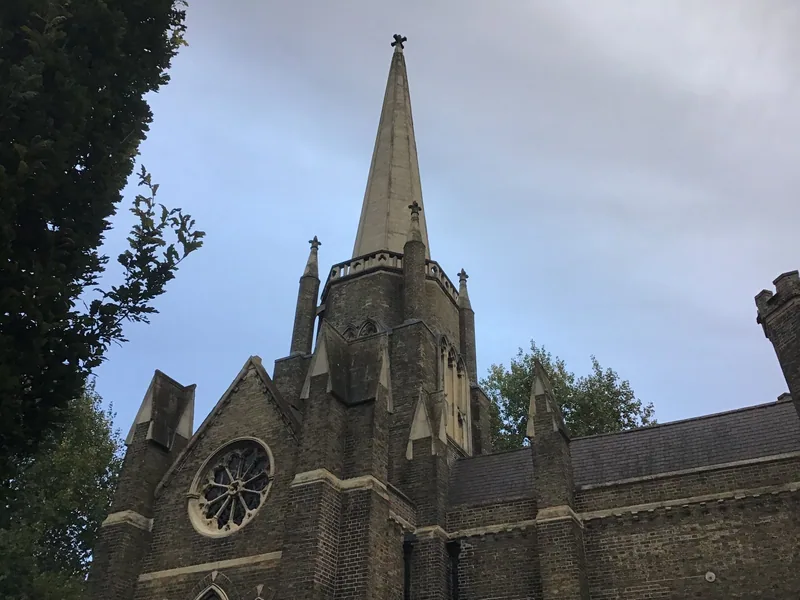
Photo: RTVBXE321 · CC BY-SA 4.0 · Wikimedia Commons · resized
Dissenters, Chartists and the Salvation Army
Abney Park was non-denominational from the day it opened, which in 1840 was unusual enough to define the place: Kensal Green split its ground between Anglicans and Dissenters, while Abney Park did not divide it at all. The people buried here are therefore disproportionately the people the Church of England had no room for.
William and Catherine Booth, who founded the Salvation Army, are the names most visitors come to find. Others repay the walk more:
- James Braidwood, first director of the London Fire Engine Establishment and generally called the father of the British fire service.
- James "Bronterre" O'Brien, Irish-born radical and a leading figure in the Chartist movement of the 1830s and 1840s.
- Joanna Vassa, daughter of Olaudah Equiano, the formerly enslaved writer who campaigned against the slave trade.
- Joseph Jackson Fuller, born into an enslaved family in Jamaica, who spent more than thirty years as a missionary in West Africa, translated The Pilgrim's Progress and settled in Stoke Newington.
- Betsi Cadwaladr, the Welsh nurse the Trust describes as the forgotten Florence Nightingale.
- Margaret Graham, the first British woman to make a solo balloon flight, in 1826.
The Nonconformist thread runs through several other London burial grounds, and if it interests you, Bunhill Fields near Old Street is the older and smaller version of the same story.
More than 200,000 people are buried here. A volunteer project called Abney Unearthed ran from 2016 to 2023 and built a searchable database of the burial records, locating nearly two thousand people whose graves had been lost from the mapping. A grave search has to be arranged with the Trust by email in advance: staff are part-time and not on site every day, and turning up without an appointment usually means nobody can help.
An arboretum that was left alone for twenty years
The cemetery was laid out on the grounds of two houses, Fleetwood House and Abney House, the second of which had been the home of the hymn writer Isaac Watts. Uniquely among the seven, it was planted as an arboretum as well as a burial ground: roughly 2,500 trees and shrubs, with the species set out in alphabetical order around the perimeter and collections of oaks, thorns and pines inside, plus a rosarium of about a thousand varieties. Abney House was pulled down in 1843, but its iron gate and railings onto Church Street survived and are still the second entrance.
The company went into administration in the 1970s and the site was abandoned. Two decades of neglect are the reason the place looks the way it does now, and when Hackney Council took ownership in the 1980s the decision was made to keep the wilderness rather than clear it. Abney Park became the first statutory Local Nature Reserve designated in Hackney.
What that means on the ground: ivy over chest tombs, sycamore and ash grown up through the plots, deadwood left standing because the invertebrates living in decaying wood here are nationally important, and foxes that barely bother to move. In late October it is one of the better places in inner London for autumn colour, and for the same reason it is loud with birds in April and May.
A yellow wind warning shuts Abney Park, and rain does not. The Trust closes the whole site whenever a yellow wind warning covers London, and reopens only after safety checks, because mature trees stand over 180-year-old masonry. Check the forecast for wind rather than rain, and go on a wet day without hesitation.
Which gate to use, and which one is step-free
There are two entrances and they are not equivalent. The main gate is on Stoke Newington High Street, next to the cafe building, and has level access from the pavement. The Church Street gate, through the old Abney House railings, was rebuilt during the restoration with a ramp and wider paths; the design was worked out with Historic England and is the more comfortable way in for a wheelchair or a pushchair.
Once inside, the surfaces change quickly. The drive running in from the High Street gate is cobbled, which is hard work on small wheels. The major paths beyond it are solid but uneven and get slippery in wet weather, and the smaller ones are narrow enough to disappear in summer. Wear shoes you do not mind ruining, and stay on the paths: the monuments lean.
Stoke Newington station is 200 metres from the High Street gate, which is a walk of about three minutes, and sits on the Overground's Weaver line out of Liverpool Street. Our page on the Overground's six line names explains which colour on the map that is. By bus, routes 73, 393 and 476 stop near the Church Street entrance, and 67, 76, 106, 149, 243, 276, 393 and 476 stop on the High Street. There is no visitor parking at all; accessible parking has to be arranged with the Trust by email before you come.
Dusk is a real closing time, not a rough one
The gates genuinely lock. The Trust publishes closing times in fortnightly blocks and follows them, so the useful afternoon shrinks fast through October: 6.30pm at the start of the month, then 6pm, then 5.30pm, and 4pm for the whole stretch from 2 November to the end of December. In winter this is therefore a morning visit. If you are combining it with lunch on Church Street, walk the cemetery first, because the reverse order leaves you at a locked gate in the dark.
Cafe, toilets and what is not here
The restoration built a cafe and public toilets at the High Street entrance, plus an education room for school groups. The accessible toilets are in the cafe building on the right of the forecourt as you come in, and you do not have to go into the cafe to use them. The cafe trades as Abney Park Cafe by Sabel and held a hygiene rating of 5 at its last inspection.
What is not here: a visitor centre, which is currently closed, a shop, or any staff presence you can count on. Fill a water bottle before you arrive.
Abney Park is not a working cemetery, and that changes how it feels. No new plots are available and burials stopped long ago, so unlike Brompton or Kensal Green you will not walk into a funeral. Families do still come to older graves, which Hackney Council administers, so the ordinary courtesies apply: keep off the plots and do not photograph anyone visiting a grave.
Tours, audio walks and doing it properly
The Trust publishes free self-guided walks and audio guides on several themes: heritage, Victorian mourning practice, the abolitionists buried here, woodland ecology and funerary symbolism. Download the one you want, and the park map, before you arrive.
Private guided tours can be booked for any group, formal or informal, by emailing the Trust. The charge is a donation of £10 a head with a minimum of £50, and groups of more than twenty pay a flat £200. Tours run morning, afternoon or evening, evenings only during the longer summer opening. This is the only guided option; there is no scheduled public tour you can simply join, which is the main difference from Nunhead, where the Friends' tours are free, and from Highgate, where you pay to get in at all.
How long, and what to pair it with
A brisk loop from the High Street gate to the chapel and out at Church Street takes about 25 minutes. Walking the perimeter and the main avenues, stopping at the Booths' memorial and the chapel, is closer to 45. Two hours is realistic with an audio walk, and in summer you can lose an afternoon here without trying.
Church Street's shops and Clissold Park are immediately west of the Church Street gate, both covered in our guide to Dalston and Stoke Newington. For a second overgrown cemetery on the same day, Tower Hamlets Cemetery Park is the closest match in character; for woodland rather than monuments, Highgate Wood and Queen's Wood are the northern equivalent. None of them costs anything, which puts them all on our list of things worth doing in London for nothing.
Frequently asked questions
Is Abney Park cemetery free to enter?
Yes. There is no entry fee, no ticket and no booking. The only things you pay for are a private guided tour, booked with the Trust in advance, and anything you buy in the cafe at the gate. Self-guided audio walks and the park map are free to download.
What time does Abney Park close?
It opens at 8am every day and closes at dusk, with exact times published in fortnightly blocks. In 2026 that means 6.30pm until 4 October, 6pm until 18 October, 5.30pm until 1 November, then 4pm for the rest of the year. The gates are locked, so allow time to walk out.
Can you visit the chapel at Abney Park?
The exterior is open to anyone walking through the park. The inside is now a working events venue after the 2021 to 2024 restoration, so it is open when something is on rather than on fixed hours. Check the Trust's events listing before you travel if seeing the interior is the point of the trip.
Is Abney Park suitable for a wheelchair or a pushchair?
Partly. The Church Street entrance has a ramp and widened paths and is the better way in; the High Street entrance is level from the pavement but the drive beyond it is cobbled. The main internal paths are solid but uneven, and the smaller ones are not usable on wheels. Expect to see the central part of the park rather than all of it.
How do I get to Abney Park from central London?
Take an Overground train on the Weaver line from Liverpool Street to Stoke Newington; the High Street gate is 200 metres from the station. From the West End, buses 73 and 476 run up to Stoke Newington High Street. There is no Underground station in Stoke Newington and no visitor parking at the park.
Sources
- Abney Park Trust - Visitor information, opening hours and access (checked September 2026)
- Abney Park Trust - Frequently asked questions (checked September 2026)
- Abney Park Trust - The chapel (checked September 2026)
- Abney Park Trust - Restoration of Abney Park 2021-2024 (checked September 2026)
- Abney Park Trust - History of Abney Park (checked September 2026)
- Abney Park Trust - Ecology of Abney Park (checked September 2026)
- Abney Park Trust - Private tours and charges (checked September 2026)
- Food Standards Agency - Hygiene rating, Abney Park Cafe by Sabel (checked September 2026)