
Syon House opens three days a week and only from March to October: Sundays and bank holidays for self-guided visits, Mondays and Tuesdays for guided tours. Turn up on a Wednesday and you will find a locked door and a garden centre. Get the day right and you get Robert Adam's boldest surviving interiors, a cast-iron glasshouse from the 1820s, and a tidal water meadow looking straight across the Thames at Kew.
Syon sits in Brentford, on the Middlesex bank, and it has been in the same family since 1594. That year it passed by marriage to Henry Percy, 9th Earl of Northumberland, and the estate is still run by Northumberland Estates today. The house you see was essentially complete by then; what the Percys did was fill it, twice, with the best designers of their day.
The site is older. Before the house there was Syon Abbey, the only Bridgettine monastery in England, and archaeologists have placed its church under the meadows between the house and the river. Our guide to Brentford and Isleworth covers the area around it.
Syon House and Park at a glance
- Season
- March to October. Closed the rest of the year except for events.
- Open days
- Sundays, Mondays, Tuesdays and bank holidays only.
- House
- Sundays and bank holidays, self-guided, 10.30am to 3.30pm, last entry 2.30pm. Mondays and Tuesdays, guided tours only, up to 90 minutes, first 10.30am and last 2pm.
- Gardens and Great Conservatory
- Sundays, Mondays and Tuesdays, 10.30am to 3.30pm, last entry 2.30pm.
- House, gardens and conservatory
- Adult £16.50 online (£17.50 on the door); child 5-16 £9.50 (£10.50); family of two adults and up to three children £48.00 (£49.00).
- Gardens and conservatory only
- Adult £7.00 online (£8.00); child £3.50 (£4.50); family £20.50 (£21.50).
- Parking
- Free, in a large car park shared with the businesses on the estate.
- Satnav
- TW7 6AZ. The estate's own postcode for post is TW8 8JF.
Three open days a week, and not the ones you would guess. Sunday, Monday and Tuesday. Most great houses close on Mondays; Syon does the opposite. The estate also reserves the right to change hours at short notice for private events and weather, so check the day before you set out rather than the week before.
What a family of four pays
Two adults and two children on the family ticket pay £48 online for the house, gardens and Great Conservatory, or £20.50 for the gardens and conservatory without the house. Parking is free, which takes the sting out of a drive from anywhere west of London. Booking online saves £1 each.
Syon is not National Trust and not English Heritage, so neither membership gets you in. What does work: Historic Houses members enter house and gardens free, Art Fund members get 50 per cent off, and the main Royal Horticultural Society cardholder gets the gardens free and the house for £9.50, because Syon is an RHS partner garden. There are also two-for-one gardens offers attached to several magazine and club schemes, and a 20 per cent local residents' discount on standard entry for a list of west London postcodes, on production of proof of address.
| Ticket | Online | On the door |
|---|---|---|
| Adult, house and gardens | £16.50 | £17.50 |
| Concession (over 60, student) | £15.00 | £16.00 |
| Child 5-16 | £9.50 | £10.50 |
| Family, 2 adults and up to 3 children | £48.00 | £49.00 |
| Adult, gardens and conservatory only | £7.00 | £8.00 |
| Child, gardens and conservatory only | £3.50 | £4.50 |
| Family, gardens and conservatory only | £20.50 | £21.50 |
Prices checked on the estate's own visitor page, September 2026.
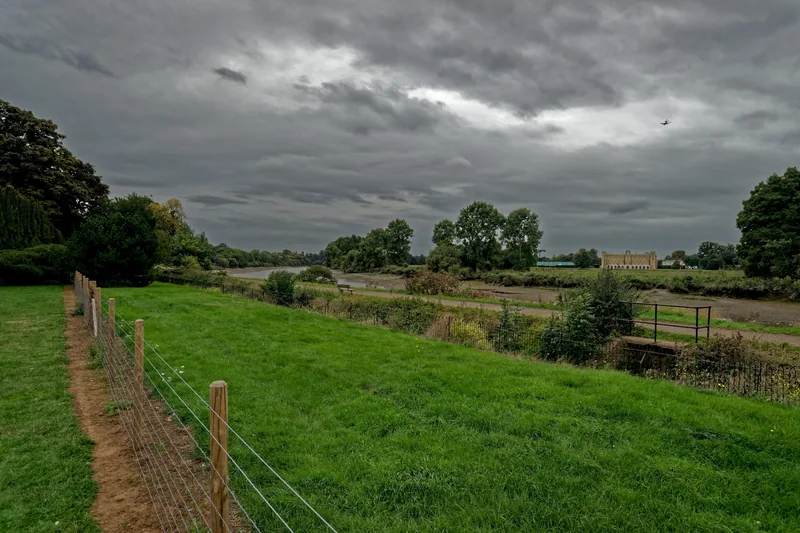
Photo: Txllxt TxllxT · CC BY-SA 4.0 · Wikimedia Commons · resized
Getting there, which is the awkward part
There is no station at the gate. The estate's own directions give three sensible public-transport routes, and all of them end with a bus:
- District line to Gunnersbury, then bus 237 or 267 to the Brent Lea stop. The pedestrian entrance is about 50 yards away. This is the shortest walk of the three.
- Piccadilly line to Boston Manor, then bus E8 to Brent Lea. About 150 yards from the stop.
- Central line to Ealing Broadway, then bus E8 to Brent Lea or E2 towards Brentford.
Brentford and Syon Lane are the nearest rail stations, but both are about a mile from the house, so only take them if you want the walk. Our guides to the District and Circle lines and the Piccadilly line cover the Tube legs.
By car, it is signed from the A4 at Gillette Corner and from junctions 2 and 3 of the M4. Parking is free and there is an electric-vehicle charging hub in the car park with fourteen points. Bicycle racks are outside the garden centre.
Adam's rooms, and why they look like that
Robert Adam was brought in during the 1760s by Hugh Smithson and Elizabeth Seymour Percy, later the 1st Duke and Duchess of Northumberland, who had inherited a house with dated interiors. The estate makes a point that explains everything about the result: Adam was not allowed to change the layout of the house, so he had to produce his effects inside rooms whose shapes were fixed for him.
What he did instead was fill them with imported antiquities and use architectural sleight of hand — screens of columns, apses, false perspectives — to make a Tudor plan feel Roman. The Great Hall has been repainted in Adam's original colours as part of a long restoration, and the Ante Room, the gaudiest room in the sequence, has been extensively restored. Works to the Long Gallery and the Red Drawing Room are planned but not done.
If you have seen Osterley, two miles north-west and remodelled by Adam at the same time for a banking family, the comparison is the point of visiting both: Osterley shows what Adam did with a free hand, Syon what he did with his hands tied. The third in the set is the Great Library at Kenwood in north London, which is free.
The Great Conservatory
The glasshouse west of the house was built for the 3rd Duke of Northumberland in the 1820s, and the estate's own account puts its significance in engineering rather than horticulture: cast iron allowed a very large area of glass held up by a remarkably thin structure. It predates the Palm House at Kew across the river, and it is the building that made that kind of glasshouse possible.
It is included in the cheaper gardens ticket, which at £7 for an adult makes it one of the better-value single buildings in west London. The same ticket covers the gardens and arboretum and the ornamental stables, which are centred on a riding school with a steel truss roof.
The park: Capability Brown, two lakes and a tidal meadow
The landscape is one of Lancelot "Capability" Brown's first major commissions. He removed the formal French gardens the Percys had laid out, opened long views to the south and west, pulled farmland into the park and created two ornamental lakes. A cast-iron bridge over the Outer Lake, designed by James Wyatt, was restored in 2012-13, and a 1960s conference centre north of the conservatory has been demolished so that Brown's lake could be put back to its eighteenth-century shape.
The part that no other London estate has is the water meadow between the house and the Thames. It still floods on high tides, which is why nothing was ever built on it, and it is why the view from the far bank at Kew shows a stretch of the tidal Thames with no buildings on one side. Our page on Hampton Court by boat describes the same reach from the water, where Kew and Syon face each other.
Picnics are allowed; barbecues and fires are not, and you take your rubbish home. Drones need prior permission, and photography in the house is for personal use only with no flash, tripods or selfie sticks, as our page on photography and drone rules in London explains for other sites.
Henry VIII, the Gunpowder Plot and a royal birth
Syon collects historical incident. The abbey's priests refused to accept the break with Rome; one of them, Richard Reynolds, was executed for treason in 1535, and the community left in 1539 and kept itself together in exile for centuries. Henry VIII's funeral cortege rested here on the way from London to Windsor, and the estate's own history repeats the story that the king's bloated body burst open overnight.
The 9th Earl, who brought Syon into the Percy family, was implicated in the Gunpowder Plot in 1605 and spent seventeen years in the Tower, where, the estate notes drily, he lived in some style and spent a good deal on refurbishing Syon in his absence. Queen Anne gave birth at Syon in 1692. The Percy Lion still stands on the east front; it was taken down, restored and put back in 2012.
Access: be warned before you book
Syon is honest about this and you should read it before buying a ticket. The estate states that because of the historic nature of the building it cannot offer access into Syon House for wheelchair users or motorised scooters. There are eight stone steps to the Great Hall, more stairs on the principal floor and a large staircase to the bedrooms, and no wheelchairs to borrow.
The grounds, the Great Conservatory and the Visitor Centre are a mix of cobbles, flagstones, grass, gravel and boards, uneven and steep in places with a few steps. There is disabled parking in the main car park and accessible toilets in the block in front of the house and in the garden centre. A carer accompanying a disabled visitor enters free with proof of carer status. Assistance dogs are welcome on a short lead; other dogs are not. Our guide to accessible London sets out what to ask before travelling.
Eating, children and the rest of the estate
The estate is shared with commercial tenants, which is how a house open three days a week pays for itself. Hillier Garden Centre is the largest, with a cafe and restaurant inside it, and a butcher, Wyndhams, trades on the site. Snakes and Ladders, an indoor children's play centre, is also on the estate. All three held a food hygiene rating of 5 at their most recent inspections in 2025 and 2026.
That mix is worth understanding before you arrive with children. A soft-play centre and a garden centre next to a Robert Adam interior is not most people's idea of a stately home, but it does mean there is somewhere warm to eat, a lavatory, and something for a five-year-old who has run out of patience. Our guide to London with kids covers the wider question.
Half a day, and what to put with it
Allow two to three hours: an hour for the house, an hour for the conservatory and gardens, and time for the meadow walk. That leaves an afternoon, and the useful combinations are all within two or three miles. The Museum of Water and Steam is the closest, in Brentford. Chiswick and Kew are across the river. Further upstream, Ham House and Marble Hill make a Thames-side pair, and Hampton Court is the big one at the end of the same river.
Syon is not one of London's free sights, and if the budget is what decides your day, our list of free things to do in London is the better starting point.
Frequently asked questions
When is Syon House open?
Only in the March to October season, and only on Sundays, Mondays, Tuesdays and bank holidays. The house is self-guided on Sundays and bank holidays from 10.30am to 3.30pm, with last entry at 2.30pm, and on Mondays and Tuesdays it is guided tours only, lasting up to 90 minutes, with the first at 10.30am and the last at 2pm.
How much does Syon House cost?
House, gardens and Great Conservatory: £16.50 for an adult online, £9.50 for a child aged 5 to 16, and £48 for a family of two adults and up to three children. Gardens and conservatory alone: £7, £3.50 and £20.50. On-the-door prices are £1 a head higher. Parking is free.
Does National Trust membership work at Syon?
No. Syon is privately owned by Northumberland Estates and is in neither the National Trust nor English Heritage. Historic Houses members get in free, Art Fund members pay half, and the main RHS cardholder gets the gardens free and the house at a reduced rate.
How do you get to Syon Park by public transport?
There is no station at the gate. The shortest route is the District line to Gunnersbury and then bus 237 or 267 to Brent Lea, about 50 yards from the pedestrian entrance. From the Piccadilly line, use Boston Manor and the E8 bus. Brentford and Syon Lane rail stations are both about a mile away on foot.
Is Syon House wheelchair accessible?
No. The estate says clearly that it cannot offer access into the house for wheelchair users or motorised scooters, because of eight stone steps to the Great Hall and further stairs inside. The grounds and Great Conservatory are reachable but uneven, with cobbles, gravel and some steps, and a carer accompanying a disabled visitor is admitted free.
Sources
- Syon Park - Visitor information: opening times, tickets and pricing, directions, accessibility (checked September 2026)
- Syon Park - History of Syon (checked September 2026)
- Food Standards Agency - food hygiene ratings for the businesses at Syon Park, TW8 8JF (checked September 2026)