
Parliament Hill is the 98-metre hill in the south-east corner of Hampstead Heath, and its summit is one of the few places in London where the view is protected by planning policy: nothing may be built that blocks the lines of sight to St Paul's Cathedral and the Palace of Westminster. It is free, open all day, and ten minutes on foot from Gospel Oak station.
Most people know it as the best free skyline view in north London. Fewer know that the summit is a measured survey point in the Mayor of London's planning rules, that the mound on the slope behind it is a scheduled Bronze Age monument rather than a queen's grave, or that the lido at its foot is a listed 1930s building. This page covers the hill and the fields at its foot. Our guide to Hampstead Heath covers the whole Heath, the ponds and Kenwood.
Parliament Hill at a glance
- Height
- 98 metres (321 feet), according to the City of London
- Cost
- Free, no gates on the hill itself
- Managed by
- City of London Corporation, as part of Hampstead Heath
- Protected views
- Summit to St Paul's Cathedral (6.6 km) and to the Palace of Westminster (7.1 km), London View Management Framework
- Nearest station
- Gospel Oak (Mildmay and Suffragette lines), about 10 minutes' walk to the summit
- Lido
- 60 m unheated outdoor pool, open every day of the year; prices on our Hampstead Heath page
- Athletics track
- Adult £5.60 a visit, no booking, card only (checked November 2026)
Why no tower may block the view of St Paul's
The view from the top is not protected by a special Act of Parliament. It is protected by the planning system. The Mayor of London's London View Management Framework names a set of designated views across the city, and the summit of Parliament Hill is one of them, classed as a "London Panorama". Every planning authority in London has to apply it when deciding on a tall building.
The framework fixes two assessment points at the same spot on the summit, by the orientation board. One, numbered 2A.1, looks towards St Paul's Cathedral, 6.6 kilometres away on a bearing of 138.7 degrees. The other, 2A.2, looks towards the Palace of Westminster, 7.1 kilometres away. From each, a "protected vista" runs to the landmark: a narrow wedge of air with a defined height limit, called the threshold plane, rising or falling along the line of sight.
The rule inside that wedge is blunt. The guidance says a development that exceeds the threshold plane of the Landmark Viewing Corridor "should be refused", and that a new building hidden behind an existing one is not exempt. Around the corridor sits a wider consultation area where tall buildings are allowed but must not spoil the view of the landmark. Together with the other designated views, it is one of the main limits on where tall buildings can go in central London.
Stand by the orientation board for the protected view. The framework's camera position for both protected vistas is "at the orientation board" on the summit, at a recorded height of 98.1 metres. That is where the dome of St Paul's sits in its cleared slot. A few steps away, the alignment is already slightly different.
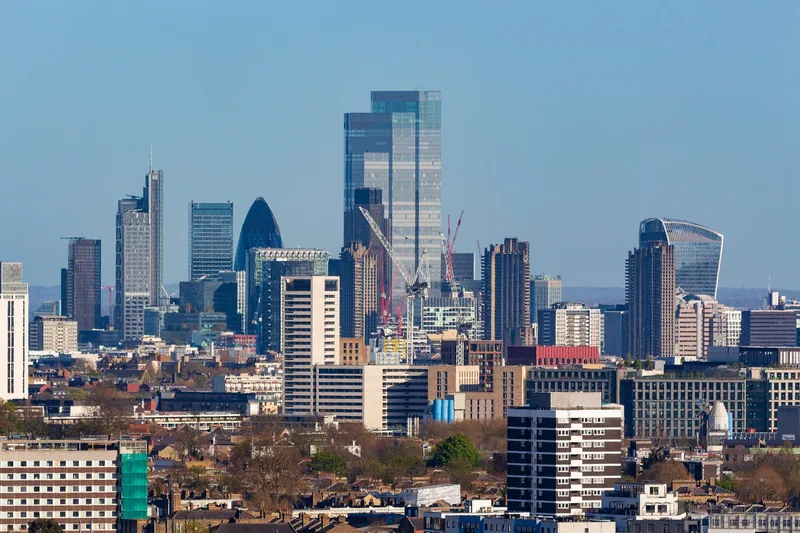
Photo: The wub · CC BY-SA 4.0 · Wikimedia Commons · resized
What you can pick out, and the second viewpoint by the oak
The framework's own description of the summit panorama is more honest than most guidebooks. It notes that St Paul's sits among a "miscellany of buildings", with its dome and colonnade visible but hard to recognise in poor weather, and that the Shard is the easiest thing to find first. The Palace of Westminster lies behind the Euston Tower and the BT Tower, and from the summit only the Victoria Tower and the lantern over the Central Lobby show.
Further left is Canary Wharf, with Shooter's Hill rising behind it; closer in are St Pancras station and the Caledonian Market clock tower.
There is a second designated viewpoint, 2B.1, lower down on the east side of the hill "alongside the prominent oak tree". The framework describes it as one of the few publicly available places from which all three towers of the Palace of Westminster can be seen together: the Elizabeth Tower, the Central Tower and the Victoria Tower. Walk down the eastern slope from the summit and look for the large single oak. The framework itself admits that trees in the foreground interrupt much of the panorama from there, so it is a view of one building rather than a panorama.
For comparison with the other free high points in the city, see London's best free viewpoints. If the two landmarks themselves are on your list, our pages on St Paul's Cathedral and on touring the Houses of Parliament cover the visits.
The Tumulus: a Bronze Age barrow, not Boudica's grave
About 500 metres north-west of the summit is a low mound known locally as the Tumulus or "Boadicea's Grave". The story that the warrior queen of the Iceni is buried here is a local tradition, and nothing supports it. Historic England's official name for the site keeps the old label, but what it has protected is a "bell barrow", a type of burial mound of the Bronze Age, many centuries before Boudica's rising against Roman rule in about AD 60 or 61.
The barrow was scheduled as an ancient monument on 12 January 1965 (list entry 1002059), which means it is protected by law and cannot be disturbed without the government's consent. When the London County Council excavated it in the 1890s, no burial was found. You can see the mound from the path; there is nothing to go into.
If you want the real Boudica, she is on the Embankment in bronze, driving a chariot towards Parliament: our page on Boudica and the Embankment statues explains that sculpture and its long journey to Westminster Bridge.
Parliament Hill Lido, a listed pool from 1938
At the foot of the hill, on Gordon House Road, is Parliament Hill Lido, an open-air pool that the City of London describes as 60 metres long, unheated, chlorinated and open on all 365 days of the year. Historic England listed it Grade II in January 1999 (entry 1113025). It was built in 1937 and 1938 by Harry Arnold Rowbotham for the London County Council's parks department, in patterned stock brick, with a curved moderne café front and walled sunbathing terraces.
The list entry calls it the most sophisticated of the thirteen lidos the London County Council built between 1909 and 1939, and says no other British city tried a programme on that scale. It also records the pool as 60 by 27 metres, with fountains or aerators on either side. Even a non-swimmer can look in from the entrance.
Prices, the winter sauna and the summer sessions are on our Hampstead Heath page, and our guide to London's ponds and lidos compares it with the heated pools. The other famous outdoor swim, in a lake rather than a pool, is the Serpentine Lido in Hyde Park, which opens only in summer. About 45 metres south-east of the lido stands a Victorian cast-iron sewer vent pipe with a fluted column, listed in its own right on the same day.
The track, the courts, the bandstand and the kites
Parliament Hill Fields, the flat ground between the lido and the slope, is the sporting end of the Heath. The athletics track is an eight-lane, floodlit, all-weather track open to the public all year. You do not need to book; an adult visit costs £5.60, payment is by card only since 1 October 2026, and at certain listed times the track is closed to the general public, so check the City's page before you go.
Next to it are public tennis courts, bookable online through the City of London, and a bandstand beside the café, where the City holds free concerts every summer. There is a playground, a paddling pool and an adventure playground nearby, which makes this the end of the Heath that works with children.
The slope itself is London's best-known kite hill. On a windy weekend there are kites over the summit all day, and in summer the Heath & Hampstead Society runs a Kite Festival here, which the City lists among the Heath's regular events. The same list includes the Heath's conker competition.
The Parliament Hill funfair dates are not published by the City. Travelling funfairs have long been part of bank-holiday weekends on the Heath, but the City of London's Heath pages do not list them, and we could not confirm which bank holidays or which corner of the Heath a fair uses this year. If a fair is the reason for your visit, check locally before travelling.
The short way up from Gospel Oak, and the long one from Hampstead
Gospel Oak station is the nearest. It is served by two Overground lines: the Mildmay line, which links Stratford and Highbury & Islington with Richmond and Clapham Junction, and the Suffragette line, which starts here and runs east to Barking Riverside. TfL's planner puts the walk from Gospel Oak to the summit at about 10 minutes and 780 metres: across Gordon House Road, past the lido and the track on level ground, then up a steady grass slope.
The other approaches are longer. From Hampstead Heath station, also on the Mildmay line, TfL gives about 16 minutes; from Kentish Town on the Northern line, 17 minutes; from Belsize Park, 23 minutes. Hampstead station on the Northern line is the worst choice, about 29 minutes across the Heath, and Hampstead village sits high up, so you walk down to the ponds and then climb the hill.
Bus route 88 starts at Parliament Hill Fields and runs through Camden Town and the West End, so from central London it brings you to the foot of the hill with no walk at all. The C11 stops at Gospel Oak station. Route 24 ends a short walk away at South End Green, the stop for Hampstead Heath station; our page on bus route 24 covers that ride from Pimlico.
Step-free routes and mobility scooters
The City of London publishes an accessible walking route that starts and ends at Gospel Oak station, on its interactive Heath map. Mobility scooters can be borrowed free of charge from Parliament Hill Lido or from the Hive, Monday to Saturday from 9.30am to 5pm, booked through the Heath Hands volunteer charity, one booking at a time.
The final climb to the summit is a grass slope with surfaced paths that get slippery after rain; the flat ground at the foot, with the lido, the track and the bandstand, is the easy part.
When to come, and what to combine it with
The view faces south-east, so the sun is behind you in the morning and to your right as it sets. Clear, cold days after rain give the sharpest skyline, and the framework itself notes that St Paul's is hard to make out in poor weather. Summer evenings are busy, with hundreds of people on the slope; a weekday morning is almost empty.
From the summit, the Heath's paths run north-west to Kenwood House, free and full of paintings, in about 20 to 30 minutes. East of Parliament Hill, across Highgate Road and up Swain's Lane, is Highgate Cemetery, and our guide to Highgate and Crouch End covers the village above it. If you want a viewpoint nearer the centre, Primrose Hill is lower but a short walk from Camden.
Frequently asked questions
Is the view from Parliament Hill protected by law?
It is protected through the planning system. The Mayor of London's London View Management Framework designates two protected vistas from the summit, to St Paul's Cathedral and to the Palace of Westminster. Under that guidance, a building that breaks the height limit inside either corridor should be refused permission.
Is Boudica buried on Parliament Hill?
There is no evidence that she is. The mound called the Tumulus, or Boadicea's Grave, is scheduled by Historic England as a Bronze Age bell barrow, far older than Boudica, and an excavation in the 1890s found no burial. The link with the Iceni queen is a local legend.
What is the nearest station to Parliament Hill?
Gospel Oak, on the Mildmay and Suffragette lines of the London Overground, about 10 minutes' walk from the summit. Hampstead Heath station and Kentish Town on the Northern line are 16 and 17 minutes away. Bus route 88 starts at Parliament Hill Fields itself.
Is Parliament Hill Lido heated?
No. The City of London describes it as an unheated, chlorinated 60-metre outdoor pool, open every day of the year, with hot showers and a sauna in winter. In January the water can be close to freezing, so first-time winter swimmers should read the City's guidance before getting in.
Can you fly a kite on Parliament Hill?
Yes, and it is the best-known kite slope in London, because the hill is open and catches the wind. In summer the Heath & Hampstead Society holds a Kite Festival there, which the City of London lists among the Heath's regular events.
Sources
- City of London - Parliament Hill viewpoint (checked November 2026)
- Greater London Authority - London View Management Framework SPG (2012), Appendix D: Protected Vistas (checked November 2026)
- Greater London Authority - London View Management Framework SPG (2012), Parts 1 and 2, London Panorama: Parliament Hill (copy hosted by Tower Hamlets Council) (checked November 2026)
- Historic England - Bell barrow called Boadicea's Grave, scheduled monument 1002059 (checked November 2026)
- Historic England - Parliament Hill Fields Lido, list entry 1113025 (checked November 2026)
- City of London - Parliament Hill Lido (checked November 2026)
- City of London - Athletics at Hampstead Heath (checked November 2026)
- City of London - Hampstead Heath accessibility (checked November 2026)