
Spencer House opens to the public every Sunday except in August, on a guided tour only, at £19.50 for an adult. St James's Palace, a hundred metres away, opens on a handful of dates in the spring for guided tours at £85 a head, and no 2026 dates were on sale when we checked. Everything else here is done from the pavement.
These are the two buildings at the bottom of St James's Street that visitors most often walk past without realising what they are. One is a Tudor palace that is still a working royal office; the other is the finest surviving private palace of eighteenth-century London, and the only one you can book a ticket for. The neighbourhood context is in our guide to Mayfair and St James's; this page is about getting inside, or making the best of not getting inside.
The Sunday rule at Spencer House is the single fact that decides most trips. If your London days do not include a Sunday, you will not see it, and if your Sunday falls in August you will not either, because the house closes that month for restoration work.
Two houses, two very different doors
- Spencer House
- 27 St James's Place, SW1A 1NR. Public tours every Sunday except August, 10:30-16:00. Adult £19.50, concession £16.50
- Spencer House group tours
- Monday mornings by prior arrangement, minimum 15 people, same price per head
- St James's Palace
- Entrance on Marlborough Road. Exclusive Guided Tours on selected spring dates, £85 per person, about 1 hour 30 minutes
- Both
- Guided access only. Neither has a cafe
- Nearest station
- Green Park (Piccadilly, Victoria and Jubilee lines), a short walk
What you can see of St James's Palace without a ticket
Walk down St James's Street from Piccadilly and the red-brick gatehouse with the octagonal clock turret closes the view at the bottom. Henry VIII built most of the palace between 1531 and 1536 on the site of the Hospital of St James, and a good deal of his brickwork survives: the gatehouse, some turrets, two Tudor rooms in the State Apartments, and the Chapel Royal.
Turn left into Cleveland Row and you follow the palace's north front. Turn the other way, into Marlborough Road, and you pass the Queen's Chapel on your right and the entrance the palace uses for visitors on your left. Friary Court, the courtyard behind the Marlborough Road front, is where the St James's Detachment of the King's Guard mounts its daily guard, and it is the yard from which Garter King of Arms proclaims a new sovereign from the Proclamation Gallery above. The Accession Council meets inside the palace when a monarch dies.
That is the reason to stand here: almost none of it is signposted, and the ceremonial weight of the place is invisible unless you know. Our guide to the Changing of the Guard explains how the St James's detachment and the Buckingham Palace ceremony fit together, because the two are parts of one operation.
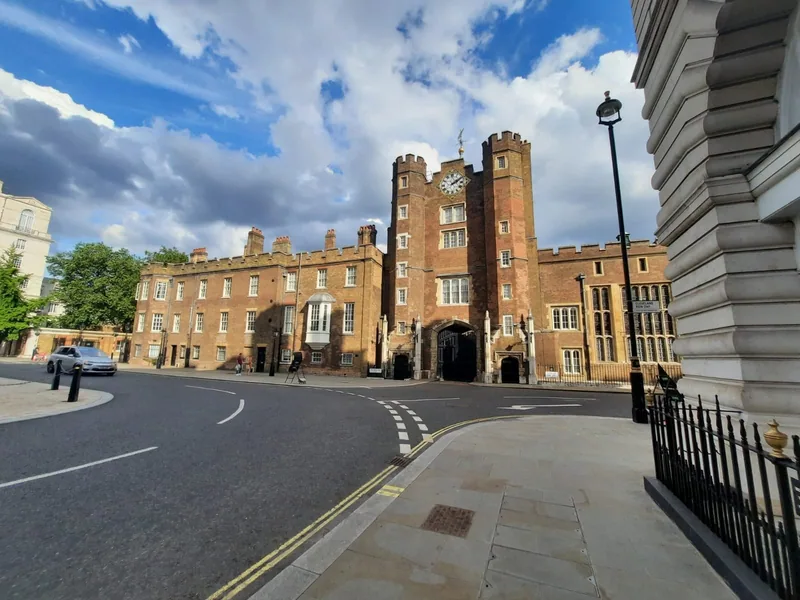
Photo: SpeedyCheetah66 · CC BY-SA 4.0 · Wikimedia Commons · resized
The £85 tour, and why you probably cannot book it
The Royal Collection Trust does open the palace, and it is worth saying plainly because most guidebooks still state flatly that you cannot go in. The Trust sells Exclusive Guided Tours on selected dates in the spring, in small groups, at £85.00 per person. Tours last about an hour and a half and start at various times between 10:30 and 18:30. Disabled visitors get a free access companion ticket. The entrance is on Marlborough Road.
The catch is supply. When we checked, the palace's own listing carried the status "Closed" and the line "Tickets for 2026 are not on sale", with an invitation to sign up for email alerts to hear when they go on sale. There is no published pattern to the release. Treat a St James's Palace tour as something to watch for rather than something to plan around, and if you are set on a royal interior on a fixed date, book the Royal Mews and The King's Gallery or the Buckingham Palace State Rooms instead.
Do not trust a booking site that offers St James's Palace tickets for a summer date. The Royal Collection Trust sells them for selected spring dates only, through its own site, and in 2026 it had none on sale at all.
The palace as an office block
The reason access is so restricted is that St James's Palace is busy. It is the working home of several royal households and a long list of offices: the Royal Collection Trust, the Marshal of the Diplomatic Corps, the Central Chancery of the Orders of Knighthood, the Chapel Royal, the Gentlemen at Arms, the Yeomen of the Guard and the King's Watermen. The State Apartments are used for in-coming state visits and for around a hundred charity receptions a year.
Its history explains the mixture. It was a royal residence for more than three hundred years, and every monarch until William IV lived there for part of the time after the Palace of Whitehall burned down in 1698. Mary Tudor signed the treaty surrendering Calais here in 1558. Elizabeth I was in residence during the Armada and set out from St James's for Tilbury. A fire in 1809 destroyed much of the east and south ranges; the State Rooms were restored by 1813, having earlier been enlarged by Christopher Wren and decorated by William Kent, with some later redecoration by William Morris. Queen Victoria married Prince Albert in the Chapel Royal in 1840, and court levées were still held at the palace until 1939.
The Chapel Royal and the Queen's Chapel: check, do not assume
There are two chapels here and they are easy to confuse. The Chapel Royal is inside the palace, off Colour Court. The Queen's Chapel, designed by Inigo Jones, is the separate building on the east side of Marlborough Road, and its doorway faces the palace across the street.
Both hold sung services in season rather than opening as sights, and the seasons alternate between them. We could not read a current, official timetable for either, so we are not printing one: the Royal Household does not publish the Chapels Royal services on a page we could reach, and a service list copied out of a travel book is exactly the kind of thing that sends a reader to a locked door on a Sunday morning. If choral music is the point of your visit, our guide to choral evensong in London lists places whose timetables are published and reliable, and the Guards' Chapel at Wellington Barracks is a five-minute walk away on the other side of the park.
Spencer House: the practical frame
Spencer House was built between 1756 and 1766 for the first Earl Spencer and Lady Spencer, on a site overlooking Green Park. The freehold is still with the Spencer family; the house was leased by Lord Rothschild in 1985 and restored over the following decade. Eight State Rooms are shown.
- When. Every Sunday except in August, when the house closes for restoration. Tours run at intervals from 10:30 to 16:00.
- How much. £19.50 adult, £16.50 concession. Walk-up tickets may be available at the front desk on a first-come basis, with a £1.50 surcharge per ticket. The house is cashless.
- How long. About an hour for the house. From April to October, weather permitting, a garden tour follows and adds around 15 minutes.
- Guided only. There is no self-guided option. Tours are led by Blue Badge guides who are members of the Guild of Tourist Guides.
- Weekdays. Group tours of 15 or more can be arranged on Monday mornings at the same price per head; special access tours at other times depend on what is happening in the house.
Because the State Rooms are hired out for weddings and corporate events, a Sunday can occasionally be lost. Booking online for a specific time is the way to avoid a wasted journey, and if you are running late on the day the house will usually put you on the next tour.
What is inside, and what you may not bring in
The eight State Rooms run as an enfilade of interconnecting reception rooms, some large and some small, all in the classical taste of the 1760s. The collection mixes pieces original to the house with long-term loans from the Royal Collection Trust, the Victoria and Albert Museum, Tate and the National Trust, chosen to reflect eighteenth-century aristocratic taste. If you like this kind of interior, the closest comparison in London is the Wallace Collection, which is free and open daily.
The rules are those of a private house rather than a museum. Large bags, backpacks, luggage and umbrellas go into a free cloakroom; small handbags may be carried; there is a bag search on entry. Pushchairs are not allowed in the State Rooms and the house does not recommend bringing children under 10, though it leaves the decision to you. Photography for personal use is allowed, without flash, tripods or selfie sticks. No food or drink may be brought in. There is no gift shop and no cafe, though the guidebook is sold in the Entrance Hall and there are plenty of places to eat two minutes away towards Jermyn Street and Piccadilly.
One small inconsistency is worth noting because it appears twice on the house's own website: the tours page says Spencer House was officially reopened by Diana, Princess of Wales, in 1991, while the frequently asked questions say 1990. We have not been able to reconcile the two, so take it as "the early 1990s" and do not repeat either date as fact.
Access at Spencer House
Better than you would expect of a Georgian town house. There are wheelchair ramps, a lift and an accessible toilet. Some rooms have seats, and folding stools are available for anyone who needs to rest during the tour. Carers and essential companions of disabled visitors are admitted free and no proof of disability is asked for. Guide dogs are welcome, and the house asks you to get in touch beforehand so arrangements can be made. Our guide to visiting London with a disability covers the wider picture.
Getting there, and what to put around it
Green Park station is the one to use, with the Piccadilly, Victoria and Jubilee lines; see our guide to the Piccadilly line for interchanges. From the station you cross Piccadilly and walk down St James's Street, or cut through the park. Buses run along Piccadilly and Pall Mall. Parking is effectively not an option.
A Sunday built around Spencer House works well because so little else in St James's is open. Take the 11:00 or 11:30 tour, then walk through Green Park and St James's Park to Buckingham Palace, and finish at the Mall. The Diana Memorial Walk passes both Spencer House and St James's Palace, with plaques set into the path, and our guide to running routes in London describes the route in full. If you would rather shop than walk, Fortnum & Mason on Piccadilly is open on Sundays under the six-hour rule.
The other way to get inside buildings on this street is to come in September: the Open House Festival puts private and institutional buildings across London on free public access for a weekend, and St James's regularly features. Dress is not formally policed at either house, but both are grand interiors in a district with several clubs that still enforce jackets, which our guide to dress codes that still exist in London explains. On the walk back, the Albert Memorial is a 25-minute stroll west through the parks.
Frequently asked questions
Can you go inside St James's Palace?
Occasionally. The Royal Collection Trust sells Exclusive Guided Tours of the palace on selected dates in the spring, at £85.00 per person for about 90 minutes, entering from Marlborough Road. No dates were on sale for 2026 when we checked, and the Trust's page listed the palace as closed, so it is not something you can plan a trip around.
When is Spencer House open?
Every Sunday except during August, with guided tours running at intervals from 10:30 to 16:00. Group tours of at least 15 people can also be arranged on Monday mornings. There is no weekday public opening and no way to walk round on your own.
How much does Spencer House cost and can I pay at the door?
£19.50 for an adult and £16.50 concession. Walk-up tickets are sometimes available at the front desk on a first-come basis with an extra £1.50 per ticket, but the house recommends booking a time slot online. Spencer House is cashless, so bring a card.
Is Spencer House suitable for children?
The house does not recommend bringing children under 10, and pushchairs are not allowed in the State Rooms. If a child becomes disruptive during a tour, the guide may ask you to take them back to the Entrance Hall. An hour of eighteenth-century interiors with no interactive element is a long hour for a small child.
Can I attend a service at the Chapel Royal, St James's Palace?
Services are held there in season, and at the Queen's Chapel across Marlborough Road at other times of year, but we could not find a current official timetable for either and we are not going to print an unverified one. Enquire with the Royal Household before travelling, and treat any service time you read elsewhere as needing confirmation.
Sources
- Spencer House - Tours (checked September 2026)
- Spencer House - Frequently asked questions (checked September 2026)
- The Royal Family - Royal Residences: St James's Palace (checked September 2026)
- Royal Collection Trust - St James's Palace (checked September 2026)
- Household Division - Changing the Guard (checked September 2026)