
St Stephen Walbrook stands behind Mansion House in the City of London, is free to enter, and opens Monday to Friday from 10.30am to 3.30pm only. It is shut every weekend. Inside, an eight-foot round altar of travertine by Henry Moore sits in the middle of the floor under Wren's dome, and in a case nearby is the telephone on which the Samaritans took their first call in 1953.
Those two objects are the reason to make the five-minute detour from Bank. The altar is one of the very few twentieth-century additions to a Wren church that improves it, and the telephone is the physical beginning of a service that now has 201 branches across the UK and Ireland. The church itself was designed by Wren in 1672 and is his prototype for the dome of St Paul's: the first classical dome built in England. The architectural historian John Summerson called it the pride of English architecture, and the church quotes him on its own front page.
Our guide to All Hallows and the City churches has the wider walk and the etiquette; Bank junction and the Royal Exchange covers the crossroads outside. This page is the church.
St Stephen Walbrook at a glance
- Address
- 39 Walbrook, London EC4N 8BN, behind Mansion House
- Cost
- Free. The church asks for a small donation towards upkeep
- Open
- Monday to Friday, 10:30–15:30. Closed at weekends
- Groups
- Contact the church in advance with the date, time and number of visitors
- Nearest station
- Bank (Central, Northern, Waterloo & City, DLR), two minutes; Cannon Street and Mansion House both under five
- How long
- Twenty minutes, or forty with the memorial booklet
- To read first
- The church publishes a downloadable booklet on all 29 of its memorials, and a history by Professor Kerry Downes
Five hours a day, five days a week, and that is all. This is a weekday church in the strictest sense: 10.30am to 3.30pm, Monday to Friday. If your only free day in London is a Saturday or a Sunday, you cannot see the Moore altar, and no amount of planning will change that. Substitute St Mary-le-Bow on Cheapside, five minutes away, which sometimes opens informally at weekends.
The altar in the middle of the floor
Walk in and the geometry is wrong in the best way. There is no altar at the east end and no screen; instead a circular block of stone stands directly under the centre of the dome, with the seating arranged around it. That is the Henry Moore altar, and the church's own account of it is unusually candid about why it exists.
Moore carved it in 1972; Lord Palumbo commissioned it for the church during the restoration that began in 1978. The stone is travertine, cut from the same quarry that supplied Michelangelo. It is about eight feet across and weighs several tons, and Moore cut forms into the circular sides so that the piece would recall the Dome of the Rock in Jerusalem and the sacrifice of Abraham and Isaac.
The theological point was deliberate. The parish that founded the Samaritans wanted an altar the congregation could stand around rather than one the priest addressed with his back to them, and moving the altar into the middle of a Wren interior was not a decision anyone could take quietly. There was a court case. Objectors took it all the way to the Court of Ecclesiastical Causes Reserved, the highest ecclesiastical court in England, which ruled that the Moore altar was acceptable as an altar for the Church of England. The restoration around it cost £1.3 million and the reordering ran from 1978 to 1987.
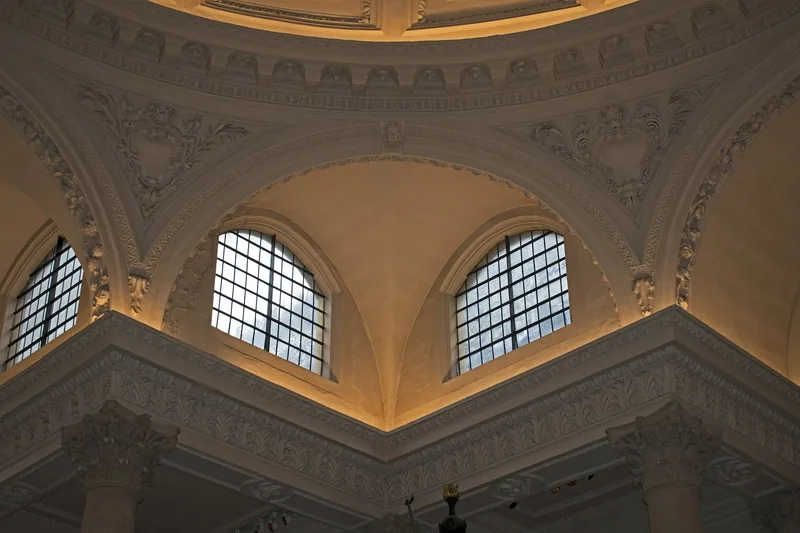
Photo: Ymblanter · CC BY-SA 4.0 · Wikimedia Commons · resized
What went out to make room
The same reordering removed a great deal, and the church does not hide it. Before the war the interior had dark stained pews, a conventional east-end altar with a reredos carrying the Ten Commandments, and stained glass in windows Wren had designed to be clear. A Benjamin West painting hung above the altar, was moved to the north wall in 1848, and was taken into storage during the 1978–87 works.
What happened to that painting became a case in its own right, and the judgment is worth knowing if you like the sound of institutions being told off. The Chancellor found that the picture had probably been introduced without permission in the first place, that it compromised the Wren building in scale and appearance, and that bringing it back would compromise it again. He described earlier incumbents as having treated the church building as a personal doll's house, and called the present parishioners the double victims of their predecessors' behaviour.
The telephone, and the day the Samaritans began
In the summer of 1953 Chad Varah took charge of this parish and set up what he called a 999 for the suicidal. He described himself as a man willing to listen, with a base and an emergency telephone. The listening began in the crypt of this church.
The number chosen was MAN 9000 — a human emergency number, and convenient because the church's own line was MANsion House 9000. The first call came on 2 November 1953, which the Samaritans still count as the charity's birthday. The Daily Mirror coined the phrase Telephone Good Samaritans on 7 December 1953 and the name stuck, although the organisation is not religious. By February 1954 Varah had handed the listening over to volunteers, having found that callers were often helped more by the untrained people who sat with them than by the appointment they were waiting for.
The actual telephone is on display in the church, and a plaque commemorating the founding was unveiled in 2015. Ask at the desk if you cannot find them. The second branch opened in Edinburgh in 1959, and there are now 201 across the UK and the Republic of Ireland.
If you need the service rather than the history. Samaritans answer calls 24 hours a day, every day of the year, and the number is 116 123, free from any phone in the UK. The charity lists other ways to get in touch on its own website. This page is about a building; it is not advice, and nothing here is a substitute for talking to someone.
The dome, and why it matters more than it looks
The dome above the altar is easy to underestimate because it is small and because St Paul's is ten minutes away. It should not be: the church states that this was the first classical dome built in England, and that Wren used it as the prototype for the one on the cathedral. Standing under it you are standing under the trial run for the most famous roof in London.
The other consequence of the reordering is light. The church's account of what went wrong in the nineteenth century is that Wren's clear windows, designed to reflect light into the building, were lost and filled with stained glass; the interior today is bright in a way very few City churches are, and the white plaster, the dark wood and the pale stone of the altar read as one piece. There is work by Patrick Heron in the church, and among those commemorated here are the architect John Vanbrugh and the medieval composer John Dunstable.
The memorial booklet, and how to use twenty minutes
The church publishes a free booklet listing all twenty-nine memorials in the building, with names and locations, and a history of the church by Professor Kerry Downes. Both can be downloaded before you come. Doing that turns a twenty-minute look into a forty-minute visit with something to find, which is the difference between a nice interior and a memorable one.
A sensible order: the altar first, from three or four positions round it, because it changes completely as you move; then the dome; then the telephone and the 2015 plaque; then the memorials. Groups are welcome but must contact the church in advance with the date, time and numbers, and school visits are arranged with the administrator.
Getting there, and what else is within five minutes
Bank station is two minutes away, but Bank is the station most visitors get lost in, and our Bank junction guide above explains the exits. Cannon Street and Mansion House are both under five minutes and simpler. If you are walking, the church is on the west side of Walbrook, behind the Mansion House, and it is easy to pass because the street frontage is modest.
Everything near it is a short walk. The London Mithraeum is two minutes away and free, and it sits on the same buried stream that gives the street its name. The Monument is five minutes south-east, Guildhall five minutes north, and the Bank of England Museum is free and three minutes away. Our City of London guide covers where to eat, which matters here because almost everything shuts at the weekend.
For the Roman street pattern this church sits on, see Roman London: what is still standing, and for the lunchtime music circuit see classical music in London. For another City church where a twentieth-century intervention transformed a Wren interior, St Bride's on Fleet Street is the comparison, and it keeps far longer hours.
Frequently asked questions
When is St Stephen Walbrook open?
Monday to Friday from 10.30am to 3.30pm. It is closed at weekends. Entry is free, though the church asks for a small donation towards its upkeep, and groups are asked to make contact in advance.
What is the stone altar in the middle?
A circular altar carved by Henry Moore in 1972 from travertine cut in the quarry that supplied Michelangelo, commissioned by Lord Palumbo during the church's restoration from 1978. It is about eight feet across, weighs several tons, and stands under the dome so that the congregation can gather around it. Objections to moving the altar were settled by the Court of Ecclesiastical Causes Reserved, which ruled it acceptable.
Were the Samaritans really founded here?
Yes. Chad Varah, then rector of this parish, began a telephone listening service in the crypt in 1953, using the number MAN 9000 because the church's line was MANsion House 9000. The first call was taken on 2 November 1953, which Samaritans treat as the charity's birthday, and the original telephone is on display in the church.
Is the church connected to St Paul's Cathedral?
Architecturally, yes. The church says Wren designed it in 1672 and used its dome as the prototype for the dome of St Paul's, and that it was the first classical dome built in England. The two buildings are about a ten-minute walk apart.
How long does a visit take?
Twenty minutes to look at the altar, the dome and the telephone. Allow forty if you download the church's booklet on its twenty-nine memorials first and work round them, which is the better way to spend the time.
Sources
- St Stephen Walbrook - opening times, address and welcome (checked September 2026)
- St Stephen Walbrook - Henry Moore and the altar (checked September 2026)
- St Stephen Walbrook - Samaritans (checked September 2026)
- St Stephen Walbrook - Chad Varah and the MAN 9000 telephone (checked September 2026)
- St Stephen Walbrook - Group visits, donations and the memorials booklet (checked September 2026)
- Samaritans - helpline hours and number (checked September 2026)