
Nicholas Hawksmoor built six churches in London, and there is no single day on which you can get inside all of them. Christ Church Spitalfields, the most famous, is open to the public only on Sundays from 1pm to 4pm. St Anne's Limehouse opens Thursday, Friday and Saturday, 10am to 4pm. St Alfege in Greenwich opens Tuesday to Sunday, 11am to 4pm. All are free, and the timetables barely overlap.
Hawksmoor was Wren's clerk and then his equal, and his churches do not look like anybody else's. They are built out of enormous simple blocks, with steeples that look like nothing in England before or since - a stepped pyramid on one, a ring of columns on another, an octagonal lantern on a third. They are much too big for their parishes, which was the point: they were built under the Fifty New Churches Act of 1711 to plant the Church of England in London's new suburbs.
Our guide to Shoreditch introduces Christ Church in a sentence, and Hawksmoor's other London work appears on our pages for Westminster Abbey, whose western towers were finished to his design in 1745, and Blenheim Palace, which he worked on with Vanbrugh. This page is the six churches, and the route that actually works.
The six, and when you can get in
- Christ Church Spitalfields, E1 6LY
- Public: Sundays 13:00–16:00. Vestibule only Mon and Tue 10:00–15:00 (you can see into the nave, not enter it). Free
- St Anne's Limehouse, E14 8HH
- Thu, Fri, Sat 10:00–16:00; Sunday services 10:30 and 18:00. Free
- St Alfege, Greenwich
- Tue–Sun 11:00–16:00; Monday closed except bank holidays 11:00–16:00. Free recitals Thu and Sat at 13:05. Free
- St George-in-the-East, Wapping
- Usually daily 09:30–16:00, subject to staff being available. Free
- St George's Bloomsbury
- Volunteer-dependent, with no scheduled times over the summer holidays. Telephone before travelling. Free
- St Mary Woolnoth, Bank
- No visiting hours published that we could find. Try a weekday lunchtime
- Group tours of Christ Church
- Up to 12 people, £60 per tour, at least two weeks' notice, limited slots per month
Christ Church Spitalfields is a Sunday afternoon, not a drop-in. The building is the one every photograph of Spitalfields includes, and most visitors assume the door is open. It is not: Monday and Tuesday get you as far as the vestibule, from which you can look into the nave but not walk into it, and the only public access to the church itself is between 1pm and 4pm on a Sunday. The parish asks you to check even then, in case of an event or a service.
What is actually inside Christ Church
The church opened on 5 July 1729 under the Fifty New Churches Act, in a parish full of Huguenot silk weavers whose houses still stand in Fournier Street next door. It was close to ruin by the 1960s. The Friends of Christ Church Spitalfields, a charity founded in 1976 and wound up in 2018, raised and spent £15 million on the restoration; the main work finished in 2004 and the redeveloped crypt opened in 2015.
The interior is the argument for the Sunday trip: a single white box of a nave with giant columns, galleries and a flat coffered ceiling, all of it about a third larger than the space seems to need. At the west end is a Richard Bridge organ of 1735, fully restored in 2015, which the harpsichordist Gustav Leonhardt called an instrument of the greatest importance. The church holds organ recitals through the year, and hearing that organ in that room is a better experience than any amount of daylight looking.
If a Sunday is impossible, the parish will arrange a tour for a group of up to twelve at £60, with at least two weeks' notice, and will separately arrange a look at the outside of the church from the normally gated areas at no charge. Both are booked by email through the parish.
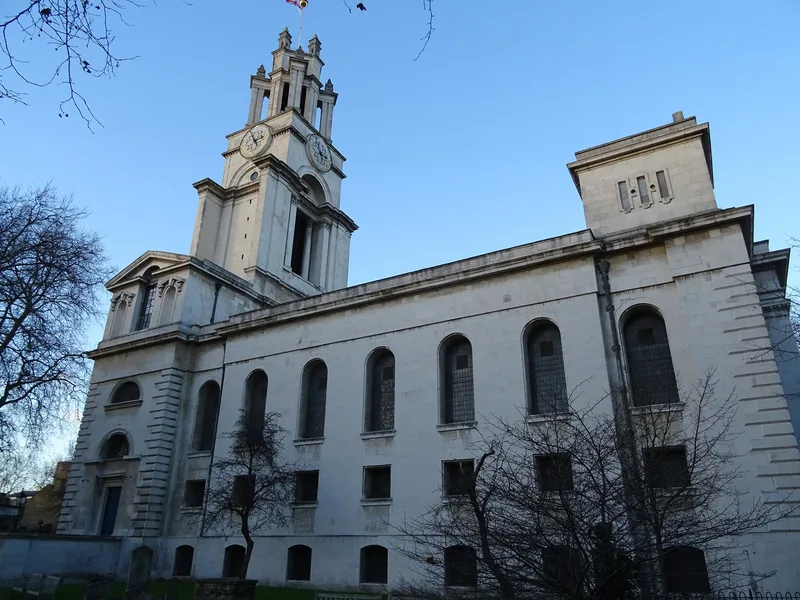
Photo: Spudgun67 · CC BY-SA 4.0 · Wikimedia Commons · resized
The Saturday that works: three churches in one day
Here is the practical answer to the timetable problem. Saturday is the day that gets you inside three of the six, and the route runs east then south, finishing in Greenwich.
| Time | Church | Getting there |
|---|---|---|
| 10:00 | St George-in-the-East, Wapping. Usually open from 9:30 | Shadwell (Overground or DLR), five minutes |
| 11:15 | St Anne's Limehouse. Open 10:00–16:00 on Saturdays | Limehouse DLR, five minutes, or walk the Thames Path from Wapping |
| 13:05 | St Alfege, Greenwich, for the free Saturday recital | DLR from Limehouse to Cutty Sark, about 15 minutes |
| 14:00 | The rest of Greenwich | On foot |
Add Christ Church on a Sunday afternoon if you have two days, and you have four of the six with no wasted journeys. The DLR does most of the work: see our guide to the DLR and the London Overground.
St Anne's Limehouse: the tower and the stair climber
St Anne's was consecrated in 1730 and is Grade I listed, and it has the strangest silhouette of the six: a tall west tower with a clock, and a churchyard that feels like a country parish dropped into the Isle of Dogs. The building has been under restoration for forty years, and the parish is frank that the job is not finished - it is raising money for a lift and hopes to complete the nave within a few years.
Access is the thing to plan. There is now a stair climber for visitors who cannot manage the steps, but it needs a trained operator, so you must contact the church in advance rather than turning up and asking. Visiting hours are Thursday, Friday and Saturday from 10am to 4pm, and the church warns that it occasionally closes for private events.
The surrounding area is covered by our guides to Poplar and Blackwall and, on the river, Wapping and Rotherhithe.
St George-in-the-East: the one that is open every day
In Wapping, between Shadwell and the river, St George-in-the-East is the easiest of the six to get into: it is usually open daily from 9.30am to 4pm for private prayer and services, though the parish notes that it may open later or close earlier depending on who is available to staff it. The parish mass is at 10.30am on Sundays.
It is also the most startling. The church was gutted in the Blitz and rebuilt in the 1960s as a smaller modern church inside Hawksmoor's surviving shell, so you walk through his walls into something entirely different - and the empty upper part of the old nave is still there above you. Nowhere else shows so plainly the difference between Hawksmoor's masonry and everything that came after. Whitechapel and the East End covers the district.
St Alfege, Greenwich: the one with free music
St Alfege is the best-run of the six from a visitor's point of view. It opens Tuesday to Sunday from 11am to 4pm, closes on Mondays except bank holidays, and puts on free lunchtime recitals at 1.05pm every Thursday and Saturday, many of them played by students from Trinity Laban Conservatoire of Music and Dance, which is next door in the Old Royal Naval College.
Hawksmoor rebuilt the church after the medieval one collapsed, and it stands in the middle of the town rather than on its edge, so it fits into a Greenwich day without a detour. General James Wolfe, who died taking Quebec, is buried here. Our guide to Greenwich has the rest, and free live music in London covers the recital circuit.
The two in the middle of town, and why they are harder
St George's Bloomsbury, on Bloomsbury Way five minutes from the British Museum, has the most peculiar steeple in London: a stepped pyramid modelled on the Mausoleum at Halicarnassus, with a statue of George I on top of it. Getting in is the problem. The church depends on volunteers, says it cannot guarantee access, and had no scheduled opening times over the summer holidays. It asks anyone making a special journey to email or telephone first, and that advice should be taken literally. The nearest stop is Museum Street on the bus, or Holborn and Tottenham Court Road on the Underground, and there is a Santander Cycles dock on Bury Place about a hundred metres away.
St Mary Woolnoth is wedged against Bank station in the City, and it is the smallest and most compressed of the six - a church built on a cramped site by an architect who liked space, with the Underground booking hall dug out beneath it. We could not find published visiting hours for it. A weekday lunchtime is the likeliest time to find the door open, and the pattern for City churches generally is set out in our guide to All Hallows and the City churches. It is a minute from Bank junction and the Royal Exchange.
How to look at a Hawksmoor church
Three habits make these buildings legible, and none of them requires any knowledge of architecture.
- Look at the size of the individual stones. Hawksmoor used very large, very plain blocks and let the joints show. Compare a Hawksmoor wall with the fussier detail of a Wren church such as St Mary-le-Bow and the difference is immediate.
- Stand where the building was meant to be seen from. Each of these churches was designed to close a view along a street. Christ Church is meant to be seen from the west along Brushfield Street, not from the pavement beneath it.
- Count the levels of the steeple. All six steeples are built as a stack of distinct stages, and Hawksmoor makes each stage a different shape. The pleasure is in watching one form turn into another.
Fitting Christ Church into a Sunday in Spitalfields
Sunday is the day the markets around the church are at their busiest, which makes the timing convenient. Spend the morning at Old Spitalfields and the Brick Lane markets, be at the church for 1pm when it opens, and give it half an hour to forty minutes. Fournier Street and Princelet Street, immediately east, hold the Huguenot weavers' houses that explain why the church is where it is.
Going west instead, Bloomsbury and the British Museum put you a few minutes from St George's Bloomsbury, if you have telephoned ahead. Hawksmoor's own training shows at St Paul's, where he worked under Wren for years before he built anything of his own.
Frequently asked questions
Can you go inside Christ Church Spitalfields?
Only on Sunday afternoons between 1pm and 4pm, when the church is open to the public and free. On Mondays and Tuesdays the vestibule is open from 10am to 3pm, which lets you look into the nave without entering it. Groups of up to twelve can book a tour for £60 with at least two weeks' notice.
How many Hawksmoor churches are there in London?
Six: Christ Church Spitalfields, St Anne's Limehouse, St George-in-the-East in Wapping, St Mary Woolnoth at Bank, St George's Bloomsbury and St Alfege in Greenwich. All are free to enter, but their opening days are different and several depend on volunteers.
Which Hawksmoor church is easiest to visit?
St Alfege in Greenwich, open Tuesday to Sunday from 11am to 4pm with free recitals at 1.05pm on Thursdays and Saturdays. St George-in-the-East in Wapping is usually open daily from 9.30am to 4pm, though that depends on staffing.
Can you see three Hawksmoor churches in one day?
Yes, on a Saturday: St George-in-the-East in Wapping from 9.30am, St Anne's Limehouse from 10am, and St Alfege in Greenwich for the 1.05pm recital, using the Overground and the DLR. Christ Church Spitalfields cannot be added, because it opens only on Sunday afternoons.
Are the Hawksmoor churches free?
Yes, all six. Only the booked group tour of Christ Church Spitalfields carries a charge, at £60 for a group of up to twelve. Donations are welcome everywhere, and St Anne's Limehouse is still raising money to finish a restoration that has been running for forty years.
Sources
- Christ Church Spitalfields - Heritage: opening times, tours and the organ (checked September 2026)
- St Anne's Limehouse - Our building: visiting hours, access and restoration (checked September 2026)
- St Alfege Greenwich - church opening times and lunchtime recital series (checked September 2026)
- St George-in-the-East - opening times and services (checked September 2026)
- St George's Bloomsbury - Visit us: opening hours and directions (checked September 2026)
- Friends of Christ Church Spitalfields - archive site on the £15m restoration and the 1735 Bridge organ (archive as at December 2017; read September 2026)