
Bank junction is the point where seven streets, three great buildings and five Underground and DLR platforms all meet. The Bank of England stands on one side, Mansion House on another, and the Royal Exchange closes the eastern end with a portico that most people walk straight past. Standing still for five minutes here tells you more about the City than an hour in a museum.
It is also a junction that has been deliberately emptied of cars. Between 7am and 7pm on weekdays, general traffic cannot cross it at all, which is why the middle of the City's busiest road intersection is now a wide stone space full of people eating sandwiches.
This page is about how to read the place: which building is which, what the Royal Exchange is now, what the traffic rules mean if you are trying to get a taxi, and the fifteen-minute walk that makes sense of it. Our guide to the Square Mile as a whole covers the wider district.
Bank junction at a glance
- Where
- EC3V, at the meeting of Threadneedle Street, Cornhill, Lombard Street, King William Street, Queen Victoria Street, Poultry and Princes Street
- The Royal Exchange
- Grade I listed; shops, restaurants and a bar; free to walk into
- Royal Exchange hours
- Monday to Friday 7.30am to 11pm, Saturday 11am to 11pm; individual shops vary
- The murals
- On the mezzanine, free to see all year round
- Traffic ban
- No general traffic or private hire vehicles across the junction, 7am to 7pm, Monday to Friday
- Station
- Bank: Central, Northern and Waterloo & City lines, plus the DLR; linked underground to Monument
- Best time
- A weekday lunchtime for atmosphere; a Sunday morning for photographs
The three buildings, and how to tell them apart
Stand with your back to the Royal Exchange steps and the layout falls into place.
- The Bank of England is the windowless stone wall on your right, running the whole length of Threadneedle Street. It has no ground-floor windows because the outer curtain wall, built by Sir John Soane, was designed to be impregnable. The only way in for a visitor is the free museum, whose entrance is round the corner on Bartholomew Lane: see our guide to the Bank of England Museum.
- Mansion House is the columned building diagonally opposite, on the south-west corner. It is the Lord Mayor's official residence, and it is not generally open to walk into.
- The Royal Exchange is the one you are standing on: the wide flight of steps and the deep portico facing down the junction. It is the grandest thing here, and it is also the only one of the three you can simply walk into.
Counting the streets is a small pleasure. Threadneedle Street, Cornhill, Lombard Street, King William Street, Queen Victoria Street, Poultry and Princes Street all arrive here, which is seven. Some counts say six, because Poultry technically hands over to the short stub called Mansion House Street for its last few yards. Either way, no other junction in central London does anything like it.
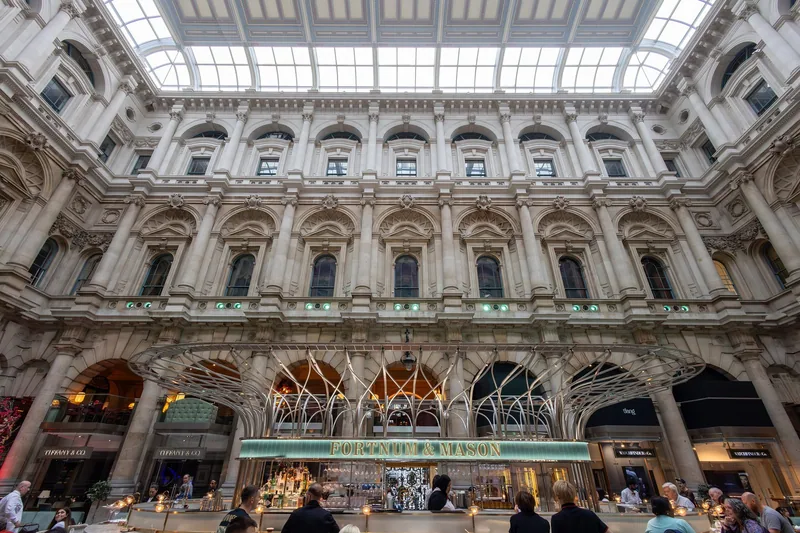
Photo: The wub · CC BY-SA 4.0 · Wikimedia Commons · resized
The Royal Exchange: three buildings, one name
Thomas Gresham built the first Royal Exchange as a place for merchants to do business under cover, and Elizabeth I opened it in 1571. It burned in the Great Fire of 1666. The second Exchange was destroyed in 1838, and the third, the one standing today, was opened by Queen Victoria on 28 October 1844.
The grasshopper weathervane on the roof is Gresham's family crest and has survived all of it. The steps below the portico are one of the traditional places where the accession of a new monarch is publicly proclaimed, which is why they occasionally appear on the news with heralds standing on them.
Inside, the old trading courtyard is now roofed over and filled with a bar and restaurant tables, ringed by jewellers, watch shops and a handful of luxury brands. You do not have to buy anything. Nobody will stop you walking in, sitting down on one of the public benches and looking up at the glass roof, which is exactly what the City workers do at four o'clock on a wet afternoon.
The murals nobody looks at
Go up to the mezzanine, around the bar and the restaurant at that level. A series of large painted panels runs round the gallery, and they are free to look at all year round. Three of them record the Exchange's own history: Elizabeth I opening the first building in 1571, the destruction of the second in 1838, and Victoria opening the third in 1844.
The rest are Victorian and Edwardian history paintings of London, commissioned at a time when the City was inventing ceremonies for itself as fast as it was reviving old ones. They are worth ten minutes, and on a weekday afternoon you will usually have them to yourself.
The Royal Exchange is one of the City's few genuinely free indoor shelters. Warm, dry, open until 11pm on weekdays, with public seating and no obligation to spend. When the weather turns and everything else in the Square Mile has closed at five, this is where to go.
Why there are no cars
Bank junction used to be one of the most dangerous places in London for anyone on foot or on a bicycle. The Corporation closed it to most traffic, and after years of trials the current rules are these.
| Rule | When it applies | Who is exempt |
|---|---|---|
| No crossing the junction | 7am to 7pm, Monday to Friday | Buses and cycles; licensed black cabs east and west between Poultry and Cornhill, on an experimental basis |
| Timed restriction on Lombard Street | 7am to 7pm, Monday to Friday | Buses and cycles |
| Queen Victoria Street closed at Mansion House Street | 24 hours a day | Cycles, in both directions |
| Threadneedle Street closed, junction to Bartholomew Lane | 24 hours a day | Cycles |
| Princes Street entry restrictions | 24 hours a day | Buses, cycles, and vehicles needing access |
Private hire vehicles, which includes app-booked cars, are not exempt. Licensed black cabs have been allowed through eastbound from Poultry to Cornhill since July 2025, and westbound since that October, under an experimental traffic order. Taxis still cannot turn towards Monument or London Bridge during the restricted hours. A public consultation on making the taxi access permanent closed on 31 May 2026, and the Corporation's Planning and Transportation Committee was due to decide in autumn 2026.
Do not order a car to Bank on a weekday. A private hire driver cannot cross the junction between 7am and 7pm, and will either cancel or set you down somewhere confusing. Walk to Cannon Street, Moorgate or Liverpool Street and order from there. Our guide to black cabs, minicabs and app cars explains the difference between the two licences and why it matters here.
If you are cycling, the junction is now one of the better-designed places in the City, with cycle access kept in almost everywhere motor traffic has been removed. See our guide to cycling in London for the wider network.
Bank station, and why people get lost in it
Four lines call at Bank: the Central, the Northern, the Waterloo & City and the DLR, and the station connects underground to Monument on the District and Circle lines. The combined station has a dozen exits scattered across the junction and the streets around it, and the walk between the Northern line and the DLR platforms is a long one.
Two practical points. First, if you are meeting someone, name the exit and the street, not "Bank station". Second, if you are carrying anything heavy or using a pushchair, check step-free access before you plan a route through here; our step-free transport guide has the detail, and the Underground guide explains the network.
The Northern line to District line link at Bank is shut while escalators are replaced. Transport for London closed that walking route from October 2025 until November 2026, and the signed alternative may take you out to street level and back in again. If it does, touch out as you leave and touch in again when you re-enter so that you are charged correctly. Step-free access is also unavailable from the King William Street entrance because of faulty lifts; use the Cannon Street entrance for the DLR and the Northern line.
A fifteen-minute walk that makes sense of the junction
Start on the Royal Exchange steps. Walk east along Cornhill, with the Exchange on your left, and turn into the narrow passages behind it: Change Alley and the courts off Cornhill are where the coffee houses stood that turned into the insurance market and the stock exchange.
Come out onto Leadenhall Street and turn into Leadenhall Market, five minutes away, for the painted Victorian ironwork. From there the towers begin: our guide to the Gherkin and the City's skyscrapers covers what you are looking at, and the free booking system for Sky Garden puts you above all of it.
Walk south instead and in ten minutes you reach the Monument and the river. Walk north-west from Bank and it is five minutes to Guildhall and the Roman amphitheatre. Every direction from this junction leads somewhere worth going, which is the point of it.
For somewhere to sit down that is not a chain, the free churches described in our guide to All Hallows and the City churches include St Stephen Walbrook, a two-minute walk down the hill behind Mansion House, and it is one of the finest interiors in London.
When to come
The junction has two completely different characters. On a weekday between noon and two it is packed, the Exchange is busy, and the atmosphere is the reason people write about the City. On a Saturday it is quiet and most shops in the Exchange are shut by early evening; on a Sunday the Exchange does not open at all and the streets are close to empty.
For photographs, come on a Sunday morning: you can stand in the middle of a junction that carries a bus every few seconds on a weekday. For anything else, come on a weekday. The reasons for that emptiness, and the rest of the City's constitutional strangeness, are explained in our guide to what the City of London actually is. If you want to see its ceremonial side, the Lord Mayor's Show sets off from Mansion House on 14 November 2026.
Frequently asked questions
Can you go inside the Royal Exchange?
Yes, and it is free. The building is open Monday to Friday from 7.30am to 11pm and Saturday from 11am to 11pm, though individual shops and restaurants keep shorter hours. You can walk in, sit in the covered courtyard and see the historic murals on the mezzanine without buying anything.
Why is there no traffic at Bank junction?
The City of London Corporation restricts the junction to reduce casualties and crowding. General traffic and private hire vehicles cannot cross it between 7am and 7pm on weekdays. Buses and cycles are exempt, and licensed black cabs are allowed east and west between Poultry and Cornhill under an experimental order.
Can you visit the Bank of England?
Not the bank itself, but the Bank of England Museum is free and open to the public, with its entrance on Bartholomew Lane rather than on Threadneedle Street. The main building has no ground-floor windows on the street because Sir John Soane designed the outer wall as a defensive curtain.
Which streets meet at Bank junction?
Threadneedle Street, Cornhill, Lombard Street, King William Street, Queen Victoria Street, Poultry and Princes Street. Counts differ because Poultry reaches the junction through the short stub called Mansion House Street, which some people count separately and some do not.
Is the Royal Exchange open on Sundays?
No. Published hours are Monday to Friday 7.30am to 11pm and Saturday 11am to 11pm, with no Sunday opening. This matches the rest of the Square Mile, where most cafes, pubs and shops close at the weekend because the office workers who use them are not there.
Sources
- The Royal Exchange - official site (checked September 2026)
- The Royal Exchange - Murals (checked September 2026)
- City of London Corporation - All Change at Bank project (checked September 2026)
- City of London Corporation - Bank junction traffic changes (PDF) (checked September 2026)
- Transport for London - Bank station (checked September 2026)