
St Bride's on Fleet Street is free and open Monday to Friday from 8am to 5pm, Saturday 10am to 3.30pm and Sunday 10am to 6.30pm - longer hours than almost any other church in the City. Its crypt holds a Roman pavement dated to about AD 180, and its spire is the one the church itself calls the wedding cake. St Dunstan-in-the-West, a few doors west along the same street, opens Monday to Friday from 10am to 3pm and is also free.
Between them these two churches cover two thousand years of one street. St Bride's is the journalists' church, because the printing trade grew up in its churchyard; St Dunstan's has been the spiritual home of London's Romanian Orthodox community for over fifty years. Neither charges, neither needs booking, and on a weekday you will have both nearly to yourself.
Our guide to All Hallows by the Tower and the City churches has the wider walk and the general rules of behaviour. This page is the Fleet Street end of it, in detail.
The Fleet Street churches: hours and cost
- St Bride's, Fleet Street EC4Y 8AU
- Free. Mon–Fri 8:00–17:00; Sat 10:00–15:30; Sun 10:00–18:30. Closed on bank holiday Mondays
- St Dunstan-in-the-West, Fleet Street EC4
- Free. Mon–Fri 10:00–15:00. Mass on Tuesdays at 12:30, and volunteer guides usually present on Tuesdays 11:00–15:00
- St Andrew Holborn, at the western end
- Free. Mon–Fri 9:00–17:00, and 9:00–16:00 from November to the end of March
- Buses along Fleet Street
- 11, 15, 26, 76 and 341 stop near St Bride's
- Stations
- City Thameslink is closest; St Paul's (Central) and Blackfriars (District, Circle) are both about five minutes
- How long
- Thirty minutes for St Bride's including the crypt; an hour and a quarter for all three with the walk
Check before Christmas, Easter and bank holidays. St Bride's closes on bank holiday Mondays, and warns that its hours change between Christmas and New Year, in the days after Easter and for occasional events. It publishes those changes in its own What's On calendar, and the parish office answers the telephone on weekdays. A wasted trip here is entirely avoidable.
St Bride's above ground: the altar, the hostage and Polly Nichols
The interior is a Wren church rebuilt inside its own shell. Three things are worth finding before you go downstairs.
The painting behind the altar. It is not an apse; it is a trompe l'oeil, painted by Glyn Jones for the church's rededication in 1957, and it takes a moment to work out that the architecture you are looking at is flat.
The Journalists' Altar, in the north-east corner. It was the Hostage Altar while the journalist John McCarthy was held in Beirut between 1986 and 1991, with vigils here and candles kept burning until his release. It is now a memorial table for journalists and support staff killed covering this century's conflicts, and what is left on it changes.
A memorial to Polly Nichols, inside the west door beneath the tower. She was the first known victim of the murders attributed to Jack the Ripper, she grew up in this parish, and she was married in this church in 1864. Our guide to the history behind the Ripper tours deals with the case.
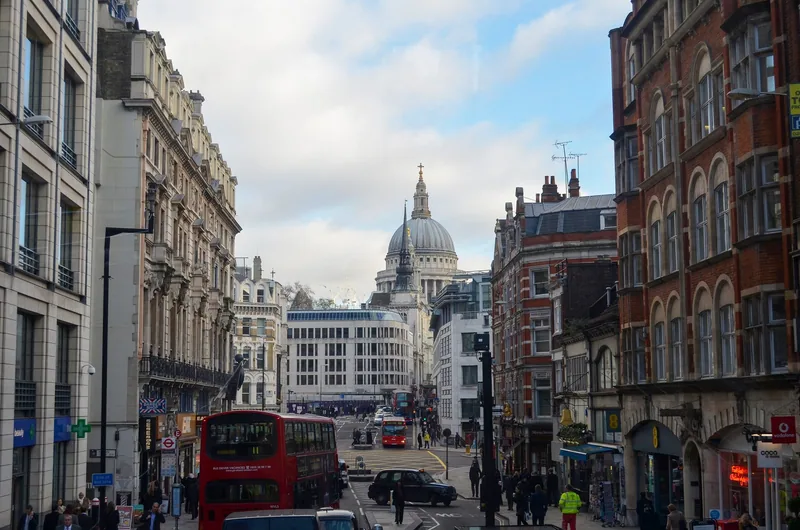
Photo: Sebastiandoe5 · CC BY-SA 4.0 · Wikimedia Commons · resized
The crypt: a Roman floor, a medieval chapel and a coffin you could lock
Twenty steps down from the body of the church is the best small archaeological site in the City after All Hallows. The church names three things to look for.
- The Roman tessellated pavement, behind the altar in the main crypt chapel, dated to around AD 180. St Bride's calls it the earliest evidence of a building on the site, and you can stand next to it.
- The medieval chapel in the north-east corner, found when architects investigated the foundations before the post-war rebuilding and restored in 2002 as a memorial to the Harmsworth family and the staff of Associated Newspapers killed in the two world wars.
- A Victorian iron casket from the era of the body snatchers, sold on the promise of "safety for the dead" - a lockable coffin, bought by people who did not want their relatives dug up and sold to anatomists.
The post-war rebuilding made excavation possible, and the digs led by the archaeologist W F Grimes found the foundations of six earlier churches on the site. That is why the crypt feels like a dig rather than a display.
The spire, and what survived 1940
The church calls it the wedding cake spire itself, and the resemblance is not in dispute: four diminishing octagonal stages, each stepped back from the one below. The tradition that a local pastry cook copied it for a tiered wedding cake is repeated everywhere and provable nowhere, so treat it as a good story with a good object attached.
What is documented is what happened to the rest. Incendiary bombs in 1940 reduced Wren's church to a roofless shell, and the spire and outer walls survived. Restoration took seventeen years, finishing with the 1957 rededication the trompe l'oeil was painted for. So the spire is Wren's and the interior is 1950s work inside his walls, which is the opposite of what most visitors assume.
Why the printers came here
The connection with the newspaper trade is older than newspapers. William Caxton set up England's first movable-type press beside Westminster Abbey in 1476; after his death his apprentice Wynkyn de Worde, who had to make the business pay, moved it to where the customers were. In 1500 he set it up in the churchyard of St Bride's, because the clergy and lawyers around Fleet Street were almost the only people who could read.
Other presses followed, and Fleet Street became the printing and then the newspaper quarter for four and a half centuries. De Worde was buried here in 1535, there is a plaque to him in the church, and the church holds an example of his printing from 1495. That is the whole explanation for the journalists' commemorative service still held here.
Music, and the hour of silence nobody knows about
St Bride's is unusual among City churches in holding two choral services every Sunday: a Choral Eucharist at 11am and Choral Evensong at 5.30pm, both sung by a professional choir. On the second and fourth Sundays of the month the sermon is replaced by an extended musical setting the church calls a Sermon in Music. All of it is free to attend and nobody will ask what you believe. Our guide to choral evensong in London explains how these services work for a visitor.
The other thing is quieter. Every weekday from 4pm to 5pm the church runs an hour it calls Space for Silence: the building open, nothing happening. If you want somewhere to sit at the end of a City afternoon that is not a coffee chain, this is it. Morning Prayer is said in the crypt at 8.15am on weekdays and a said Eucharist at 1.15pm on Wednesdays. Recitals are advertised separately; classical music in London covers the City church circuit.
St Dunstan-in-the-West: a Romanian church on Fleet Street
A few minutes west, close to where the street meets the Strand, St Dunstan-in-the-West is a Guild Church of the Church of England that has for more than fifty years also been the spiritual home of London's Romanian Orthodox community. The church describes itself as a centre of ecumenical encounter, and the practical result is a building shared by two traditions at once, which is not a combination you will find elsewhere on this street.
It opens Monday to Friday from 10am to 3pm for worship, quiet prayer and visiting, with mass at 12.30pm on Tuesdays, and volunteer church watchers usually on duty on Tuesdays between 11am and 3pm. That makes Tuesday the day to come if you want someone to explain the building. A church has stood here since about the year 1000; the present one has been on Fleet Street for about 180 years, and it is a noted concert venue.
Tuesday is the day this end of Fleet Street works. St Bride's is open all week, but St Dunstan's has its mass and its volunteer guides on a Tuesday, and Dr Johnson's House round the corner is a weekday museum. A Tuesday between 11am and 3pm gets you all three; a Sunday gets you St Bride's and nothing else.
The third church, at the Holborn end
If you are walking the whole Fleet valley, St Andrew Holborn sits at the top of it, near where the buried River Fleet passes under Holborn Viaduct. It is free, open Monday to Friday from 9am to 5pm, or to 4pm from November to the end of March. A church of St Andrew has stood here for over a thousand years.
It is ten minutes from St Bride's, and it puts you on the edge of Holborn for the rest of the afternoon.
Access, steps and toilets
St Bride's is largely step free at street level, with movable seating that makes room for a wheelchair; only the raised side-aisle seating has steps, three of them. Step-free entry is by the west door at the Salisbury Court end of St Bride's Avenue, and the church asks you to ring if that door is shut for an event. A hearing loop covers the main body of the building, large-print orders of service are available, and guide, hearing and assistance dogs are welcome.
The crypt is the exception and there is no way round it: twenty steps down, with uneven steps and flooring at the bottom. If the Roman pavement is the reason you came, know that before you travel.
Accessible toilets are available only while services are taking place, not to passing visitors; the church points people to the City of London's community toilet scheme instead, which our guide to public toilets in London explains. There is no parking, Blue Badge bays are in Dorset Rise and Tudor Street, and building work has stopped drop-offs in Salisbury Square.
A forty-minute walk along the street
| Stop | Minutes | What it is |
|---|---|---|
| Temple station or Temple Bar memorial | - | Start where Fleet Street begins; see our guide to Temple Bar and the City boundary |
| St Dunstan-in-the-West | 3 | Weekdays 10am–3pm; the Romanian Orthodox interior |
| Dr Johnson's House, Gough Square | 6 | Paid, up a court off the north side; where the Dictionary was written |
| St Bride's | 5 | The crypt, the Journalists' Altar, the spire from the alley |
| Ludgate Circus and up to St Paul's | 8 | Finish at St Paul's, or turn north for St Andrew Holborn |
The spire of St Bride's is hard to see from Fleet Street itself, because the church sits back behind buildings; the view is from St Bride's Avenue, the narrow alley that leads to the door. For the pubs on this route, see historic pubs in London and the Fleet Street pub walk; St Bride's own visitor pages point people to the Old Bell Tavern behind the church, which it says housed Wren's workmen while the church was being built. For the twentieth-century buildings on the street, including the black glass of the old Daily Express office, see art deco London. South of the street, Temple Church and the Inns of Court is a separate walk again, and St Mary-le-Bow is fifteen minutes east along Cheapside.
Frequently asked questions
Is St Bride's Church free to visit?
Yes, including the crypt. It is open Monday to Friday from 8am to 5pm, Saturday from 10am to 3.30pm and Sunday from 10am to 6.30pm, and it closes on bank holiday Mondays. Hours change between Christmas and New Year and after Easter, so check the church's own calendar first.
Why is St Bride's called the journalists' church?
Because the printing trade began in its churchyard. Wynkyn de Worde moved England's first commercial printing press there in 1500 to be near his customers, the clergy and lawyers of the area, and Fleet Street grew into the printing and then the newspaper quarter. The church holds a journalists' commemorative service and keeps a Journalists' Altar as a memorial.
Can you see the Roman pavement at St Bride's?
Yes. It is behind the altar in the main crypt chapel and dated to about AD 180, and it is free to see. The crypt is reached by twenty steps and has uneven flooring, so there is no step-free access to it.
Is the wedding cake story true?
The church itself calls the spire the wedding cake spire, and the four stepped octagonal stages plainly look like a tiered cake. The specific tradition that a Fleet Street pastry cook copied it is repeated widely and has never been proved, so it is best treated as a story rather than a fact.
What is St Dunstan-in-the-West used for now?
It is an Anglican Guild Church and has been the spiritual home of London's Romanian Orthodox community for more than fifty years, so the interior combines both traditions. It is free and open Monday to Friday from 10am to 3pm, with mass at 12.30pm on Tuesdays and volunteer guides usually present on Tuesday afternoons.
Sources
- St Bride's Church - Visit us: opening times, what to see, guided tours, accessibility (checked September 2026)
- St Bride's Church - Our history (Wynkyn de Worde, the 1940 fire, the spire) (checked September 2026)
- St Andrew Holborn - opening times and free entry (checked September 2026)
- City of London Corporation - Temple Bar (the Fleet Street boundary) (checked September 2026)
- Food Standards Agency - food hygiene rating register (The Old Bell Tavern, 95 Fleet Street, rated 5) (checked September 2026)