
You can legally paddle on the tidal Thames, and almost nobody should do it on a first visit without a guide. The rules are set out in the Tideway Code, the Port of London Authority's code of practice for rowing and paddling, and they are specific: no paddleboards below Putney Bridge for three hours before and two hours after high water at London Bridge, and no paddleboards at all below Chelsea Bridge between 11am and 6pm from Good Friday to 30 September except in a group led by a qualified, commercially licensed leader.
The reason is not bureaucracy. The 95 miles of river between Teddington Lock and the sea is the busiest inland waterway in Britain, it runs a fast tide in both directions, and through central London the banks are vertical walls with almost nowhere to get out. The calm water for learning is above Teddington, on the canals, or on a lake.
This page sets out where you may paddle, what licence you need for each stretch, and which rules are hard rather than advisory. Our guide to swimming ponds and lidos covers where you may get into the water, which is a different question with different answers.
Paddling in London: which water, which permission
- Tidal Thames (Teddington Lock to the sea)
- Port of London Authority. No licence to paddle, but the Tideway Code's restrictions apply and some are absolute
- Non-tidal Thames (above Teddington)
- Environment Agency. Unpowered boats, including canoes, kayaks and paddleboards, must be registered
- Canals: Regent's, Grand Union, Limehouse Cut
- Canal & River Trust. A small-craft licence is required, from about £5 a day, or a Paddle UK waterways licence
- One licence for both
- A Paddle UK waterways licence covers Canal & River Trust and Environment Agency waters, so the canals and the upper Thames together
- Canal & River Trust reservoirs
- Not covered by a paddling licence
- Lee Valley lakes and river
- Entering the water is banned by byelaw, but the Authority runs its own watersports centres
- Emergencies on the tidal river
- 999, and ask for the Coastguard
What the Tideway Code actually is
The Tideway Code is a printed code of practice, now in its second edition dated 2025, produced jointly by the Port of London Authority, the Thames Regional Rowing Council and Paddle UK. It runs to more than 130 pages and it covers rowing boats, canoes, kayaks, dragon boats and stand-up paddleboards between Teddington Lock and the sea.
Its core is a navigational concession called working the slacks. Water runs faster round the outside of a bend and slower on the inside, and human-powered boats going against the tide are allowed to break the normal rule of keeping to starboard in order to use that slower water. The Code calls this a privilege rather than a right, and says explicitly that it can be withdrawn if it is abused.
That concession applies only inside two defined areas, the Upper Tideway Code Area and the Lower Tideway Code Area. Outside them the ordinary international collision regulations apply, and every vessel must keep to the starboard side of the river regardless of the tide.
The paddleboard restrictions are timetabled, not vague. Below Putney Bridge, no stand-up paddleboard may be on the water from three hours before to two hours after high water at London Bridge, and anyone paddling there must carry a VHF radio and a mobile phone on their person, not in a dry bag on the board. Below Chelsea Bridge there is no paddleboarding at all between 11am and 6pm from Good Friday to 30 September, and at any other time only as part of a group led by a Paddle UK trained, commercially licensed leader, never solo and never at night. These are the Code's own words, not our interpretation.
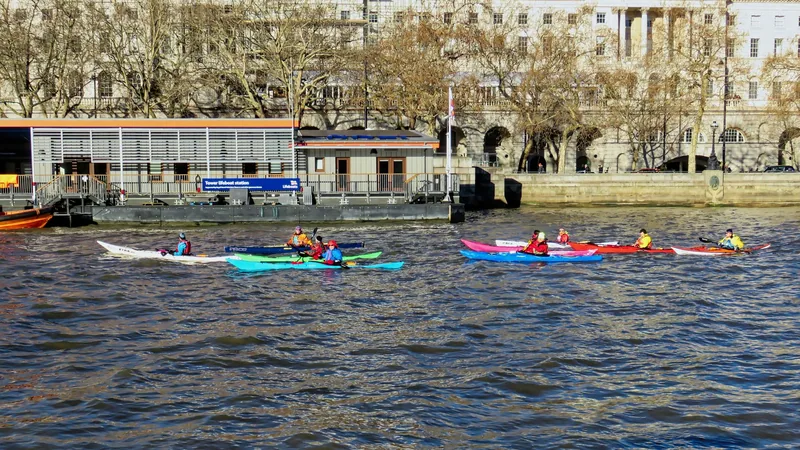
Photo: Acabashi · CC BY 4.0 · Wikimedia Commons · resized
Central London: legal, and not recommended by the people who wrote the rules
The Code defines Central London as the river between Putney Bridge and Tower Bridge, and its verdict on it is unusually blunt for an official document. There are twenty bridges in that stretch plus countless piers, moorings and wharves; the edge is almost entirely wall, so the water is choppier and there are few places to get out; and it states that Central London is not especially well suited to recreational activities, particularly in fine rowing boats, all open boats and paddleboards. The boat it says copes best is a sea or touring kayak with a closed cockpit.
Small boats are not banned. They simply need a plan, and the Code sets out what must be in it. Collision regulation Rule 9a applies throughout: keep to the starboard side in your direction of travel, stay out of the Fairway and as close to the bank as is safe, use the bridge arch nearest the shore and pass inside the piers.
Three fixed no-go areas exist. There are exclusion zones in front of the MI6 building at Vauxhall Bridge and in front of the Palace of Westminster, which small boats must not enter at all. And there is a 100-metre exclusion zone around the London Heliport above Battersea Rail Bridge, which you may pass through but must not stop in.
Below Tower Bridge the Code's rules resume as far as the Thames Barrier, with named turning procedures at Cherry Garden Pier and at the Barrier itself that differ depending on whether the tide is ebbing or flooding. This is the point at which most readers should conclude that the tidal river is a guided activity.
The three things that will actually stop you
The ebb tide flag. The PLA runs an Ebb Tide Flag Warning system. Under Extreme Caution, all human-powered vessels are advised not to go afloat on the ebb. Under Caution, beginners, novices, juniors under 15, weaker crews and anyone who does not normally paddle the tidal Thames are advised to stay off it. Check the flag before you commit to a session, because a booked trip can be called off on the morning.
Sewage. The Code devotes two pages to combined sewer overflow discharges and lists where they are in central London: Putney Embankment foreshore, Chelsea Bridge Embankment foreshore, the Heathwall pumping station at Nine Elms, Albert Embankment at Vauxhall Bridge, Victoria Embankment at Charing Cross rail bridge and Blackfriars Bridge foreshore. The PLA publishes a live discharge status. Falling in here is not the same as falling in on a lake.
Qualifications, if you want to lead rather than follow. Every commercial paddlesport leader operating on the Tideway must hold a Local Knowledge Endorsement from the PLA. Paddleboard groups must run at a minimum of one leader to four paddlers, and their leaders need a Paddle UK Paddle Sport Leader award plus a specific SUP Safer Thames Tideway qualification. For a beginner the Code recommends at least five previous outings on the Upper Tideway before going below Putney, in a led group at three paddlers to one leader, and never solo or at night.
The kit the Code expects
- A buoyancy aid rather than any other kind of personal flotation device: the Code prefers them because they are inherently buoyant and need no inflating.
- Not a pouch or bum-bag flotation device. The Code discourages them outright, because they are very hard to put on and operate once you are already in the water.
- A VHF radio and a phone on your person below Putney Bridge if you are on a paddleboard. You do not need a licence to listen on VHF; you do need one to transmit.
- Lights if you are out in the dark or in poor visibility, with separate specifications for rowing boats, paddled boats and coaching launches.
- The right leash for a paddleboard. The Code has its own section on paddleboard leashes; read it before buying one, because the wrong type is a hazard in moving water.
Where a beginner should actually paddle
Four options, in order of how little can go wrong.
A lake. Beckenham Place Park in Lewisham runs booked paddleboarding sessions on its purpose-built lake, including family sessions and hire from age two upwards with an adult, and it is the most forgiving water in London because there is no current at all. Our page on Beckenham Place Park covers the booking system and the age rules.
The Lee Valley. The regional park bans entering the water under its own byelaws, but runs watersports from its own centres, including a white-water course at Waltham Cross where rafting starts at £58 a person and a monthly paddling membership costs £15. Our guide to the Lee Valley sets out which venue is where.
The canals. The Regent's Canal, the Hertford Union and the Limehouse Cut are flat, slow, walled and usually shallow, and a small-craft licence from the Canal & River Trust starts at about £5 a day. The stretch through Little Venice and Regent's Park is the prettiest; the eastern cuts around Hackney Wick are emptier. Watch for narrowboats at bridges, and note that a paddling licence covers the Trust's canals and rivers but not its reservoirs.
The Thames above Teddington. This is the answer most visitors are actually looking for. Above Teddington Lock the river is the Environment Agency's, non-tidal, slow and lined with banks you can climb out on. Unpowered boats must be registered with the Agency, with annual and short-period options, and a Paddle UK waterways licence covers it as well as the canals. The reach through Twickenham and the Richmond riverside past Eel Pie Island is the obvious stretch.
Use a guided trip for the tidal river and save the licence question entirely. The Tideway Code requires every commercial paddlesport leader on the Tideway to hold the PLA's Local Knowledge Endorsement, which means somebody who has been examined on the bridges, the crossing zones and the turning points is making the decisions. The PLA does not publish a public list of holders, so ask a provider directly which of its leaders hold one and what their Paddle UK qualifications are. We do not recommend individual operators.
What a paddle on the tidal river is like when it works
It is worth saying why anybody does this. From a kayak at Greenwich the Old Royal Naval College is above you at the scale it was designed to be seen from, which is from a boat. Going up on the flood from Putney, the tide does the work and you can keep pace with the towpath for nothing. And the stretch between Tower Bridge and the Barrier is a working port: dredgers, aggregate barges and the river bus, at eye level.
The river bus matters practically as well as visually. Services run all day, every day including weekends, and sightseeing boats start from about 10am; the Code tells recreational users below Putney to know the timetable. Our guide to the Uber Boat river bus gives the routes and the piers those boats are aiming for.
If the appeal is the river itself rather than being on it, the Thames Path follows most of the same water on foot for nothing, and mudlarking on the foreshore gets you down to the water's edge, with its own separate and currently restrictive permit position. Totally Thames in September is when the river's own organisations put on the most for the public.
Frequently asked questions
Can you kayak on the Thames in central London?
Yes, it is not banned, but the Tideway Code states that central London is not especially well suited to recreational paddling and that the only craft well suited to the conditions is a sea or touring kayak with a closed cockpit. Collision regulations apply throughout, and there are exclusion zones at Vauxhall Bridge, the Palace of Westminster and the London Heliport.
Can you paddleboard on the Thames in London?
Only within strict limits. No paddleboarding below Putney Bridge for three hours before and two hours after high water at London Bridge. Below Chelsea Bridge, none at all between 11am and 6pm from Good Friday to 30 September, and otherwise only in a group led by a qualified commercially licensed leader, never solo and never at night.
Do you need a licence to kayak on the Thames?
Not on the tidal river below Teddington Lock, though the Tideway Code's restrictions apply there. Above Teddington the Environment Agency requires unpowered boats, including canoes, kayaks and paddleboards, to be registered. On the canals the Canal & River Trust requires a small-craft licence from about £5 a day, and a Paddle UK waterways licence covers both.
Where can a beginner learn to paddle in London?
On still water first. The swimming lake at Beckenham Place Park runs booked paddleboard sessions, the Lee Valley has its own watersports centres, and the canals are flat and slow. The non-tidal Thames above Teddington is the best river option for a first outing.
Is the water in the Thames clean enough to fall into?
Treat it as untreated. The Tideway Code lists combined sewer overflow discharge points through central London, including at Putney, Chelsea Bridge, Nine Elms, Vauxhall, Charing Cross and Blackfriars, and the Port of London Authority publishes a live discharge status. Check it before an outing and wash before eating afterwards.
Sources
- Port of London Authority, Thames Regional Rowing Council and Paddle UK - The Tideway Code, second edition 2025 (read September 2026)
- Port of London Authority - The Tideway Code page (checked September 2026)
- Port of London Authority - Water safety campaigns and guidance for the tidal Thames (checked September 2026)
- Port of London Authority - Regulations, codes of practice and river user guidance (checked September 2026)
- Canal & River Trust - Licensing your canoe, kayak or paddleboard (checked September 2026)
- GOV.UK, Environment Agency - River Thames boat registration and other charges, 2026 (checked September 2026)
- PTP - Paddlesport at Beckenham Place Park lake (checked September 2026)
- Lee Valley Regional Park - White Water Centre prices and memberships (checked September 2026)