
The Port of London Authority, usually shortened to the PLA, is the public body that runs the tidal River Thames: the 95 miles from Teddington Lock in south-west London to the North Sea. It keeps the river safe for shipping and everyone else on it, guides ships with its pilots, licenses commercial boats and riverside structures such as piers, owns Richmond Lock, publishes the official tide tables and decides who may search the foreshore. Upstream of Teddington the Thames belongs to a different authority, the Environment Agency.
For a visitor, the PLA is the organisation behind several things that otherwise seem arbitrary: why a boat to Hampton Court depends on the tide, why you cannot swim off the South Bank, why mudlarking needs a permit you cannot currently get, and why tide times are printed in GMT. This page explains what the authority does and where its waters end. For travelling on the river itself, start with our guides to the Uber Boat river bus and to Thames river cruises.
The Port of London Authority at a glance
- What it is
- A trust port: a self-financing public trust with no shareholders, funded by charges on river users
- Created
- By the Port of London Act 1908; the current law is the Port of London Act 1968, as amended
- Area
- 95 miles of the tidal Thames, from Teddington to the North Sea
- Above Teddington
- The Environment Agency, which runs the non-tidal locks including Teddington
- Headquarters
- London River House, Gravesend, Kent; London office in Seething Lane, near Tower Hill
- Former head office
- The Grade II* building on Trinity Square, Tower Hill, 1912 to 1922
- Emergency on the river
- Call 999 and ask for the Coastguard
Where the PLA's river begins and ends
Teddington is the dividing line. Below the locks there the Thames is tidal, rising and falling twice a day with the sea, and it is the PLA's. Above them the river is fed by rainfall rather than tides, and its locks, from Teddington itself upstream into Oxfordshire, are run by the Environment Agency. Teddington Lock is in fact three locks side by side, the barge lock, the launch lock and the skiff lock, all of them Environment Agency locks. Our guide to Teddington and Hampton covers the riverside on foot.
The PLA's history page sets out what it inherited in 1908: from the Thames Conservancy, responsibility for the tidal river from Teddington Lock to a line between Havengore Creek in Essex and Warden Point on the Isle of Sheppey in Kent, and from three private dock companies, the docks themselves. It no longer handles cargo; its last cargo operation, Tilbury Docks, was privatised in 1992.
Two structures on the PLA's river are not the PLA's to run. The Thames Barrier at Woolwich is managed by the Environment Agency, though ships passing through it follow the PLA's directions; see our page on the Thames Barrier. And Richmond Lock, a short way downstream of Teddington, is owned and operated by the PLA itself, which makes it the authority's one lock.
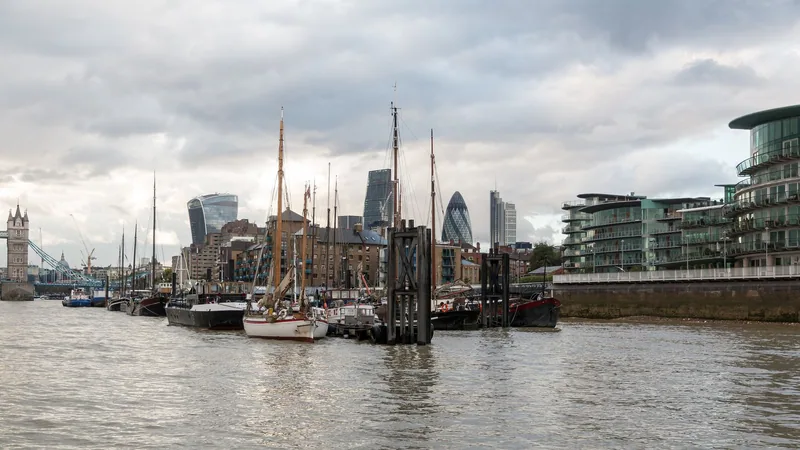
Photo: Dietmar Rabich · CC BY-SA 4.0 · Wikimedia Commons · resized
What the PLA actually does
Most of its work is invisible from the bank. In its own description it covers:
- Traffic control. London Vessel Traffic Service watches the whole river, about 600 square miles of waterway, 24 hours a day from an operations centre in Gravesend.
- Pilots. PLA pilots board the largest ships and guide them in and out of the port.
- Harbour patrols. Launches patrol between Southend and Putney, and two more patrol the upper river between Putney and Teddington daily from a base at Richmond Lock.
- Surveying and dredging. It charts the riverbed, dredges where ships need depth, and publishes bridge clearances for the tidal river and two of its creeks.
- Licensing. Every commercially operating vessel within the port's limits needs a PLA licence, and anything built in or over the river, a new pier included, needs a river works licence.
- Rules for everyone else. The Thames byelaws, the codes for rowers and paddlers, and the consent needed for any event on the water or foreshore.
The PLA describes the tidal Thames as the UK's busiest waterway, with more than 600,000 ship movements a year. The Port of London as a whole is the UK's largest port, handling over 50 million tonnes of cargo, though most of that now passes through terminals far downstream around Dartford, Purfleet and Tilbury rather than through London itself.
Why it matters on a river boat
Every boat you board in London, from the Uber Boat commuter service to a dinner cruise, operates under a PLA licence and inside PLA rules. The piers are licensed river works too, although several of the busiest passenger piers, including Westminster, Embankment and Tower, are managed by Transport for London. None of this changes your ticket, but it is why the river has one set of rules for every craft on it, from container ships to paddleboards. Our page on the river bus or a sightseeing cruise helps you choose between them.
The tide is the part a passenger notices. Towards Richmond the river runs very shallow at low water, and there the PLA keeps the level up with a half-tide lock and weir. For about two hours either side of high tide the weir's three steel gates are raised into the footbridge and boats pass freely; the rest of the time they are lowered and boats must queue for the lock alongside. In a drought the gates stay down for longer. That is why the boat to Hampton Court runs to a timetable that changes with the tide and can lose time at the locks, as our page on Hampton Court by boat explains. The structure itself, opened in 1894, is described on our page about Richmond Bridge and the upper Thames.
Boat speed on the tideway is partly the river's. The PLA warns that the tide runs at around five miles an hour. A boat going downstream on an ebb tide gets that for free; the same trip back against it is slower, so journey times on the river can differ by direction and by time of day.
Reading the PLA's tide tables
The PLA publishes tide predictions for gauges all along the river, from the estuary to Richmond, as an online tool and in its annual "Tide Tables and Port Information" booklet. Three details catch visitors out.
- Times are in Greenwich Mean Time. The PLA's instruction is to add an hour during British Summer Time, which runs from late March to late October.
- Heights are in metres above chart datum. Chart datum is a level so low that the tide seldom falls below it, so a "low water" of half a metre means the river is very low indeed and the foreshore wide.
- The printed book and the website can differ slightly. The PLA explains that the booklet uses Admiralty predictions and the website its own software, so times may differ by a few minutes and heights by up to 0.1 metres.
For a riverside walk or a pub with a terrace, the tide table tells you whether you will see a full river or a strip of mud and shingle. Our guide to riverside pubs on the Thames explains how to use it for an evening out.
Swimming, paddling and the foreshore
These are the PLA rules that most often surprise visitors, and all three are stricter than people expect.
Swimming. The PLA's position is that most of the tidal Thames is not safe to swim in, even for strong swimmers, because of the current, eddies around bridges and piers, cold water, sewage after heavy rain and constant boat traffic. It permits swimming upstream of Putney Bridge as far as Teddington, and on certain estuary beaches in Kent and Essex. Not in central London.
Paddling and rowing. Kayaks, canoes and paddleboards on the tideway follow the Tideway Code, which the PLA produces with the rowing and paddling bodies. What it allows, and when, is set out on our page about paddling on the tidal river.
The foreshore. Walking on the exposed riverbank where it is safe and public is one thing; searching it is another. Anyone searching the foreshore between Teddington and the Thames Barrier, in any way and for any reason, needs a permit, issued by the PLA on behalf of itself and the Crown Estate. New registrations and the waiting list are suspended after demand passed 10,000. What you can still do without one is on our mudlarking page.
If someone falls into the Thames, call 999 and ask for the Coastguard. That is the PLA's own instruction. For someone in the water, it advises floating on your back with your ears submerged until help comes, rather than trying to swim against the tide.
The old head office at Tower Hill
The building most people associate with the PLA is the one it no longer uses as a head office. The former Port of London Authority Building faces Trinity Square Gardens across the road from the Tower of London. Historic England's list entry, which grades it II*, dates it to 1912 to 1922 and credits the architect Sir Edwin Cooper: a large detached building of Portland stone, nearly square, with the entrance at the canted south-east corner and a broad tower above it carrying a colossal sculpted figure. A large rotunda once filled the courtyard; it was destroyed in the Second World War.
The list entry singles out a suite of richly panelled rooms on the second floor, including the dining room, the chairman's room and the board room. The building has since been converted into a hotel. The tower and its figure are best seen from the gardens opposite. The PLA's headquarters is now London River House in Gravesend, and its London office is Walsingham House on Seething Lane, a few minutes away. Our page on the Tower of London covers the area.
Where the PLA's story is kept
The authority's archive, which the PLA says includes more than 50,000 plans and engineering drawings, thousands of books and photographs and records going back to 1799, is held and managed by the London Museum Docklands at West India Quay. The museum's galleries on the river and the port, described on our page about London Museum Docklands, are the best place to see what the enclosed docks were like before they closed between 1967 and 1981.
At its peak in the 1930s, according to the PLA, its enclosed docks covered 713 acres of water in five groups, with quaysides running for more than 36 miles. Trade through the port peaked in 1964 at 61 million tons. Every September the river festival Totally Thames puts some of that history back on the water, with events that need the PLA's consent.
Frequently asked questions
What does the Port of London Authority do?
It manages the tidal Thames from Teddington to the North Sea. It controls ship traffic, provides pilots, patrols the river, surveys and dredges it, licenses commercial boats and riverside works, owns Richmond Lock, publishes tide tables and issues foreshore permits.
Who is responsible for the River Thames above Teddington?
The Environment Agency. It runs the non-tidal Thames and its locks, including the three locks at Teddington. Below Teddington the river is tidal and the Port of London Authority is the harbour authority.
Can you swim in the Thames in London?
Not in central London. The PLA says most of the tidal Thames is unsafe for swimming, with strong tides, cold water and heavy boat traffic, and permits it only upstream of Putney Bridge as far as Teddington and on certain estuary beaches.
Are the PLA's tide times in summer time?
No. The PLA publishes its tide tables in Greenwich Mean Time and tells users to add an hour during British Summer Time, from late March to late October. Heights are given in metres above chart datum.
Where was the Port of London Authority building?
On Trinity Square at Tower Hill, opposite the Tower of London. The Grade II* building by Sir Edwin Cooper dates from 1912 to 1922 and is now a hotel. The PLA's headquarters today is in Gravesend, Kent.
Sources
- Port of London Authority - About us (checked November 2026)
- Port of London Authority - Our history (checked November 2026)
- Port of London Authority - Richmond Lock and Weir (checked November 2026)
- Port of London Authority - Tidal information (checked November 2026)
- Port of London Authority - Swimming in the tidal Thames (checked November 2026)
- Port of London Authority - Licensing and permits (checked November 2026)
- GOV.UK - River Thames: locks and facilities for boaters (checked November 2026)
- Historic England - Former Port of London Authority Building, list entry 1079138 (checked November 2026)