
Kingston upon Thames is a riverside market town that happens to be inside Greater London: 28 minutes from Waterloo, with a medieval market place still trading, a stone on which Saxon kings are said to have been crowned, and boats upriver to Hampton Court in summer. Surbiton, one stop closer to town, is a quieter Victorian suburb with one of the best railway stations in Britain.
The first thing to say is that this does not feel like London. The postcodes are KT rather than SW or SE, the river is narrow enough to see both banks properly, and the town has a shape it got in the Middle Ages rather than in the nineteenth century. Our explainer on London postcodes covers why the outer boroughs use town postcodes at all.
For a visitor, Kingston is most useful as the base or the endpoint for a day that also includes Hampton Court, Richmond Park or a boat. On its own it is a pleasant afternoon and not much more.
Kingston and Surbiton at a glance
- Best for
- A riverside market town, boats to Hampton Court, shopping, a Saxon coronation stone
- Stations
- Kingston and Surbiton (South Western Railway, both Zone 6); Hampton Wick and Norbiton nearby
- From Waterloo
- 28 minutes direct to Kingston; as little as 17 minutes to Surbiton
- No Underground
- National Rail and buses only. Contactless and Oyster work on both
- Hampton Court
- About two miles upriver; reachable by bus, on foot along the Thames, or by boat in season
- Time needed
- Half a day, or a full one with Hampton Court or Richmond Park
Getting there: two towns, two speeds
Kingston sits on a loop of the South Western Railway line out of Waterloo, and a direct train takes about 28 minutes. Surbiton is on the fast main line towards Woking and Southampton, and the quickest trains reach it from Waterloo in about 17 minutes, with slower ones taking around 24. Both stations are in Zone 6, so contactless and Oyster work normally and the daily cap applies.
That difference matters if you are choosing where to stay or where to change. Surbiton is the faster connection to central London; Kingston is where the town, the river and the shops are. They are about twenty minutes apart on foot, or a few minutes by bus.
There is no Underground station in either place, and no Night Tube. Trains run late but not all night, so check the last service before an evening out. Our guide to London's main railway stations explains how Waterloo works, and buying UK train tickets covers the fares that apply beyond the Oyster zones if you carry on west.
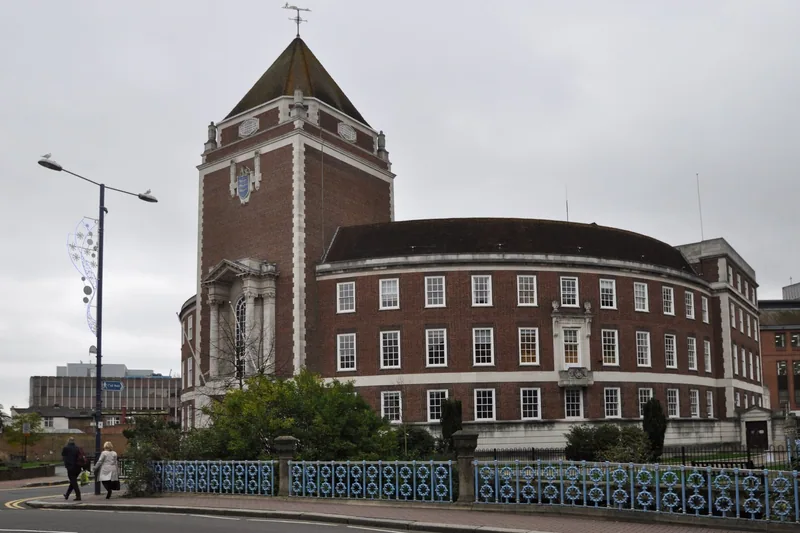
Photo: Stevekeiretsu · CC BY-SA 4.0 · Wikimedia Commons · resized
The Coronation Stone, and how much of the story is true
Beside the Guildhall, in a railed enclosure with a seven-sided plinth, sits a lump of sarsen stone. Tradition says that seven Saxon kings were crowned on it in Kingston during the tenth century, and the names are cut into the plinth.
The truthful version is more interesting than the legend. Kingston certainly was a royal site: Athelstan was crowned here on 4 September 925, close to the old border between Wessex and Mercia, and the surviving account describes him greeting the people in the market place before entering a church for the ceremony. Edward the Elder in 900, Edmund in 940, Edwy in 955 and Edward in 975 are also traditionally associated with Kingston, and modern historians add Edgar in 959.
The stone itself is a different matter. Historic England's listing describes the association as a tradition, probably dating from the late eighteenth century, rather than an established fact, and the monument you see is a Victorian commemorative structure with Saxon-style railings. It is free, it takes two minutes, and it stands beside Clattern Bridge, a medieval bridge over the Hogsmill that is both Grade I listed and a scheduled monument.
Athelstan's coronation is the reason this town exists in the history books. The pattern set here in 925, a public greeting in the market place followed by a church ceremony, is recognisably the shape of a British coronation a thousand years later. That is a better thing to know while standing in front of the stone than a list of seven names.
The Ancient Market and the town centre
Kingston's Market Place is still a working market and has been for centuries, with stalls selling fruit and vegetables, fish, cheese, flowers and street food around the ornate Victorian Market House in the middle. The Apple Market next to it is the older trading square. It is a genuine market rather than a heritage display, busiest on Saturdays.
Behind the market, All Saints Church stands on the site traditionally associated with the Saxon coronations. It is a large parish church, free to enter, and worth ten minutes.
The rest of the centre is shopping. Kingston is one of the biggest retail centres in south-west London, with a covered mall, the main chains along Clarence Street and the pedestrianised streets around it, and a department store on the river. It is a good place to buy something you forgot to pack and a poor place to spend a holiday afternoon.
Out of Order: twelve telephone boxes falling over
On Old London Road, on the edge of the town centre, twelve disused red telephone boxes lean against each other in a snaking line, each at a greater angle than the last, like dominoes caught mid-fall. The sculpture is called Out of Order, it is by David Mach, it was commissioned by the borough and unveiled on 19 December 1989, and it is the single most photographed thing in Kingston.
It is free, it is outdoors, it is there all the time, and it takes one minute. Everybody takes the same photograph and everybody is pleased with it.
The river, and the boats to Hampton Court
Kingston Bridge crosses the Thames at the centre of town, and the riverside on both sides is the best part of the place: a wide towpath, boats moored along the bank, pubs and cafés with terraces facing the water, and Canbury Gardens stretching downstream.
Passenger boats run upstream from here towards Hampton Court and downstream towards Richmond in the warmer months. Turks, a family firm that has been on this stretch of the Thames for around three centuries, operates trips between Richmond and Hampton Court with piers at St Helena Pier in Richmond and beside the palace; in September services were running at weekends rather than daily. Schedules are seasonal and weather-dependent, so check the operator's timetable on the day rather than planning a tight connection. Our page on going to Hampton Court by boat covers the whole route and what it costs.
Walking is the reliable alternative. The Thames Path runs from Kingston Bridge upstream to Hampton Court in about an hour, flat the whole way, past Hampton Wick and the wall of Bushy Park. Our guide to the Thames Path and London's walking routes has the other stretches.
The cheapest way to combine Kingston with Hampton Court is to walk between them. Train to Kingston, an hour on the towpath upstream, the palace in the afternoon, then the direct train from Hampton Court station back to Waterloo. No boat timetable to catch, no extra fare, and the walk itself is one of the better riverside hours in London.
Hampton Court, Bushy Park and Richmond Park
Three of the biggest days out in outer London are within a few miles.
- Hampton Court Palace is about two miles upriver. In the period checked for this guide it opened Wednesday to Sunday and shut on Mondays and Tuesdays. Adult admission ran at £29.00 midweek, rising to £32.00 on a weekend, with that pricing holding until 27 November 2026. The Mantegna Gallery is closed until spring 2027. Check the current prices and opening days before travelling.
- Bushy Park sits beside the palace and is free, enormous and full of deer. It is the least visited of the big royal parks and the easiest to have to yourself.
- Richmond Park has a gate at Kingston, reached by a steep climb from Norbiton. The deer rut runs from September to November, when the Royal Parks ask visitors to stay at least 100 metres from any active male.
The Hampton Court Garden Festival, which takes over the palace grounds for several days each summer, is covered on our page about the Hampton Court flower show.
Surbiton: a railway station worth a detour
Surbiton is a comfortable Victorian and inter-war suburb of big houses, a short high street and a lot of commuters, and there is precisely one thing in it that an architecture-minded visitor should see.
Surbiton station was built in 1937 by the Southern Railway's own architects' department under J R Scott, and it is one of the best modern movement railway buildings in Britain. It is reinforced concrete, flat-roofed and streamlined, with a tall four-bay booking hall lined in marble, low flanking wings and a continuous cantilevered concrete canopy with a moulded edge. It is listed at Grade II.
You do not need a ticket to look at it: the booking hall is a public space and the frontage is on the street. If you are coming out to Hampton Court anyway, changing at Surbiton and spending five minutes in the booking hall is a free and genuinely worthwhile detour.
The rest of Surbiton is a pleasant high street with cafés, a couple of good restaurants and a riverside path leading north towards Kingston. It is a nice place to live and there is nothing else in it for a visitor.
Eating, and the Korean detour next door
Kingston's riverside pubs are the obvious choice and the ones with terraces fill up fast on a warm weekend. The town centre has the usual range of chains plus a reasonable spread of independent restaurants around the market place. Prices are lower than central London and higher than the inner suburbs.
The interesting eating is a mile and a half away. New Malden, the next town east, has the largest Korean community in Britain, and its high street is lined with Korean restaurants, bakeries and supermarkets. It is a short train ride or bus from Kingston and is the reason many Londoners come out to this corner at all. Our guide to Korean food in London and New Malden explains what to order and how the table cooking works.
Who this suits
Good for
- A river town with real history, half an hour from Waterloo
- Anyone going to Hampton Court who wants more than the palace
- A flat riverside walk with pubs at both ends
- Architecture, if you get off at Surbiton
- Practical shopping in a town rather than a mall
Not the place for
- Museums or galleries: there is very little
- Nightlife beyond pubs and chain bars
- A short trip: Zone 6 means a real journey each way
- Boats, unless you check the season and the day first
- A rainy day, since almost everything good here is outdoors
For a comparison, Richmond is the same kind of riverside town with more to look at and higher prices, and Wimbledon is the other south-west London town worth an afternoon. If you are following the river, our pages on Twickenham and the Richmond riverside and Hammersmith and Barnes take the same Thames downstream.
Frequently asked questions
How do you get to Kingston upon Thames from central London?
South Western Railway runs the trains, and they all start at Waterloo. Kingston is about 28 minutes away on a direct service; the quickest trains reach Surbiton in about 17. Both stations are in Zone 6, so contactless and Oyster work and the daily cap applies. There is no Underground station in either town.
Were seven Saxon kings really crowned in Kingston?
Kingston was certainly a royal coronation site: Athelstan was crowned here on 4 September 925, and several other tenth-century kings are associated with the town. The claim that a specific stone was used is a tradition that Historic England dates to the late eighteenth century, and the monument you see today is a Victorian one. The history is real; the stone's role is not established.
Can you get a boat from Kingston to Hampton Court?
In the warmer months, yes. Passenger boats run on this stretch of the Thames between Richmond and Hampton Court, with reduced weekend-only services by September. Timetables are seasonal and depend on the weather, so check the operator's schedule on the day. Walking the towpath upstream from Kingston Bridge to Hampton Court takes about an hour and always works.
What is the sculpture of telephone boxes in Kingston?
It is called Out of Order, by the artist David Mach. Twelve disused red telephone boxes lean against each other in a falling line on Old London Road. It was commissioned by the Royal Borough of Kingston upon Thames and unveiled on 19 December 1989. It is outdoors, free and takes a minute to see.
Is Surbiton worth visiting?
For one building. Surbiton station, built in 1937 by the Southern Railway's architects under J R Scott, is a Grade II listed modern movement design in reinforced concrete with a marble-lined booking hall, and is one of the best inter-war stations in Britain. You can look at it without a ticket. The rest of Surbiton is an ordinary and pleasant suburban high street.
Sources
- Historic England - Coronation Stone, Kingston upon Thames (list entry 1080066) (checked September 2026)
- Historic England - Surbiton Station (list entry 1185071) (checked September 2026)
- Royal Borough of Kingston upon Thames - The Coronation Stone (checked September 2026)
- Art UK - Out of Order by David Mach (checked September 2026)
- Turks Thames Cruises - Richmond and Hampton Court services (checked September 2026)
- Historic Royal Palaces - Hampton Court Palace tickets and prices (checked September 2026)
- Transport for London - Journey Planner, train times from Waterloo (checked September 2026)