
The river bus is a commuter service that happens to have a beautiful view. A sightseeing cruise is a tour that happens to float. They use many of the same piers, cost roughly the same for a single trip, and suit completely different days out.
Visitors often assume these are two versions of the same thing, and then feel cheated when the fast catamaran they boarded at Westminster races past the Tower of London without a word of explanation. It did not race past by mistake. It is a bus.
The full detail of the commuter service is in our guide to Uber Boat by Thames Clippers, and the tour operators are covered in our overview of cruises on the Thames. This page is only about the choice between them: what each actually costs on the same stretch of water, what you get for the money, and which one is wrong for your particular day.
The short answer
- Choose the river bus if
- You are going somewhere. Speed matters, you can read a map, and you would rather spend the saved hour on land.
- Choose a sightseeing cruise if
- The boat is the outing. You want commentary, an open top deck and no pressure to get off.
- Single fare, Westminster to Greenwich
- River bus £11.40 or £13.70 by contactless, depending on the time band (fares valid to 31 October 2026). Sightseeing single from about £11.30 online.
- The catch nobody mentions
- Neither counts towards your daily contactless cap. River travel is always an extra line on the bill.
The real difference is what the boat does when there is something to look at
A river bus holds a steady speed and turns into each pier at an angle designed to save seconds. Passengers face forward in rows, most of them indoors, and about half of them are looking at a phone. The windows are large and clean, but they are windows.
A sightseeing boat is slower, sits lower in the water and has an open upper deck with benches. The captain or a crew member talks into a microphone and tells you which building is which. When the boat passes under Tower Bridge, everyone on the top deck looks up at the same moment, and the boat does not hurry.
That is the whole decision in one sentence: one is designed around arrival time, the other around the view. Everything else follows from it.
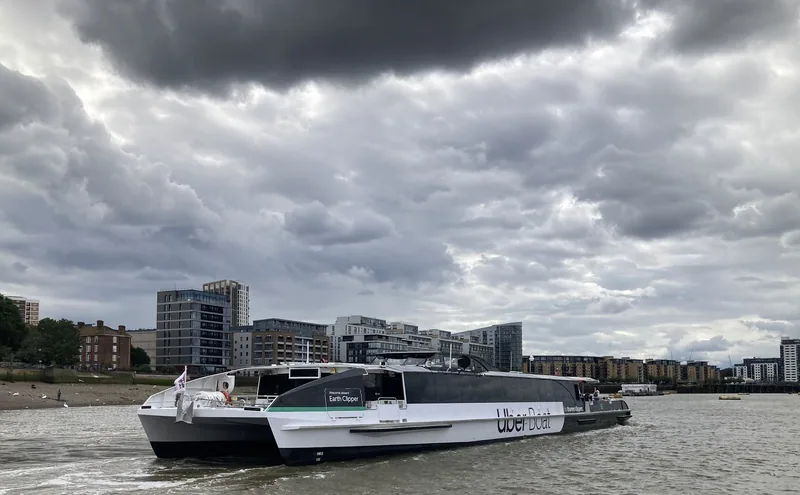
Photo: Stanley Hapgood · CC BY-SA 4.0 · Wikimedia Commons · resized
What each costs on the same stretch of water
Compare like with like, Westminster to Greenwich, one way, one adult:
| Ticket | Adult price (September 2026) | What it buys |
|---|---|---|
| River bus, contactless or Oyster, Central + East zones | £11.40 off-peak, £13.70 peak | One journey, no commentary, no stopping |
| River bus, paper ticket at the pier | Higher than the contactless fare | The same journey, at the worst rate |
| Sightseeing single to Greenwich | From about £11.30 booked online | Commentary, open top deck, roughly one hour |
| Hop-on hop-off river pass | Varies by season and operator; sold only in the booking system | Unlimited trips between four piers for 24 hours |
River bus fares in that table were published by the operator as valid until 31 October 2026, after which a new set is issued, so treat them as a guide rather than a promise. Sightseeing prices move with the season and with whatever online discount is running that week.
The important point is that a single trip costs about the same either way. The price gap only opens up when you start travelling more than once.
River fares sit outside the daily cap, both ways. Your contactless card will cap your Tube and bus spending for the day, but every river journey is charged on top and does not count towards that cap. A family who use the boat twice can add £40 to a day they thought was already capped.
Travelling more than once changes the answer
Two river bus singles cost you twice. A hop-on hop-off pass costs once and then stops charging. If your plan involves Westminster in the morning, Greenwich for lunch and Tower Pier in the afternoon, the pass is usually the cheaper object, and it is the only one of the two that lets you dawdle.
Against that, a pass ties you to four piers. The river bus serves 24, from Putney in the west to Barking Riverside in the east, which matters if you are staying somewhere like Canary Wharf or want to reach Battersea Power Station by water. No tour boat goes there.
If you already hold a paper or Oyster Travelcard, it gives one third off the river bus and off most sightseeing tours. Most visitors now use contactless instead, so this rarely applies, but it is worth checking against our page on Travelcards and railcard discounts before you write it off.
Commentary: live, recorded, or none at all
Sightseeing operators differ here more than they differ on route. City Cruises says its sightseeing boats carry free live or recorded commentary in English, plus an audio guide in eight languages including French, German, Spanish, Italian, Japanese, Mandarin and Russian. That is the one clear advantage for anyone whose English is functional rather than fluent.
Thames River Sightseeing runs a shorter and simpler service between Westminster, Butler's Wharf near Tower Bridge, and Greenwich, and gives the journey as about an hour.
On the river bus there is no commentary at all. You will hear the next pier announced and nothing else. If you want to know what you are looking at, load a map before you board, because phone signal drops in places along the river.
Frequency, first boats and the last one home
Sightseeing boats between the four central piers run every 30 minutes through the day, with the first leaving Westminster at 10:00 and, on the off-peak timetable, the last leaving for Greenwich at 19:20. There are three seasonal timetables, so the last departure in December is not the last departure in July.
The river bus starts much earlier and finishes later, and runs several times an hour on the busiest central stretch. It is the only one of the two that is useful before breakfast or after a show.
Whichever you pick, ask one question at the pier: when does the last boat come back? Greenwich is a long way from the centre by land if you misjudge it, though the DLR will rescue you.
Tides change the upriver timetable, not the central one. Boats between Westminster and Greenwich run to a fixed timetable. Boats heading west to Kew, Richmond and Hampton Court depend on the tide, so their departure time moves from day to day and there may be only one a day.
Piers matter more than operators
The view from the water is identical from every boat. What is not identical is where you get on and off.
Westminster Pier is the most convenient for first-time visitors, sitting beside Westminster Bridge and opposite the London Eye. Tower Pier puts you at the Tower of London. Greenwich Pier lands you beside the Cutty Sark, with the whole of Greenwich up the hill behind it.
Embankment, Blackfriars and Bankside are served by the river bus but not by the sightseeing passes, which is a good reason to prefer the bus if your hotel is near one of them.
On step-free access the river does well. All river bus boats take wheelchairs, and every pier is step-free apart from Cadogan, Wandsworth Riverside Quarter and London Bridge City. Our guide to step-free travel across London has the rest of the network.
A worked example: two adults and two children, aged 7 and 12
Say the plan is Westminster to Greenwich in the morning, an afternoon in Greenwich and a return by boat.
On the river bus, children aged four and under travel free (up to two per paying adult) and children aged 5 to 15 pay half the adult fare, but only if the child's card carries a Zip Oyster or the Young Visitor discount, which staff add at a Tube station. Without it, your 12-year-old is charged as an adult, twice, and the saving is gone. Our page on children's fares on London transport explains how to get the discount loaded before you reach the pier.
On a sightseeing boat, child pricing is built into the booking page and no card admin is needed. For a family making two river trips in a day, the hop-on hop-off pass is usually both cheaper and less trouble, and the commentary is worth more to a seven-year-old than a fast crossing is.
Four separate singles each way on the river bus, at Central and East zone prices, will come to roughly £45 to £55 for the family before any discount. That is real money next to a capped day on land, and it is the number to hold in your head when someone suggests the boat twice.
When the river bus is the better tour anyway
There is one case where the commuter boat beats the tour boat at the tour boat's own job. On a bright, cold weekday morning outside the rush, the front deck of an RB1 boat from Westminster is close to empty, the light on the water is good, and you will be at Greenwich in about 40 minutes with the whole day ahead of you. You get no commentary, but you get space, speed and a seat outside.
On a hot Saturday in August the same boat is packed, the outside deck is full, and the tour boat, with its bigger open top deck and its slower pace, is the more comfortable place to be.
Season and hour change this decision more than price does. If you are trying to keep the day cheap, our guide to London on a budget is blunt about which river trips are worth the money.
Two things the river does that no bus tour can
An open-top bus tour covers more famous buildings than a boat does, and our comparison of hop-on hop-off bus tours sets out how those work. But the river gives you two things the road cannot.
The first is the approach to Greenwich, where the Old Royal Naval College opens up from the water exactly as it was designed to. The second is passing under Tower Bridge, which is a different experience from standing on it.
If you are in London during September, the river also has its own month-long festival of races, walks and foreshore events, which we cover in our guide to Totally Thames.
Frequently asked questions
Is the river bus included in my daily travel cap?
No. Journeys on Uber Boat by Thames Clippers are not included in the daily or weekly contactless and Oyster caps, and they are not covered by a Travelcard either, although a Travelcard gives one third off. Budget for river travel as a separate cost on top of your capped Tube and bus spending.
Can I use Oyster or contactless on a sightseeing cruise?
No. Sightseeing operators sell their own tickets, online or at the pier, and do not accept pay as you go. Contactless and Oyster work on the river bus only, where you touch in and out at the pier readers and staff must see you touch in.
Which boat is best for photographs?
A sightseeing boat, because of the open upper deck and the slower speed. On the river bus the outside deck is small and often full, and the boat will not slow down for you. Whichever you take, go upstairs: the two banks of the Thames both have something worth seeing and the top deck lets you cross from side to side.
Do I need to book a sightseeing cruise in advance?
Not usually, but online prices are often lower than the price at the pier, and summer weekend sailings from Westminster do sell out. Booking also lets you check the last return departure, which changes with the season and catches people out at Greenwich.
Is the river worth it in winter?
Yes, with a warm coat. The boats run all year, the light between November and February is excellent from about 15:00, and the top decks are empty. The main loss is that you will want to sit inside for part of the trip, which costs you nothing on a river bus and some of the value of a sightseeing ticket.
Sources
- Transport for London - River Bus (checked September 2026)
- Transport for London - River fares (checked September 2026)
- Uber Boat by Thames Clippers - Ticket information (checked September 2026)
- City Cruises - 24h Hop-On Hop-Off River Pass (checked September 2026)
- City Cruises - Sightseeing cruise schedule (checked September 2026)
- Thames River Sightseeing - Westminster to Greenwich (checked September 2026)
- Transport for London - Caps and what is excluded (checked September 2026)