
London still has a handful of shopfronts from the late eighteenth and early nineteenth centuries, and the best of them stand within an hour's walk of each other, from St James's Street to New Oxford Street. What makes them rare is not the age of the firm but the survival of the timber front itself: the small panes, the slim pilasters, the panelled base and, in a few cases, the counters and shelves inside.
A shopfront is the ground-floor face of a shop: the window, the door and the frame around them. Most London shops have replaced theirs many times over, because a front is the cheapest part of a building to change and the first part a new tenant wants to make their own. The few that were never replaced are now protected by law, and reading them is a pleasure that costs nothing and needs no ticket.
This page is about the buildings, not about buying. For the shopping streets themselves, start with our shopping guide; for what to buy on Jermyn Street and Savile Row, see the tailoring and shirt-making streets. Every shopfront named below is checked against its Historic England list entry, with the entry number.
The shopfronts on this walk
- Berry Bros. & Rudd, 3 St James's Street
- Grade II*, list entry 1264868. Shopfront of about 1800, original shutters and shop fittings
- Lock & Co., 6 St James's Street
- Grade II*, list entry 1264869. Late-eighteenth-century front, interior largely intact
- Floris, 89 Jermyn Street
- Grade II, list entry 1275733. Early-nineteenth-century front, fittings from the 1851 Great Exhibition
- Paxton & Whitfield, 93 Jermyn Street
- Grade II, list entry 1216774. Mid-nineteenth-century front
- 34 Haymarket
- Grade II*, list entry 1357092. Late-eighteenth-century double bow front
- Twinings, 216 Strand
- Grade II, list entry 1236754. Early-nineteenth-century doorway
- The Old Curiosity Shop, 13-14 Portsmouth Street
- Grade II*, list entry 1227133. Seventeenth-century timber-framed house
- James Smith & Sons, 53 New Oxford Street
- Grade II*, list entry 1113171. Victorian front of about the 1870s
- Walking time
- About 65 minutes on foot from the first to the last, by the TfL journey planner, before any stops (checked November 2026)
- Cost
- Free. All are seen from the pavement
How to read a Georgian shopfront in five parts
A shopfront of around 1800 is a small classical temple laid flat against the house. Know its five parts and you can date a front from across the street.
- Pilasters. Flat columns at each side that frame the whole front and appear to hold up the beam above. On a good front they are slim and fluted or panelled.
- Fascia. The horizontal board above the window where the name is painted. On an early front it is shallow, often no deeper than a hand's width, and sits under a projecting cornice. A deep, boxy fascia is nearly always modern.
- Console brackets. The scrolled blocks at each end of the fascia, sitting on top of the pilasters. They arrived later and are typical of Victorian fronts more than Georgian ones.
- Glazing bars and small panes. Before the 1840s glass came in small sheets, so the window was divided by thin wooden bars into many panes. Thick bars and small panes are the surest single sign of an early front.
- Stallriser. The solid base under the window, usually panelled timber, that keeps the glass off the pavement and away from kicked mud. The listing descriptions call these "risers" or "stallboards".
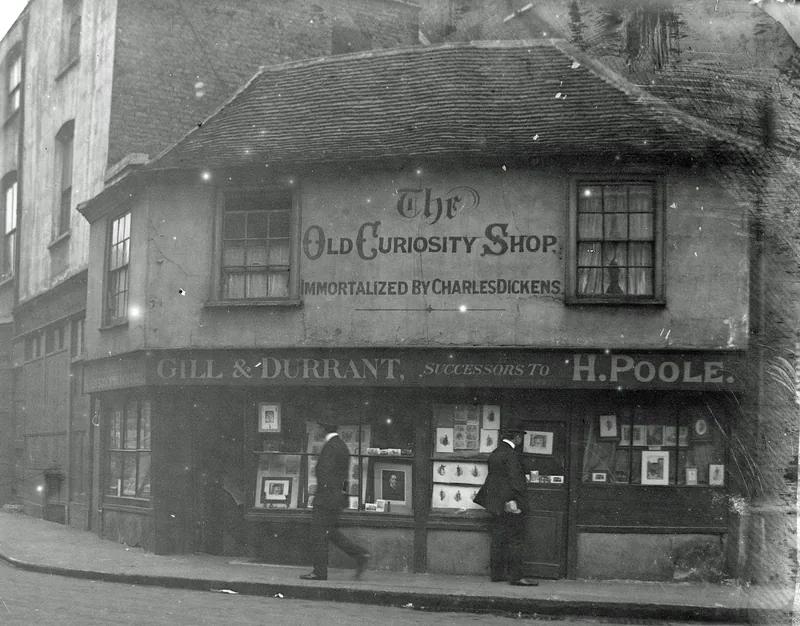
Photo: Peter Elfelt · CC BY-SA 4.0 · Wikimedia Commons · resized
Why so few early shopfronts are left
The first reason is glass. The excise duty on glass was abolished in 1845, and within a generation shopkeepers could buy large sheets of plate glass. A window of a dozen small panes suddenly looked old-fashioned, and owners tore out their glazing bars to fit one big pane. Many Georgian fronts that survive did so because the business inside was conservative or proud of its age.
The second is rebuilding. Regent Street was almost entirely reconstructed in the early twentieth century, and wartime bombing removed much of the City. Each new building came with a new front.
The third is ordinary trade: a new tenant wants a brand front. That is why the survivors cluster in St James's, where wine merchants and hatters stayed in the same building for centuries.
A deep fascia with a plastic sign means the front is not original, whatever the date on it. Many shops paint "established 1820" above a front put in last decade. The date belongs to the firm. Look at the glazing bars, the depth of the fascia and the pilasters instead; they cannot be faked as easily as a date.
What listing protects, and why the counters are covered too
England's listed buildings are compiled under the Planning (Listed Buildings and Conservation Areas) Act 1990. Section 1(5) of the Act says that any object or structure fixed to a listed building is treated as part of the building. In practice that means a fitted counter, a run of built-in shelving or a carved screen is protected along with the walls, unless the list entry expressly leaves it out.
Section 7 of the Act forbids any work to demolish, alter or extend a listed building in a way that affects its special character unless it has listed building consent, which in London comes from the borough council. Section 9 makes unauthorised work a criminal offence, with a possible prison sentence. That is why a new tenant of a listed shop cannot simply rip out the front and why some brand-new businesses trade behind a two-hundred-year-old window.
St James's Street: a wine merchant and a hatter side by side
Start at the bottom of St James's Street, opposite the gatehouse of St James's Palace, on the east side. Our overview of Mayfair and St James's introduces the area; here the interest is in two fronts a few doors apart.
Berry Bros. & Rudd at No. 3 occupies a pair of houses of about 1731-32, made into one shop around 1800. The list entry records a timber shopfront of that date with arcaded windows and doorway, panelled risers, glazing bars and original shutters, and says the interior of the shop retains its original shelving and fittings. To the left of the front is a narrow timber-framed passage that leads to Pickering Place, a tiny court behind. The wine merchant is on the food register as Berry Bros & Rudd Limited, SW1A 1EG, rated 5 at its inspection in March 2025.
Lock & Co. at No. 6 is listed separately as "Lock's of St James's". The house is late seventeenth century, refronted in the mid-eighteenth, and the shopfront is late eighteenth: two entrances under one entablature, a reeded frame round the shop door, and windows that keep their original thick glazing bars and project slightly from the wall with a single pane on each return. Historic England's own description calls the original shop interior largely intact and the firm the oldest hatters in London, a supplier to Lord Nelson among others.
Jermyn Street: two fronts from two centuries
Walk up St James's Street and turn right into Jermyn Street, about six minutes. Two neighbours on the south side show how fronts changed between the Regency and the 1850s.
Floris at No. 89 is a house of about 1675 rebuilt in the early nineteenth century. Its listed front has an eight-pane window with thick glazing bars and a recessed, panelled and glazed door, under a fascia with a bracketed cornice topped by a coat of arms. The list entry adds a detail almost nobody mentions: the interior fittings and shelving were reset here from the Great Exhibition of 1851. If the arms over the door catch your eye, our page on what a Royal Warrant means explains them.
Paxton & Whitfield at No. 93 is in a house of the same date, about 1675, with a shopfront of the mid-nineteenth century: thin mullions to the window, panelled risers, pilasters and a moulded cornice over the fascia. Next to Floris, the bars are thinner and the panes larger. The cheesemonger is rated 5 on the food register, Paxton & Whitfield, SW1Y 6JE, from an inspection in October 2025.
34 Haymarket: the double bow front
Continue east along Jermyn Street to its end and turn left up Haymarket, about seven minutes. On the east side, No. 34 has what may be the finest Georgian shop window in London, though few people walking to the theatres give it a second look.
The house dates from about 1741, and the shopfront and interior from the late eighteenth century. The list entry describes a double front with the shop door in the centre and the house door to the right, both panelled with patterned fanlights, and display windows that bow out prominently on either side of the shop door, with their original glazing bars and small panes, under a fascia entablature. Inside, it records late-eighteenth-century fittings, including the counter and shelving, and an Adam-style wooden screen at the back.
The building was for generations the shop of the tobacconists Fribourg & Treyer, whose name you may see in older guidebooks. That firm no longer trades here, so look at the front and not for the name. It is a good example of listing protecting a building after its business has gone.
The Haymarket bow windows are best seen from across the road. The pavement on the east side is narrow and busy with theatre queues in the evening. Cross to the west side and look back: the two curved windows only read properly as a pair from a few metres away.
Strand and Portsmouth Street: a doorway and a timber house
From Haymarket the route runs past Trafalgar Square and east along the Strand, the longest leg at about twenty-five minutes. At 216 Strand is the narrow stuccoed doorway of Twinings, an early-nineteenth-century front with Grecian columns, a lion and two seated Chinese figures above. Our guide to tea and coffee to take home covers the shop, the firm and the listing in detail, so this walk only pauses to look up.
Cross the Strand and walk up through the streets behind the Royal Courts of Justice towards Lincoln's Inn Fields, about eleven minutes. On the corner of Portsmouth Street stands the Old Curiosity Shop, a two-storey house of the seventeenth century, timber-framed and plastered under a tiled roof, with its upper floor overhanging the street. Historic England says the shop windows appear, at least in part, to date from the seventeenth or early eighteenth century, with early-nineteenth-century glazing.
The list entry says the building is "said to be" the original of Dickens's Old Curiosity Shop, and lists it at Grade II* on account of those literary associations. Treat the Dickens link as a tradition, not a fact. If you have time, Sir John Soane's Museum is on the far side of the same square.
New Oxford Street: the Victorian answer
The last stop, about fourteen minutes north-west through Holborn, is a deliberate contrast. James Smith & Sons at 53 New Oxford Street is listed at Grade II* as James Smith and Sons, Hazelwood House, and shows what replaced the Georgian front once plate glass arrived.
The building went up in the mid-nineteenth century as part of the laying out of New Oxford Street. The shopfront, of about the 1870s, is mahogany with plate-glass windows and painted glass panels lettered with the firm's goods, a fascia of painted glass reading "Established 1830", and a cast-iron cresting above. The entrance is recessed between engraved glass panels and closed at night by wrought-iron gates. Inside, the list records showcases and counters of a typical high-class late Victorian or Edwardian shop, which it calls a rare survival in London.
The firm has occupied the ground floor since 1867, according to the list entry, and still sells umbrellas and walking sticks. From here the British Museum is five minutes north.
Walking the route, and when to go
The TfL journey planner puts the walking between the stops at about 65 minutes (checked November 2026). With time to look, allow an hour and a half. The route works in either direction; starting at the New Oxford Street end puts you near Tottenham Court Road station, and ending in St James's leaves you by Green Park. Our page on walking in London has the general advice on pavements and crossings.
| Leg | Walking time |
|---|---|
| 3 St James's Street to 93 Jermyn Street | About 6 minutes |
| Jermyn Street to 34 Haymarket | About 7 minutes |
| 34 Haymarket to 216 Strand | About 26 minutes |
| 216 Strand to Portsmouth Street | About 11 minutes |
| Portsmouth Street to 53 New Oxford Street | About 14 minutes |
Go on a weekday in daylight, when the shops are open and lit; many of the traditional shops in St James's close or open only briefly on a Sunday.
You can walk into most of these shops without buying anything. A listed interior is half the point, and staff in shops of this kind are used to people who come in to look at the counters and shelving. Keep bags close, do not photograph customers, and ask before taking pictures inside.
If the walk leaves you wanting more of the same, the Victorian shopfronts of Cecil Court and the book streets are a short detour north of Trafalgar Square, and our list of souvenirs worth buying includes several things these old firms still make.
Frequently asked questions
What is the oldest shop in London?
There is no single official answer, because "oldest" can mean the oldest firm, the oldest building or the oldest surviving shopfront. Historic England's list describes Lock & Co. on St James's Street as the oldest hatters in London, and the Old Curiosity Shop on Portsmouth Street as a seventeenth-century building, but neither claim is a ranking of all shops.
Is the Old Curiosity Shop in London the one Dickens wrote about?
It is said to be. Historic England's list entry uses those words and lists the building at Grade II* on account of its literary associations. The building itself is a genuine seventeenth-century timber-framed house, which is rare in central London whatever the truth of the Dickens story.
Can a listed shop change its shopfront?
Only with listed building consent from the local council. The Planning (Listed Buildings and Conservation Areas) Act 1990 makes it an offence to alter a listed building in a way that affects its special character without that consent, and fixtures such as counters and shelving count as part of the building.
Sources
- Historic England - 3, St James's Street SW1, list entry 1264868 (checked November 2026)
- Historic England - Lock's of St James's, list entry 1264869 (checked November 2026)
- Historic England - 34, Haymarket SW1, list entry 1357092 (checked November 2026)
- Historic England - 89, Jermyn Street SW1, list entry 1275733; also 93 Jermyn Street, 1216774 (checked November 2026)
- Historic England - The Old Curiosity Shop, list entry 1227133 (checked November 2026)
- Historic England - James Smith and Sons, Hazelwood House, list entry 1113171 (checked November 2026)
- legislation.gov.uk - Planning (Listed Buildings and Conservation Areas) Act 1990, sections 1, 7 and 9 (checked November 2026)
- Food Standards Agency - hygiene ratings for Berry Bros & Rudd Limited, SW1A 1EG, and Paxton & Whitfield, SW1Y 6JE (checked November 2026)