
Borough Market is five minutes from the station, does not trade at all on a Monday, and at 13:00 on a Saturday is close to unusable. The three walks that fix it are twelve minutes south to Bermondsey Street, fifteen minutes east to the Maltby Street arches at the weekend, and three minutes to a seventeenth-century coaching inn on Borough High Street.
London Bridge is an unusual place to be hungry. It has one of the most famous food markets in Europe on its doorstep, a station that rebuilt itself around a shopping concourse, the tallest building in the country overhead, and a long run of railway arches behind it that have quietly filled with bars and bakeries.
That sounds like an easy question with an obvious answer, and the obvious answer is often wrong. We have a separate page on this part of Southwark, and another on the market in detail. This page is about which direction to walk in, and when.
The short version
- Monday
- The market is closed. Go to Borough High Street, Bermondsey Street or the station concourse instead
- Weekday morning
- Borough Market at its best: room to move and traders who will talk to you
- Saturday lunchtime
- The worst hour of the week. Eat before 11:00 or walk south
- Friday evening and weekends
- Maltby Street and the Ropewalk arches, 15 minutes east
- Any evening
- Bermondsey Street, 12 minutes south, where the restaurants take bookings
What is wrong with Borough Market as a lunch plan
Nothing is wrong with the market. What is wrong is treating it as a restaurant. It is a wholesale and retail food market with hot-food stalls attached, and that has three consequences that visitors discover too late.
First, it keeps market days, not restaurant days, and Monday is not one of them. Thousands of people arrive on a Monday, find the gates shut and a few edge cafes open, and eat badly.
Second, there is almost nowhere to sit. Most of what you buy is eaten standing in a passage, holding a cardboard tray, while other people try to get past you with shopping.
Third, the prices are not market prices. A hot sandwich or a plate from a stall is commonly £10–£14 in September 2026, which is restaurant money for street-food seating. The cheese and bread are worth it; a burger is not.
Saturday between 12:30 and 15:00 is the single worst time to try to eat here. The passages are narrow, the queues for the best-known stalls run to twenty or thirty minutes, and anyone with a pushchair or a wheelchair will struggle. If Saturday is your only day, arrive when it opens at 09:00 and be finished by 11:30.
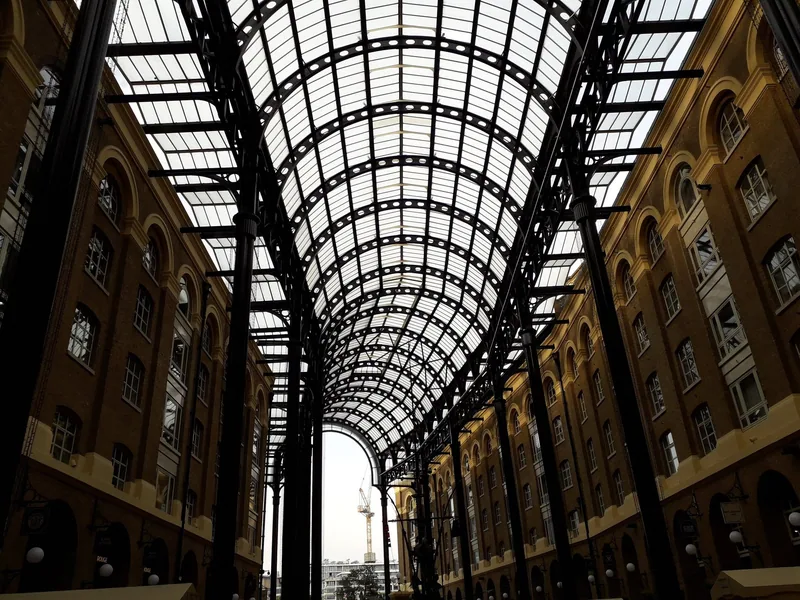
Photo: Caroline McHardy · CC BY-SA 4.0 · Wikimedia Commons · resized
Making the market work: a weekday morning
Come between Tuesday and Friday, before noon, and it becomes the place people describe. You can reach the counters, the traders have time, and the covered sections are genuinely pleasant in bad weather. The current hours are published on the market's own visitor page; they change at Christmas and on bank holidays, so check before you travel.
Two things are worth building a morning around. Kappacasein, on Stoney Street, makes a raclette and a grilled cheese sandwich from Montgomery cheddar that is the best-known thing in the market and costs about £9. Bread Ahead, near Cathedral Street, sells doughnuts filled to order and runs baking classes on site. Neal's Yard Dairy on Park Street is a working cheesemonger where you can taste before you buy, and Monmouth Coffee's Park Street shop is the original branch of the roastery, which our coffee guide explains the significance of.
Buy from the stalls, then walk 200 metres and sit down for free. The churchyard beside Southwark Cathedral and the benches along the river past Tower Bridge are both a couple of minutes away and almost always have space. Doing this turns an awkward standing lunch into a decent one and costs nothing.
Sitting down at the market's edge
Several proper restaurants sit around the market rather than in it, and they take bookings, which the stalls do not.
Padella, at 6 Southwark Street, is a small pasta bar that has become the area's best-known queue. The menu is short and the prices are low for central London: in September 2026 tagliarini with chilli, garlic and pangrattato is £9.50, cacio e pepe £13.50, and pappardelle with eight-hour beef shin ragu £16.50. Expect to wait at peak times, and see our list of restaurants that do not take reservations for how these queues work.
Tapas Brindisa has been beside the market since the early 2000s and is the reliable middle option, with small plates that add up to roughly £25–£35 a head. Elliot's on Stoney Street cooks from market produce at a similar level. Roast, upstairs in the Floral Hall above the market, is the expensive one, built around British meat and game, with mains in the high twenties and a view down into the trading floor.
For fish specifically, the market's fishmongers and the oyster counters around it are better value than most restaurant seafood in central London; our guide to oysters and seafood explains what is in season.
Three minutes: the George Inn on Borough High Street
Turn away from the river and, through an archway off Borough High Street, you find the George Inn: the last galleried coaching inn left in London, rebuilt in 1677 after a fire and now owned by the National Trust. This is a pub that still trades rather than a preserved exhibit, with a cobbled yard that fills with drinkers on a warm evening and low-ceilinged bars inside.
Food is standard pub cooking at roughly £15–£19 for a main, and that is not really why you go. It is the only building of its kind in the city and it is ninety seconds from the station. Our guide to historic pubs explains which other interiors are legally protected.
Borough High Street around it has a run of chains, sandwich shops and a couple of larger pubs, which is the practical answer on a Monday when the market is shut.
Twelve minutes south: Bermondsey Street
This is the walk that fixes London Bridge for dinner. Leave the station by the Tooley Street side, go under the railway, and follow Bermondsey Street south. It takes about twelve minutes and the character changes completely: a narrow street of small restaurants, coffee shops, wine bars and galleries with almost no chains.
Two Spanish places sit at either end, both from the same chef: a standing tapas bar at number 104 where you cannot book and plates are £7–£14, and a larger sit-down restaurant further south with mains around £22–£28. Casse Croute at 109 is a tiny French bistro with a blackboard menu of three starters, three mains and three puddings that changes daily; expect £22–£26 for a main and book, because it seats very few people. There is also a branch of a well-known Italian group at 184 and a coffee shop at 199 that is one of a small local chain.
The street is busy on Friday and Saturday evenings and calm on a weekday lunchtime. It is the answer if you want to sit at a table, hear the person opposite you, and not queue.
Fifteen minutes east, at the weekend only: Maltby Street
The Ropewalk, a line of railway arches off Maltby Street, holds a small food market that only exists at the end of the week. It runs on Friday evening, Saturday and Sunday, and the exact hours are listed in our comparison of London's food markets. Outside those times the alley is shut and you will have walked for nothing.
Compared with Borough it is tiny, and far more relaxed. There is a Spanish ham and sherry bar in one arch, a bakery in another, gin and beer producers with weekend taprooms, and a handful of hot-food traders. Prices are similar to Borough for food and rather better for drink.
The same stretch of arches is the start of the Bermondsey Beer Mile, a run of brewery taprooms that open on Saturdays. If beer rather than lunch is the point, our guide to London's breweries covers how the taproom system works.
Twenty minutes west: The Cut and the theatre crowd
The third direction is less obvious and useful in the evening. Walk west past the South Bank towards Waterloo and you reach The Cut, the street between the Old Vic and the Young Vic. The Anchor & Hope at number 36 has been one of London's best-known pub dining rooms since the early 2000s, with a daily-changing menu, no bookings for most tables and mains around £20–£26. Meson Don Felipe at number 53 is an old-fashioned Spanish tapas bar with a guitarist, which has survived on that street for decades.
Both fill before curtain-up at the two theatres and empty again by 20:00, so 20:15 is a good time to arrive. If you are coming from Shakespeare's Globe instead, it is a similar walk along the river.
Pie and mash, sixteen minutes south-east
On Tower Bridge Road, past Bermondsey Street, is one of the last traditional pie and mash shops in London: tiled walls, marble tables, a pie with mashed potato and parsley liquor for well under £10, and jellied eels for anyone brave enough. It has been trading on that corner since the early twentieth century.
This is a piece of working-class London food history rather than a meal you will rave about, and our guide to pie, mash and jellied eels explains what to order and what liquor actually is. Opening hours are short and lunchtime-only, so check before walking.
What each direction costs
| Where | Walk from the station | When it works | Typical spend per adult |
|---|---|---|---|
| Station concourse | 0 minutes | Any day, including Monday | £8–£14 |
| Borough Market stalls | 5 minutes | Tuesday to Sunday, best before noon | £10–£16 |
| Restaurants around the market | 5 minutes | Lunch and dinner, Tuesday to Saturday | £18–£40 |
| Borough High Street pubs | 3 minutes | Any day | £15–£22 |
| Bermondsey Street | 12 minutes | Any day; book at weekends | £20–£35 |
| Maltby Street arches | 15 minutes | Friday evening, Saturday, Sunday only | £12–£25 |
| The Cut, towards Waterloo | 20 minutes | Evenings, especially after 20:00 | £20–£30 |
| Pie and mash, Tower Bridge Road | 16 minutes | Weekday lunchtimes | Under £10 |
Each band is our September 2026 estimate for one adult including a drink where that applies, not a quoted menu price. Everything except the verified Padella prices above should be treated as a guide and checked.
Every stall in the market has a published hygiene score, not just the restaurants. Southwark Council inspects the market traders individually and the Food Standards Agency publishes each result with its date at ratings.food.gov.uk. It is a useful thirty seconds before you commit to a queue.
Frequently asked questions
What should we do at London Bridge on a Monday?
No. The market does not trade on Mondays, although a few permanent shops and cafes around its edges open. If you are at London Bridge on a Monday, eat on Borough High Street or walk twelve minutes to Bermondsey Street instead, and come back to the market later in the week.
Where can I sit down to eat near Borough Market?
The market itself has very little seating. The restaurants at its edge take bookings, and the churchyard by Southwark Cathedral has free benches two minutes away. For a guaranteed table with a booking, Bermondsey Street is the reliable answer.
How expensive is Borough Market?
More than most visitors expect. Hot food from a stall is commonly £10 to £14, which is restaurant money without a chair. The produce stalls, cheesemongers and bakeries are better value, particularly if you are assembling a picnic rather than buying a cooked plate.
What is open near London Bridge in the evening?
The market's hot-food traders finish in the late afternoon, but the surrounding restaurants, the Borough High Street pubs and the whole of Bermondsey Street serve into the evening. Last food orders are typically between 21:00 and 22:00, earlier on a Sunday, so do not leave it until after a late attraction visit.
Can we eat near London Bridge before going up the Shard?
Yes, and it is worth doing rather than eating in the building, where you are paying for the height. Book something on Bermondsey Street or around the market, allow a full hour, and go up afterwards. Our page on visiting the Shard covers the timed entry system.
Is there anywhere quiet to eat near the station with children?
Bermondsey Street on a weekday, or the pubs on Borough High Street, which have space and high chairs. Avoid the market passages at the weekend entirely with a pushchair. The Old Operating Theatre across the road is a good short stop to pair with lunch for older children.
Sources
- Borough Market - Visit us, opening times (checked September 2026)
- National Trust - The George Inn, Southwark (checked September 2026)
- Food Standards Agency - Food hygiene ratings (checked September 2026)
- Network Rail - London Bridge station (checked September 2026)