
H. G. Wells was born on Bromley High Street in 1866 and the house is gone. David Bowie grew up here, went to school here and started his arts lab in a back room of a Beckenham pub in 1969, and that pub is a chain restaurant now. What survives is better than either: a listed Victorian bandstand Bowie actually played on, a Georgian mansion in a park with a swimming lake, and eighteen minutes from Victoria.
Bromley is the biggest town centre in south-east London, with a shopping street, two railway stations and the Glades centre. Beckenham, two miles north-west, is quieter, greener and has the pubs. Together they are a comfortable, expensive outer-London borough with three genuinely good things in it and a great deal of ordinary suburb around them.
We measured the trains. Bromley South to Victoria is eighteen minutes off-peak and eighteen to twenty-three in the morning peak. Beckenham Junction to Victoria is twenty-four minutes. Bromley North, the other station, is a two-stop branch line and takes twenty-seven minutes to London Bridge via a change at Grove Park.
Bromley and Beckenham at a glance
- Where
- BR1, BR2 and BR3, the London Borough of Bromley, south-east London
- Stations
- Bromley South (Zone 5), Bromley North (Zone 4), Beckenham Junction (Zone 4, also a tram terminus), Beckenham Hill, Ravensbourne, Shortlands
- Measured journey times
- Bromley South to Victoria 18 minutes; Beckenham Junction to Victoria 24; Bromley North to London Bridge 27 with a change at Grove Park
- Fares
- Bromley South to Zone 1 £4.40 off-peak / £6.60 peak; Beckenham Junction £4.00 / £5.30
- Free
- The Bowie Bandstand, Beckenham Place Park, Church House Gardens, the Wells mural in Market Square
- Not free
- Swimming in Beckenham Place Park's lake, which is booked and charged
The Bowie Bandstand, and why it is listed
In Croydon Road Recreation Ground in Beckenham stands a cast-iron Edwardian bandstand that is one of the more unusual grade II listings in London. Historic England listed it on 8 August 2019, on the fiftieth anniversary of the concert that made it famous, and the list entry gives two separate reasons.
The first is architectural. It was erected in 1905 by the McCallum and Hope Iron Foundry of the Ruchill Iron Works in Glasgow, and it is the only bandstand by that foundry known to survive in Britain. The paperwork behind it is unusually complete: Beckenham Urban District Council looked at 25 designs from 16 contractors in January 1905, and in May awarded the contract for two bandstands at £135 each, on condition the work was finished within ten weeks. The second bandstand went up in Alexandra Park in Penge and no longer exists.
The second reason is David Bowie. Historic England's own words: he "played, compered and co-organised the Growth Summer Festival at the bandstand during his rise to fame in 1969; arguably the first festival in England of its kind, and immortalised by his song 'Memory of a Free Festival'". Bromley Council's local history timeline dates his founding of the Beckenham Arts Lab, in a back room at the Three Tuns on Beckenham High Street, to the same year.
The bandstand was in poor condition for decades. Restoration by the specialists AF Starr ran from July 2023 to March 2024, with Purcell as conservation consultants and a paint historian commissioned to identify the original colours; it is now painted in the dark brown and buff they found, with a path of personalised bricks around it, and it was formally reopened on 17 May 2024. It is in a public park, it is free, and there is nothing to stop you standing on it.
The bandstand is a fifteen-minute walk from Beckenham Junction and costs nothing. Croydon Road Recreation Ground was bought by the Beckenham Local Board, laid out in 1890 and opened in September 1891, and it is an ordinary municipal park with tennis courts and a playground. There is no interpretation centre, no shop and no ticket. Bring the song.
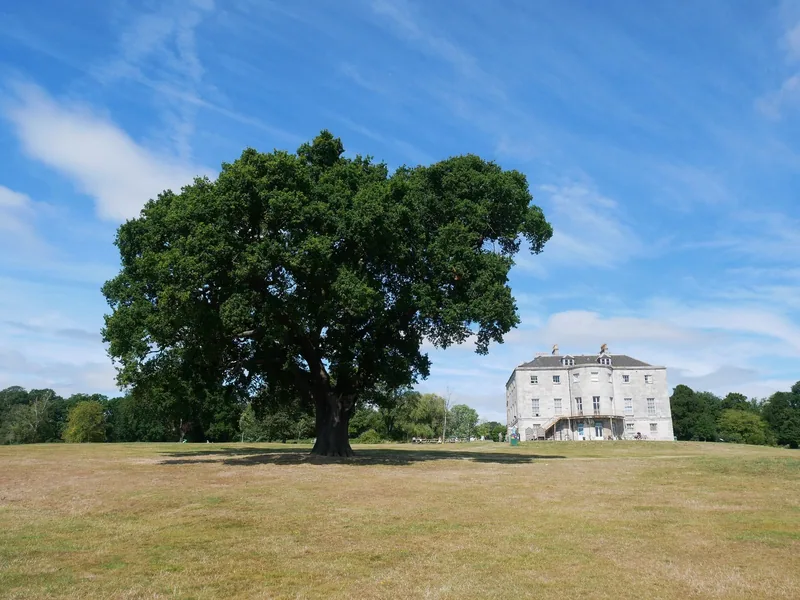
Photo: Doyle of London · CC BY-SA 4.0 · Wikimedia Commons · resized
H. G. Wells's birthplace, which is a Primark
Herbert George Wells was born on 21 September 1866 above his parents' failing china shop, Atlas House, on Bromley High Street. The shop was named after a figure of Atlas holding a lamp in the window.
Be careful with the address, because the sources disagree. Bromley Council's own local history timeline gives it as 47 (now 172) High Street, and adds that Primark is on the site; other accounts say number 46. The house itself was demolished, the Art Deco building that replaced it is the shop, and the commemorative plaque has been moved onto the adjoining Victoria Chambers. There is nothing to see except a plaque on a shopfront, and it takes one minute.
The better Wells monument is a mural painted in Market Square in 1986, and the better resource is Bromley Central Library, which holds the borough's H. G. Wells collection. If you have come for Wells specifically, the library is the visit and the plaque is the photograph.
Bowie's Bromley, honestly
Bowie moved to Bromley as a child and joined Bromley Technical High School in Keston in 1958 — the school is now Ravens Wood, and it is a working school, not a site to visit. The family house was on Plaistow Grove near Sundridge Park, and it is a private home on a residential street; please do not knock.
The Three Tuns, where the Arts Lab met, is still a building on Beckenham High Street but has been an Italian chain restaurant for years. There is a plaque. Put together, the Bowie trail in this borough is one listed bandstand you can stand on, one plaque on a restaurant, one plaque on a house you should look at from the far pavement, and a school you cannot enter. The bandstand is worth the journey and the rest is not.
Beckenham Place Park and the mansion in it
The largest green space in the borough is Beckenham Place Park, and it is free, open and genuinely good: 240 acres of woodland, meadow and old golf course, with a swimming lake created in 2019. The lake is the draw and it is the one thing here that has to be booked and paid for; our guide to Beckenham Place Park and its swimming lake has the swimming prices, the season and the booking rules.
The building at the top of the hill is worth knowing about. Beckenham Place Mansion is listed grade II* and Historic England dates it to about 1773, built for John Cator, noting that it resembles Danson Park in Bexley — designed by Sir Robert Taylor in 1765 — and may be by the same architect. The detail that makes it: the great portico on the north-west front, with four giant composite columns and the Cator arms and the motto Nihil sine labore, is said to have been added in 1787 and brought here from Wricklemarsh House in Blackheath, a demolished mansion four miles away. There is a café in the mansion, which held a hygiene rating of 4 at an inspection in July 2025.
Beckenham Hill and Ravensbourne stations both sit at the park's edge, and the southern end of the chain of south London estate parks runs from here westwards.
Bromley High Street, the Glades and the listed bits
Bromley's shopping street is long, busy and mostly chain stores, and the Glades centre opened in 1991. Three buildings on it are listed and one is a pub you can drink in. The Royal Bell at 171-177 High Street is listed grade II; Historic England names the architect as Ernest Newton and records that the range was rebuilt in 1898 on the site of an earlier inn of 1666, in red brick with nine pedimented dormers and Neo-Jacobean pargetting on the bay windows. It held a hygiene rating of 5 at an inspection in February 2026.
The parish church of St Peter and St Paul, grade II*, was largely rebuilt after bombing but keeps its medieval tower. Bromley North station, grade II and listed in 1990, is a small Edwardian terminus that feels like a country branch line an hour from the coast, and is in fact fifteen miles from Charing Cross. There is also a grade II K2 telephone kiosk at the junction with College Slip, which is a rarer object than the phone box you are picturing.
Bromley South and Bromley North are not the same station and not a short walk apart. Bromley South is the fast one, in Zone 5, eighteen minutes from Victoria. Bromley North is in Zone 4 but sits on a two-station branch and needs a change at Grove Park for anywhere useful — twenty-seven minutes to London Bridge. They are about fifteen minutes apart on foot through the town centre. Check which one your train actually serves.
Where else to go from here
The borough is large and the good things in it are scattered. The Museum of the Mind at Bethlem Royal Hospital, on the Beckenham side, is free and is one of the most unusual small museums in London. Down House, where Darwin wrote On the Origin of Species, is in this borough too, out at Downe, and needs a bus from Bromley or Orpington.
Northwards, the Crystal Palace dinosaurs are twenty minutes away and are the best free thing for children within reach. Beckenham Junction is also a terminus of the Croydon tram network, which is the easy way to Croydon and the only tram in London.
Our guides to Crystal Palace and Forest Hill and to London's suburban shopping centres cover the neighbours.
The borough boundary confuses people: Penge, Crystal Palace's eastern half, Chislehurst, Orpington, Biggin Hill and Downe are all in Bromley, which was formed in 1965 out of two boroughs and two urban districts. Our page on London postcodes explains why a BR postcode does not mean the place is far out.
Frequently asked questions
How long does it take to get to Bromley from central London?
Eighteen minutes from Victoria to Bromley South on a Southeastern train, and eighteen to twenty-three in the morning peak, when we measured it in September 2026. Bromley South is in fare Zone 5, so a journey to Zone 1 costs £4.40 off-peak and £6.60 peak on contactless. Bromley North is slower despite being in Zone 4.
Can you visit the bandstand where David Bowie played?
Yes, free and at any time. It is in Croydon Road Recreation Ground in Beckenham, about fifteen minutes' walk from Beckenham Junction station. It was restored between July 2023 and March 2024 and formally reopened on 17 May 2024, and it is listed grade II both as the only surviving bandstand by its Glasgow foundry and for the 1969 festival Bowie organised there.
Is there anything left of H. G. Wells's birthplace in Bromley?
No. The house on Bromley High Street was demolished; Bromley Council's own history gives the address as 47, now 172, High Street, and says Primark stands on the site. A plaque has been moved to the adjoining building. There is also a mural to Wells in Market Square, painted in 1986, and a collection of his material at Bromley Central Library.
Is Beckenham Place Park worth a trip?
If you want a large free park with woodland, a grade II* Georgian mansion, a café and a swimming lake, yes — it is the best single reason to come to this borough after the bandstand. Beckenham Hill and Ravensbourne stations are both at the edge of it. Swimming in the lake is charged and booked separately; the park itself is free.
Are Bromley and Beckenham good places to stay in London?
They are cheaper than central London and well connected to Victoria, and Bromley has a proper town centre with restaurants that stay open. Against that: you are in Zone 4 or 5, the last trains matter, and there is nothing to walk to in the evening beyond the high street. For most visitors, somewhere inside Zone 2 is worth the extra.
Sources
- Historic England - National Heritage List for England open data and list entries (Bowie Bandstand 1465007; Beckenham Place Mansion 1359317; Royal Bell 1054095; Bromley North station 1186833; Church of St Peter and St Paul 1084373; The George Inn, Beckenham 1359323) (checked September 2026)
- London Borough of Bromley - Croydon Road Recreation Ground bandstand restoration, contractors and reopening date (checked September 2026)
- London Borough of Bromley - local history timeline 1860-2000, for the Wells birthplace address, the Arts Lab and the Glades (checked September 2026)
- Transport for London Journey Planner - measured Bromley and Beckenham journey times (checked September 2026)
- Transport for London - Single Fare Finder, for the Bromley and Beckenham fares and zones (checked September 2026)
- Food Standards Agency - food hygiene rating search (The Royal Bell, Bromley BR1 1NN, rated 5 in February 2026; Beckenham Place Cafe, BR3 5BP, rated 4 in July 2025) (checked September 2026)