
Mitcham Cricket Green is a triangle of grass with a pavilion of 1904 on it, a grade II* manor house behind it and a claim to be the oldest cricket ground still in use in the world. Morden, a mile west, is the end of the Northern line and the gate to a National Trust park with a river running through it. Both are free, both are twenty-five minutes from the centre, and almost nothing has been written about either.
This is the London Borough of Merton, south-west London, Surrey until 1965. The through-line is the River Wandle, which rises at Carshalton and Croydon and runs north to the Thames at Wandsworth, and which powered the snuff, calico and printing mills that made these places industrial long before they were suburban.
Be clear-eyed about it. There is no gallery, no view, no high street worth a detour and no restaurant we would send you across London for. What there is: a green with three centuries of cricket on it, a free National Trust park, one of the largest mosques in western Europe, and a listed station building that may or may not have been built for the world's first public railway.
Mitcham and Morden at a glance
- Where
- CR4 (Mitcham) and SM4 (Morden), London Borough of Merton
- Stations
- Morden (Northern line terminus, Zone 4); Mitcham Eastfields (Zone 3, Thameslink); Mitcham Junction (rail and tram); Mitcham and Belgrave Walk tram stops; Morden South and Morden Road
- Measured journey times
- Morden to Bank 28 minutes off-peak, 31-32 peak; Morden to Leicester Square 29; Mitcham Eastfields to Blackfriars 26 at any hour; Mitcham Junction to Victoria 24
- Fares
- Morden to Zone 1 £3.60 off-peak / £4.80 peak; Mitcham Eastfields £3.70 / £4.60; Mitcham Junction £4.00 / £5.30
- Free
- Morden Hall Park, Mitcham Cricket Green, the Wandle Trail
- Best day
- A Saturday in the cricket season: the green is in use and Merton Abbey Mills is trading
Mitcham Cricket Green, and how old the claim really is
The green is a large open triangle between London Road and Cricket Green, with a pavilion, a church, almshouses and an obelisk round its edges. Mitcham Cricket Club plays here and claims 1685 as the date cricket started on this ground, which would make it the oldest cricket ground in continuous use anywhere.
Handle that date carefully. The Merton Historical Society, which has gone through the local material more thoroughly than anyone, puts it like this: cricket has been played on the Lower Green for more than 300 years, and a print titled "Crickette on Ye Olde Meecham Green" is reputed to have been dated 1685. That is a reputed date, not a proved one.
What is documented is better than the claim anyway. A Mitcham team challenged All London in 1707 and played the MCC at Lord's in 1813. James Sutherton, a Mitcham player and the licensee of The Cricketers on the green, ran out W. G. Grace for six runs here, and two years later played in the first Test match, at Melbourne in 1877. The Australian side practised on this green before the first Test played in England, in 1878, and came back in alternate years.
The pavilion was built in 1904, and the Historical Society points out the oddity: it faces the green but is cut off from it by a busy road, and before it existed the players changed in the pubs. Our guide to watching cricket at Lord's and The Oval covers the professional game; this is the other end of it — free, unfenced, and on most summer Saturdays there is a match you can watch from a bench with nobody collecting money.
Round the green, a 330-metre box on Historic England's map returns twenty-four listed entries. The best is The Canons on Madeira Road, grade II*: Historic England calls it a "substantial manor house", dates it to the late seventeenth century, and describes brick under later stucco, a hipped plain-tile roof, and a west front of five bays. Beside its pond is a listed dovecote of the same period. The house is council-owned and used for community purposes, so what you see is the outside and the grounds. There are also the Tate Almshouses, a listed obelisk at the junction with Cricket Green, and a drinking fountain and horse trough.
The listed pub on the green is not open. The Burn Bullock at 315 London Road is listed grade II — an early-to-mid-eighteenth-century front with a timber-framed jettied wing of the sixteenth or seventeenth century behind it, panelling of the same date inside, and polychromed brickwork on one stack. It is a genuinely important building. It does not appear on the Food Standards Agency register, which in practice means it is not trading. Do not plan a pint here.
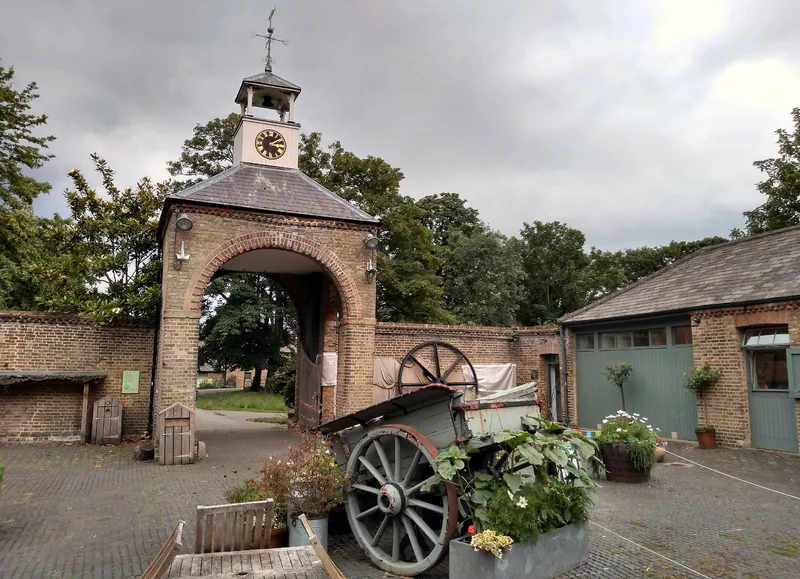
Photo: AndyScott · CC BY-SA 4.0 · Wikimedia Commons · resized
Mitcham station, and the railway claim attached to it
At 409-411 London Road stands a small stock-brick building with a pediment, a recessed carriage entrance and a cast-iron balcony with honeysuckle motifs. Historic England lists it grade II, describes it as a "station office, probably formerly house", dates it to circa 1800, and then adds the sentence that makes it interesting: it was "formerly said to have been built for the horse drawn Surrey Iron Railway of 1803".
The Surrey Iron Railway was the first public railway in the world authorised by Act of Parliament, and it ran from Wandsworth to Croydon through here, pulled by horses. Note Historic England's wording: formerly said. The attribution is now doubted, so we will not tell you this is the world's oldest station building. What is true is that the trams stop outside it, on the alignment of that railway. Mitcham and Belgrave Walk are both on the Croydon tram network.
Morden Hall Park, which is free and has a river in it
Morden Hall Park is the National Trust's park at the edge of Morden, entered from Morden Hall Road about ten minutes north of the Tube station. It is a registered park at grade II covering forty hectares, with the Wandle running in several channels across it, a rose garden, wetland, a snuff mill and a stableyard café rated 5 at an inspection in April 2025.
The park is free and open, and it is one of very few National Trust properties in London you walk into without paying. Our full guide to Morden Hall Park and south London's estate parks has the opening pattern, the accessibility and what is inside the buildings. What this page adds is the context: the Wandle Trail runs through, and from the northern gate it is fifteen minutes to Merton Abbey Mills and about two hours to Wandsworth.
Merton Abbey Mills, and the Morris connection
Where the Wandle crosses Merantun Way, between Morden and Colliers Wood, is the site of the works that William Morris took over in 1881 and ran as Morris & Co.'s printing and weaving shops until 1940. Liberty printed silk here too. The site is now a small craft and food market in and around the surviving mill buildings, with a working waterwheel, and it trades at weekends.
It is modest — a dozen or so units, a stage, a wheel, and the Wandle running past — and it will take you half an hour. It is also the only place in London where you can stand on the ground where Morris's textiles were actually made. Our guide to the William Morris Gallery in Walthamstow holds the collection; this holds the site. Note that the gallery itself was closed for refurbishment from June 2026 and reopens on 3 October 2026.
Nearby, Deen City Farm sits beside the Wandle between Merton Abbey and Mitcham, with farm animals, a riding school, a playground and a café. It is a registered charity that relies on donations from visitors rather than an admission charge, which makes it one of the better cheap outings for small children in this quarter of London. Our guide to city farms and the best playgrounds in London explains how these places work.
Baitul Futuh, Morden
Five minutes from Morden South station, on London Road, is the Baitul Futuh Mosque, built for the Ahmadiyya Muslim Community and one of the largest mosques in western Europe by capacity. A serious fire destroyed part of the complex in 2015 and it has been rebuilt.
It runs guided visits and open days, and non-Muslim visitors are welcome by arrangement. We could not read current visiting times on a source we are willing to print, so contact the mosque in advance rather than arriving unannounced, and dress as you would for any place of worship. Our guide for Muslim visitors to London covers prayer facilities across the city.
The end of the Northern line, and what that is worth
Morden has been the southern terminus of the Northern line since 1926 — the borough marked the station's centenary in 2026 — and it is the practical reason to consider this area at all. Morden to Bank is twenty-eight minutes off-peak and thirty-one or thirty-two in the morning peak; Morden to Leicester Square is twenty-nine. That is a direct, frequent, deep-Tube service from Zone 4 at £3.60 off-peak.
The station is the terminus, so every train is empty when it arrives and you always get a seat — which, given that the Northern line is one of the hotter deep lines, is worth something in July. Mitcham's rail services are separate and go elsewhere: Mitcham Eastfields runs to Blackfriars in twenty-six minutes on Thameslink at any hour we tested, and Mitcham Junction to Victoria in twenty-four. Our explanation of how Thameslink works covers the northern end of that.
Do not judge the distance by the fare zone. Morden is Zone 4 and twenty-eight minutes from Bank; Mitcham Eastfields is Zone 3 and twenty-six minutes from Blackfriars. Both are quicker into central London than several Zone 2 addresses on slow bus corridors. If you are choosing somewhere cheap to stay, measure the journey rather than counting the zones — our page on London's travel zones explains what the numbers do and do not tell you.
Who this area suits
It suits three kinds of visitor and no others. If you are walking the Wandle Trail, this is the middle of it and it is the best stretch. If cricket history interests you, the green is a pilgrimage that costs nothing. If you have children and are staying in south-west London, Morden Hall Park and Deen City Farm are a good, cheap, flat day.
Everyone else should go elsewhere. Tooting, two stops up the Northern line, has two covered markets and far better food. Wimbledon has the village, the common and the tennis museum. Carshalton, at the head of the same river, has the ponds and three free museums.
To walk it as one day: start at Carshalton Ponds, follow the Wandle through Mitcham and the cricket green, cut through Morden Hall Park, stop at Merton Abbey Mills and finish at Earlsfield for a train. About ten miles, nearly all flat and off-road, and on our list of free things to do in London.
Frequently asked questions
Is Mitcham Cricket Green really the oldest cricket ground in the world?
The club claims cricket has been played there since 1685, which would make it the oldest ground in continuous use. The evidence is a print said to be dated 1685, and local historians treat the date as reputed rather than proved. What is certain is that the ground has been in use since at least the eighteenth century, is registered as a town green, and has a pavilion of 1904.
Can you watch cricket at Mitcham for free?
Yes. It is an open green with no fence and no gate, and on most Saturdays in the season there will be a club match, with benches round the edge. There is no admission and no ticket. Bring a coat: the green is exposed and the pavilion is for players.
How long does it take to get from Morden to central London?
Twenty-eight minutes to Bank off-peak on the Northern line, thirty-one or thirty-two in the morning peak, and twenty-nine to Leicester Square, when we measured it in September 2026. Morden is in fare Zone 4, so a journey to Zone 1 costs £3.60 off-peak and £4.80 peak. As the terminus, it is also where you are most likely to get a seat.
Is Morden Hall Park free?
Yes. It is a National Trust park you can walk into without paying, about ten minutes north of Morden Tube station, with the River Wandle running through it in several channels, a rose garden, a snuff mill and a café in the stableyard. Some events and the car park are charged.
Is Merton Abbey Mills open during the week?
It is a weekend market, so the stalls trade on Saturdays and Sundays. The site, the surviving mill buildings and the waterwheel can be walked past at other times, but the point of coming is the market. It is on the Wandle between Morden Hall Park and Colliers Wood, and it takes about half an hour to see.
Sources
- Historic England - National Heritage List for England open data and list entries (The Canons 1358036; dovecote 1080904; Mitcham Station 1080935; Burn Bullock public house 1193391; Tate Almshouses 1193086; obelisk at Cricket Green 1193483; Morden Hall Park registered park 1001336) (checked September 2026)
- Merton Historical Society - cricket on Mitcham Green and the 1685 print (checked September 2026)
- London Borough of Merton - conservation areas, including Mitcham Cricket Green (checked September 2026)
- Transport for London Journey Planner - measured Morden and Mitcham journey times (checked September 2026)
- Transport for London - Single Fare Finder, for the Morden and Mitcham fares and zones (checked September 2026)
- Food Standards Agency - food hygiene rating search (Stableyard Cafe, Morden SM4 5JD, rated 5 in April 2025; and the absence of the Burn Bullock from the register) (checked September 2026)