
Croydon is sixteen minutes from Victoria on the fastest trains and fourteen from London Bridge, and it has the only tram network in London. It also has a medieval palace of the Archbishops of Canterbury, a street market that has traded since the thirteenth century, a town centre rebuilt in concrete in the 1960s, and a museum in the terminal building of what was once Britain's main airport, open one Sunday a month. It is a town rather than a suburb, and it does not behave like part of London.
Croydon Council's figures put nearly 400,000 people and more than 16,000 businesses in the borough, and under the London Plan the town centre is designated a Metropolitan centre, an Opportunity Area and one of only two strategic office centres outside central London. None of that makes it an obvious day out, and we will not pretend otherwise. Come for three things: the trams, the concrete and the airport museum. Stay for lunch at Boxpark and go home.
Croydon at a glance
- Where
- South London, on the Surrey edge. Post town CROYDON, postcodes CR0 to CR9, not LONDON
- Stations
- East Croydon and West Croydon, both fare Zone 5 plus the trams fare zone
- Trains
- Victoria in 16 minutes on the fastest services, London Bridge in 14
- Fare
- Victoria to East Croydon £6.60 peak, £4.40 off-peak, contactless or Oyster
- Trams
- Flat bus fare of £1.75, rising to £1.85 on 1 November 2026. Daily bus and tram cap £5.25, rising to £5.55
- Open one Sunday a month
- Croydon Airport Visitor Centre, Airport House, Purley Way, CR0 0XZ
Getting there, and the postcode confusion
Croydon has two main stations and they are not interchangeable. East Croydon is the big one: fast trains to Victoria and London Bridge, and trains to Brighton and Gatwick, step-free with four lifts in TfL's station data. West Croydon, ten minutes' walk west, is the southern terminus of the Overground's Windrush line, which runs up through Crystal Palace, Canada Water and Shoreditch to Highbury and Islington without touching Zone 1; see our guide to the Overground's six line names. It is step-free by the London Road car park entrance.
Both are in fare Zone 5 and both also sit in the trams fare zone, which works differently: a tram costs the flat bus fare of £1.75 and counts towards the £5.25 daily bus and tram cap rather than the Tube cap. Both figures rise on 1 November 2026, to £1.85 and £5.55.
Croydon addresses use CROYDON as their post town and codes beginning CR, not LONDON. That catches people booking hotels: a CR postcode is usually inside Greater London and covered by contactless, but it is not in the London postal districts. Our page on London postcodes explained covers the trap. East Croydon is also on the Gatwick line, which our guide to Gatwick to central London covers.
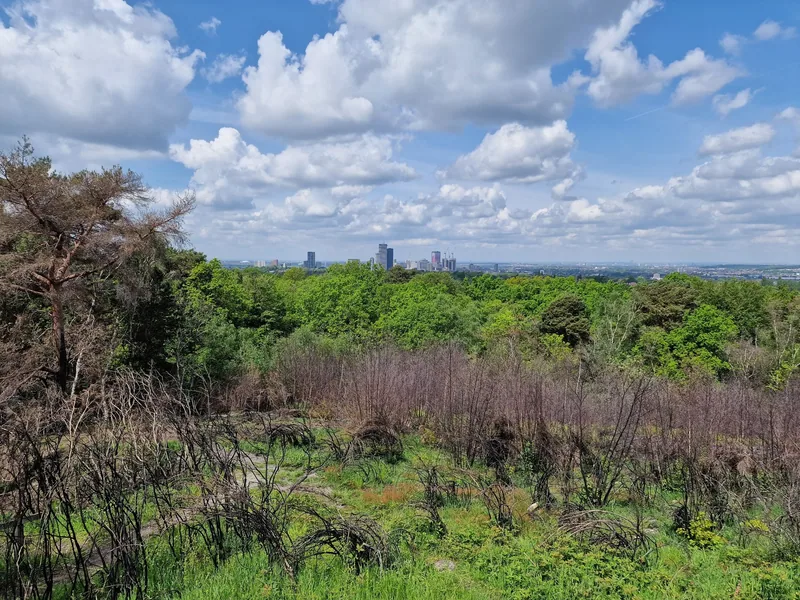
Photo: Amakuru · CC BY-SA 4.0 · Wikimedia Commons · resized
The trams, which exist nowhere else in London
London Trams run from Croydon town centre to Wimbledon, Beckenham Junction, Elmers End and New Addington, on street track through the centre and segregated track outside it. It is the only tram network in the capital and the cheapest transport in London: a flat £1.75 whatever the distance, with the Hopper fare applying, so a second tram or bus within the hour costs nothing.
Two trips are worth making for their own sake: west to Wimbledon, which follows the Wandle valley and passes Morden Hall Park, covered in our guide to Morden Hall Park and south London's estates; and east to New Addington, which climbs onto the North Downs and gives the best view on the network. Our guide to London Trams and the Croydon network has the routes and how to pay, and three Superloop express bus routes also pass through, including a direct link from West Croydon to Heathrow for one bus fare; see the Superloop and outer London buses.
A day of trams and buses in Croydon costs £5.25 and nothing more. Trams are charged as buses, so the daily cap is the bus cap rather than the Tube one, and zones do not apply to either. Ride from Wimbledon to New Addington and back, take three buses, and the transport costs less than one Zone 1 Tube journey. Children under 11 travel free.
The concrete, which is the real reason to come
Croydon's town centre was rebuilt as an office city between about 1959 and 1975, under a private Act of Parliament that let the borough push redevelopment through at a speed nowhere else managed. The result is a skyline of office towers, a flyover through the middle of town, and a second generation of glass towers since 2015. The buildings to look for are all within fifteen minutes of East Croydon: No 1 Croydon, the tapering tower beside the station, known locally as the Threepenny Bit building after the twelve-sided coin; the flyover carrying the A232 over the town on concrete legs; and Fairfield Halls, the 1962 concert hall, a deliberate cousin of the Royal Festival Hall.
Our guide to brutalist London sets it against the Barbican. Croydon is the one place where the idea was carried out at the scale of a town rather than a single site, and whether that is magnificent or dreadful is a question you can settle in an hour on foot.
Fairfield Halls reopened on 16 September 2019 after a £42 million refurbishment funded largely from the value of the land around it, with contributions from the Coast to Capital enterprise partnership and the Mayor of London's Creative Enterprise Zone scheme. It holds a concert hall, the Ashcroft Playhouse and gallery space, it is the permanent home of Talawa Theatre Company, and prices are well below the South Bank for comparable performers.
The Museum of Croydon, and a contradiction worth knowing
The Museum of Croydon is in the Croydon Clocktower on Katharine Street, next to the town hall, and it is free. Its opening hours are where two official sources disagree, so here are both.
The council's Clocktower opening-times page gives the Riesco and Exhibition galleries as Wednesday and Friday 11:00 to 13:00 and 14:00 to 16:00, Saturday 11:00 to 13:00 and 14:00 to 17:00, with the Atrium Gallery open Monday to Saturday 09:30 to 17:30 and the Clocktower closed on Sundays and all bank and public holidays. The museum's own site says Wednesday to Saturday from 10:00, excluding bank holidays. The council page also still carries a line about a gallery reopening in spring 2025, which suggests it has not been updated. Check both before travelling, and do not plan a Sunday or a bank holiday around it.
Croydon Airport, open one Sunday a month
This is the most interesting thing in the borough and the hardest to get into. Between 1920 and 1959 Croydon was London's international airport: where air traffic control was invented, where Imperial Airways flew from and where Amy Johnson took off for Australia. The 1928 terminal and control tower survive on Purley Way, now Airport House, with a Visitor Centre inside.
- It opens on the first Sunday of every month only. There are no other public opening days.
- You must be on a guided tour. A tour lasts about an hour, followed by up to thirty minutes in the museum on your own.
- Groups are about twelve people, and tickets go on sale roughly four weeks before each open day.
- Prices: £11 for a pre-booked adult, £2.50 for a child, £11 on the day subject to availability, annual pass £10.
- Address: Airport House, Purley Way, Croydon CR0 0XZ. Check in ten minutes before your tour.
Do not travel to Croydon Airport without a booked ticket. The Visitor Centre opens on the first Sunday of the month, tours are the only way in, groups are capped at about twelve and tickets are released about four weeks ahead. Turning up hoping for a place is how people end up looking at a locked door on an industrial estate.
The Old Palace, which is medieval rather than Tudor
On Old Palace Road, behind Croydon Minster, stands what the school that now occupies it calls the best-surviving example of a medieval palace of the Archbishops of Canterbury: their summer house, one of ten residences they kept between Lambeth and Canterbury.
It began as a twelfth-century manor house, and the core of what stands now was built in the fifteenth century, including a great hall and the Guardroom, one of the earliest uses of brick in Britain. Henry VI and Henry VII came here, and so did Mary and Elizabeth. That Tudor guest list is presumably why so many listings call it a Tudor palace; the building is older. It is now a school, so access is by arranged tour rather than by turning up: the Friends of Old Palace run public tours on published dates, and small-group tours can be requested in term time in the late afternoon.
Where to eat, and the thirteenth-century market
Surrey Street Market runs down the hill west of the High Street and the council says it has traded since 1276. It opens Monday to Saturday from 06:00 to 18:00, with a Sunday market added after a £1.1 million refurbishment from 10:30 to 17:00, and it sells fruit, vegetables and household goods at prices aimed at people who live here.
For lunch, Boxpark Croydon at 99 George Street, beside East Croydon station, is the obvious answer and a good one: a yard of stacked shipping containers holding more than twenty independent kitchens, with Afghan, Jamaican, Greek, Vietnamese and Himalayan food among them, several rated 5 at inspections in August and September 2026. It shows football on big screens, which changes the atmosphere entirely on a match day. Our guide to food halls in London explains the format and eating cheaply in London the prices. A Malaysian restaurant in Tokia Square on the High Street, rated 4 in June 2025, appears in our guide to Malaysian and Singaporean food, and the Boxpark dumpling counter and a Himalayan restaurant on Godstone Road in Purley in our page on Nepalese and Himalayan food.
What is being demolished, and what is not
The Whitgift Centre, the 1960s shopping mall in the middle of the town, has been the subject of a redevelopment scheme for more than a decade. The position in September 2026 is this. In July 2026 the John Whitgift Foundation sold its freehold of the centre to Unibail-Rodamco-Westfield for £31.5 million, including Green Park House and parts of the former Allders department store, and the council has endorsed a masterplan framework for what it calls the North End Quarter: shops, culture, public spaces and new homes, ahead of a planning application.
No demolition or construction dates have been published. The Whitgift Almshouses and the Allders building are to be kept. For a visitor the translation is that the town centre will be a building site for years, that the Whitgift Centre is still open and still looks like 1968, and that anybody who gives you a date is guessing.
Green space, and the walk out
Croydon is greener than its skyline suggests. Wandle Park, five minutes west, had the River Wandle uncovered through it and is the start of the Wandle Trail north to Wandsworth. Lloyd Park, on the eastern side, is large, hilly and almost empty on a weekday. Shirley Windmill opens on a small number of days a year and needs checking first.
The best half-day out of the town centre is north to Crystal Palace, where Crystal Palace Park has the Victorian concrete dinosaurs and a view back over south London with Croydon's towers in the middle distance. Anyone relying on lifts should check routes first: the older suburban stations are a mixed picture, and our guide to step-free travel in London explains how to find out.
Frequently asked questions
Is Croydon worth visiting?
For half a day, if you are interested in post-war architecture, trams or aviation history. The 1960s office city, the only tram network in London and the airport visitor centre are all genuinely distinctive. As general sightseeing it does not compete with central London, and we would not send a first-time visitor here.
How long does it take to get from London to Croydon?
Sixteen minutes from Victoria on the fastest trains and fourteen from London Bridge, to East Croydon. Contactless and Oyster work: Victoria to East Croydon is £6.60 at peak times and £4.40 off-peak, and East Croydon is in fare Zone 5.
When is Croydon Airport Visitor Centre open?
The first Sunday of every month only, and entry is by pre-booked guided tour of about twelve people. Tickets go on sale roughly four weeks in advance at £11 for an adult and £2.50 for a child. The address is Airport House, Purley Way, Croydon CR0 0XZ.
Can you visit the Old Palace in Croydon?
Only on an arranged tour. The building is now a school, so there is no walk-in access. The Friends of Old Palace run public tours on published dates, and individual or small-group tours can be requested during term time in the late afternoon. Book before travelling.
How much does a tram cost in Croydon?
The flat bus fare, £1.75 until 1 November 2026 and £1.85 after that, whatever the distance. Trams count towards the daily bus and tram cap of £5.25, rising to £5.55, rather than the Tube cap, and zones do not apply. A second tram or bus within an hour is free under the Hopper fare.
Sources
- Croydon Council - Whitgift Centre freehold sale supports town centre regeneration, 15 July 2026 (checked September 2026)
- Croydon Council - Croydon Clocktower and Museum of Croydon opening times (checked September 2026)
- Croydon Council - Surrey Street Market trading days and hours (checked September 2026)
- Historic Croydon Airport Trust - Visitor Centre opening, tours, prices and booking (checked September 2026)
- Old Palace of John Whitgift School - History of Old Palace (checked September 2026)
- Croydon Council - Fairfield Halls: reopening of the new cultural quarter (checked September 2026)
- Transport for London - detailed station data (lifts, entrances and fare zones at East and West Croydon) (checked September 2026)
- Transport for London - Bus and tram fares, including the tram fare and daily cap (checked September 2026)