
London does have trams: 39 stops in the far south of the city, radiating from Croydon out to Wimbledon, Beckenham Junction, Elmers End and New Addington. They cost the same as a bus, £1.75 with a contactless card or Oyster, and they are capped at £5.25 a day. Wimbledon to East Croydon takes 29 to 31 minutes and passes through several miles of south London that no Underground line reaches.
Most visitors never see them, and for most visits that is the right decision: the network does not come within eight miles of Trafalgar Square. But if you are going to Croydon, if you are staying in Wimbledon, or if you want a long ride through a part of London the guidebooks skip, this is the cheapest hour of sightseeing on the TfL network. The trams appear on the Tube map as a green double line, and they are the only TfL rail mode where you pay a flat bus fare.
London Trams at a glance
- Stops
- 39
- Services
- Wimbledon to Beckenham Junction, Wimbledon to Elmers End, and New Addington to Croydon (Church Street)
- Adult fare
- £1.75 pay as you go, rising to £1.85 on 1 November 2026
- Daily cap
- £5.25 for buses and trams together, rising to £5.55 on 1 November 2026
- Children
- Free for under-11s, no card needed
- Wimbledon to East Croydon
- 29-31 minutes
- New Addington to East Croydon
- 21 minutes
- Trams an hour through East Croydon
- 19 or 20 for most of a weekday, 12 in the evening
- First and last
- From about 05:00 to about 01:30
- Step-free
- Every stop, and every tram
Where the trams actually go
Everything meets in Croydon. Three services run, and the destination is on the front of the tram:
- Wimbledon to Beckenham Junction. West to east through Merton Park, Morden Road, Phipps Bridge, Mitcham, Mitcham Junction and the old industrial Wandle valley, then round Croydon town centre, out past Addiscombe and Woodside and on to Birkbeck and Beckenham Junction.
- Wimbledon to Elmers End. The same route as far as Arena, then a short branch to Elmers End, which is a main-line station for trains to Charing Cross and Cannon Street.
- New Addington to Croydon. South-east from Croydon up through Lloyd Park, Coombe Lane, Gravel Hill and Addington Village to New Addington. This one does not run through to Wimbledon: it terminates at Church Street in the town centre.
Beckenham is on the far side of Croydon from Wimbledon, not between the two, which is worth knowing if you are reading a route description rather than a map. If you want New Addington from Wimbledon you change at Sandilands or in the town centre.
The loop through central Croydon is one-way, so you will not leave from the stop you arrived at. Trams heading towards Croydon call at Reeves Corner, Centrale, West Croydon, Wellesley Road and then East Croydon. Trams heading away from Croydon call at East Croydon, George Street and Church Street. Centrale and West Croydon have no westbound platform at all.
What it costs, and why that is the interesting part
The tram is charged as a bus journey. An adult pay-as-you-go single is £1.75 with a contactless card, a phone or an Oyster card, whatever the distance, so Wimbledon to Beckenham Junction, the length of the network, costs the same as one stop. That rises to £1.85 on 1 November 2026.
Two rules make it better than that. The Hopper fare gives you unlimited bus and tram journeys within one hour of touching in for the same £1.75, applied automatically if you use the same card each time, so a tram out and a bus back within the hour is one fare. And the bus and tram daily cap is £5.25, which means three journeys is the most you will pay in a day however many you make. Neither figure interacts with the Tube: bus and tram fares have their own cap, separate from the Tube and rail one, and our page on how the contactless fare caps work explains what that means if you use both in a day.
For families the tram is cheap in a way the Tube is not. Children under 11 travel free on buses and trams with no card and no photocard, and 11 to 15-year-olds travel free with an 11-15 Zip Oyster photocard or at half the adult fare with the Young Visitor discount added to an Oyster card. A family of four with two young children rides for £3.50. The full set of children's rules is in children's fares on London transport.
Touching in: the bit that catches people at Wimbledon
On a tram you touch in and you do not touch out, exactly as on a bus. The reader is a yellow pad on the platform at the stop, not on the tram, and you must use it before you board. Cash is not accepted anywhere on the bus and tram network.
There are three places where that simple rule is not enough, and TfL spells them out.
- Wimbledon. Arriving by tram, touch out on the station gates even if they are standing open. Leaving by tram, touch in at the gates as you enter the station and again on the yellow reader on the tram platform.
- Changing between Tube or train and tram at Wimbledon. Touch out on a rail or Tube reader first, then touch in again on a tram platform reader. One tap will not do both.
- Elmers End and Mitcham Junction. Arriving by train and changing to a tram, touch out on the National Rail reader and then touch in on the tram platform reader.
Get that wrong and you are charged as if the rail journey never ended, which is the most common way of paying too much on this network. What happens next, and how to get the money back, is covered in what happens if you forget to touch out. There are ticket inspections on the trams, and the consequences of travelling without a valid fare are in penalty fares and ticket inspectors.
The trams themselves, and step-free travel
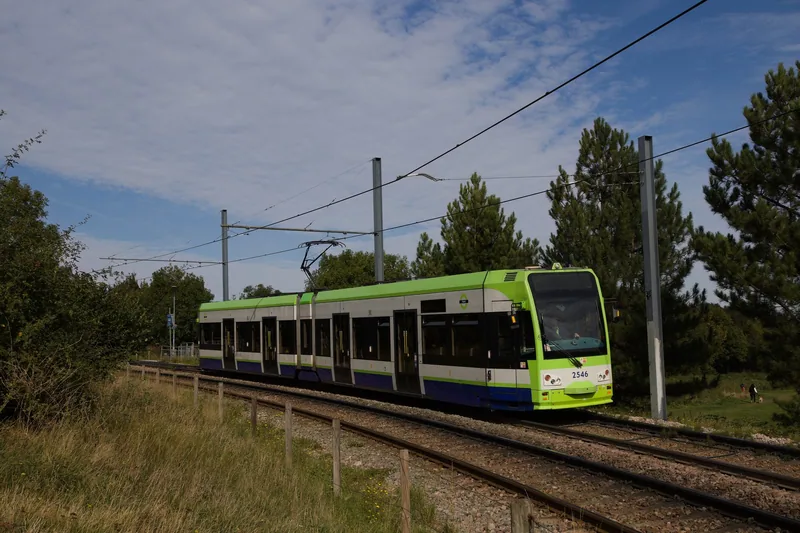
The trams are low-floor single vehicles, part street tram and part light railway. In central Croydon they run along the road; for most of the rest of the route they are on their own segregated track, much of it former railway line, which is why they keep moving between stops rather than crawling behind traffic.
Every stop on the network is step-free and so is every tram, with level boarding from the platform. That makes this the most consistently accessible rail mode in London, better than the Tube and on a par with the DLR. There is no gap to bridge with a ramp and no lift to fail. Our guide to step-free and accessible transport in London covers the rest of the network.
Inside, the trams are two-thirds seated with a wide standing area, there are no gates at the stops, and they are quiet. They are also, for the same reason, exposed: the stops are open platforms with a shelter, so on a wet January evening you stand in the weather for up to five minutes.
How often, and how late
On the Wimbledon to Croydon corridor, TfL's timetable puts 19 or 20 trams an hour through East Croydon for most of a weekday, which is one every three minutes. That drops to about 12 an hour in the late evening and on Sunday mornings. Individual branches are less frequent than the trunk: the Wimbledon line runs about every five minutes in the middle of the morning, the New Addington line about every seven or eight.
The service starts around 05:00 and the last trams run past 01:00, later than the Underground on a weeknight. There is no separate night service. Live status sits on TfL's status page under Tram.
The one reason a visitor should ride: the Wandle valley
Board at Wimbledon, sit on the right-hand side and stay on for 29 minutes. What you get is not scenery in the postcard sense, and that is the point: a Victorian suburb, then allotments, then the River Wandle, then a tram running past a retail park and a tram depot, then the back of a town centre with a 1960s skyline that London usually keeps out of photographs. It is the least curated hour on the TfL network.
Two stops are worth getting off at. Phipps Bridge and Morden Road both sit on the edge of a National Trust park with a snuff mill and a rose garden, a green interruption in the middle of the Wandle industrial corridor; our guide to Morden Hall Park and south London's parks has the details and the opening times. Mitcham Junction puts you on the Wandle Trail if you would rather walk a stretch and pick up the next tram, and the Thames Path and London's walking routes page sets out how the river paths join up.
The other ride with something to show you is the New Addington branch, which climbs out of Croydon through Lloyd Park and Coombe Lane into genuinely open country on the edge of the North Downs, 21 minutes from East Croydon. Sitting at the front on that one is the closest thing London has to a funicular.
Wimbledon to Croydon and back costs £3.50, or £5.25 with everything else you do that day. Two tram singles at £1.75 are cheaper than one Zone 1 Tube journey, and if you add buses at either end you still stop paying at the £5.25 daily cap. Tram fares do not touch your Tube cap, so plan the day as one or the other.
When the tram is the wrong answer
If you are coming from central London, the tram is the last leg of a journey and not the journey. Wimbledon is a direct main-line train from Waterloo or the end of the District line, and East Croydon has frequent trains from Victoria and London Bridge. Both of those are quicker than any tram and neither is covered by the bus and tram cap, so a day that combines them needs the Tube and rail cap instead; our page on how the travel zones work explains where the boundaries fall.
The tram is also not a way of reaching Wimbledon's tennis. The All England Club is up the hill on the other side of town, served by the District line to Southfields, as our guide to Wimbledon village and town explains.
Frequently asked questions
Does London have trams?
Yes, in south London. The network has 39 stops and runs from Wimbledon and Beckenham Junction through Croydon out to Elmers End and New Addington. It is shown on the Tube map as a pair of green lines and is operated by Transport for London. There are no trams in central London.
How much is a London tram ticket?
£1.75 for an adult with a contactless card, a phone or an Oyster card, whatever the distance, rising to £1.85 on 1 November 2026. The bus and tram daily cap is £5.25, and the Hopper fare gives you unlimited bus and tram journeys within an hour of touching in for that single fare. Cash is not accepted.
Do you touch out on a London tram?
No. Touch in on the yellow reader on the tram platform before you board, and that is all. The exceptions are Wimbledon, Elmers End and Mitcham Junction, where a rail journey and a tram journey meet: there you must touch out of the railway on its own reader before touching in for the tram.
How long does the tram take from Wimbledon to Croydon?
About 29 minutes to East Croydon westbound and 31 minutes eastbound, because the route runs one way round the town centre. Trams leave Wimbledon about every five minutes in the middle of the day. Getting to Wimbledon from central London takes another 20 to 30 minutes on top.
Are London trams wheelchair accessible?
Yes. Every stop and every tram is step-free, with level boarding straight from the platform, and no ramp or lift is involved. Along with the Docklands Light Railway, the tram network is the most consistently accessible part of London's rail system.
Sources
- Transport for London - Bus and tram fares (checked September 2026)
- Transport for London - Touching in and out, including tram journeys at Wimbledon, Elmers End and Mitcham Junction (checked September 2026)
- Transport for London - Tram route sequence (Unified API) (checked September 2026)
- Transport for London - Tram timetable and stop intervals (Unified API) (checked September 2026)
- Transport for London - Trams (checked September 2026)
- Mayor of London - MD3517, July 2026 fare changes (bus and tram fares from 1 November 2026) (checked September 2026)