
The Crystal Palace stood on the ridge above Sydenham from 1854 until it burned down on the night of 30 November 1936, and the two places below it were built because of it. What is left for a visitor is genuinely odd: eleven hectares of the last real Great North Wood, a railway tunnel in the trees that is now a licensed bat roost, a Wren church spire standing in a suburban street, and forty-six almshouses built for Thames watermen.
Sydenham is in the London Borough of Lewisham, SE26. Penge is in Bromley, SE20. They meet at the foot of the hill and they are not the same kind of place: Sydenham runs up a long steep slope of Victorian villas, Penge is flatter, denser and cheaper. Neither has a museum, a gallery or a paid attraction of any kind, and both are about twenty minutes from the centre.
We measured it. Sydenham to London Bridge is twenty minutes by Southern and twenty-three to twenty-six via Canada Water on the Windrush line. Penge East to Victoria is nineteen minutes, off-peak and peak alike. That is faster than a good deal of Zone 2.
Sydenham and Penge at a glance
- Where
- SE26 (Sydenham, Lewisham) and SE20 (Penge, Bromley), between Forest Hill and Crystal Palace
- Stations
- Sydenham (Southern and Windrush line); Penge East (Southeastern, Zone 4); Penge West (Southern and Windrush line, Zone 4); Sydenham Hill (Zone 3); Lower Sydenham; Kent House
- Measured journey times
- Sydenham to London Bridge 20 minutes direct; Penge East to Victoria 19; Penge West to London Bridge 22-26
- Fares
- Sydenham to Zone 1 £3.70 off-peak / £4.60 peak; Penge £4.00 / £5.30
- Free and open all hours
- Sydenham Hill Wood and Cox's Walk (11 hectares); Sydenham Wells Park; the St Antholin spire on Round Hill
- The hill
- Sydenham Hill reaches about 112 metres. Plan walks downhill and take a train back
Sydenham Hill Wood, and the tunnel full of bats
London Wildlife Trust's reserve at Crescent Wood Road, SE26 6LS, covers eleven hectares and is described by the Trust as part of the largest remaining tract of the old Great North Wood, the belt of worked coppice and wooded common that once ran from Deptford to Selhurst. It holds more than 200 species of trees and plants. It is free and open at all times.
Two features make it worth the climb. The first is the abandoned railway. The Nunhead to Crystal Palace High Level line ran through here, opened in 1865 to carry visitors up to the Palace and closed in 1954 after the Palace had gone; you can walk the track bed to a sealed tunnel mouth which is now a registered bat roost. The second is a Victorian folly, originally a garden ornament from one of the demolished villas, standing in the trees with nothing around it.
The third thing is not in the wood but across it. Cox's Walk is an oak-lined avenue cut in 1742 by a publican named Francis Cox, and when the railway cutting was dug in 1865 the avenue had to be carried over it on an ornamental footbridge, which is still there. Walking that bridge is the single most atmospheric five minutes in south-east London.
Use Sydenham Hill station, not Sydenham, and know that neither platform is accessible. The Trust gives Sydenham Hill as a ten-minute walk from the Crescent Wood Road entrance and five minutes from the Low Cross Wood entrance into Dulwich Wood, and warns that the station has steps and a steep slope on both sides. The nearest step-free station is Forest Hill. Inside the wood the paths are uneven with many steps; the flat way in is through Dulwich Wood from Grange Lane, where parking is free.
Our guide to Herne Hill and Dulwich approaches the same wood from the Dulwich side, which is the gentler half. London Wildlife Trust has a £1,020,000 National Lottery Heritage Fund grant to reunite Sydenham Hill Wood and Dulwich Wood as a single reserve, so expect path and fence work over the next few years. For the wider picture of how this ridge looks in October, see autumn colour in London.
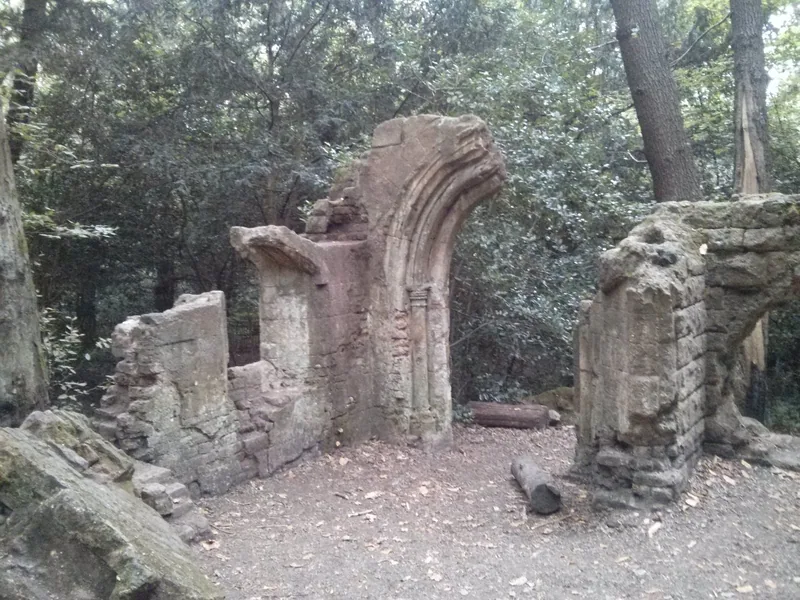
Photo: ChrisSampson87 · CC BY-SA 4.0 · Wikimedia Commons · resized
A Wren spire in a suburban street
This is the strangest listed object in either place and almost nobody knows it is there. On the north side of Round Hill, SE26, standing on a brick plinth between two facing modern terraces, is the upper part of a church spire by Sir Christopher Wren, brought here from the demolished City church of St Antholin. Historic England lists it at grade II and has done since 30 August 1954.
The list entry describes it precisely: a panelled octagonal spire, the upper part only, with round windows in shell architraves round the lower part, and a composite capital as a finial carrying a ball and a wolf-head weathervane. St Antholin, Watling Street, was pulled down in 1875; the spire was bought and re-erected out here in the suburbs, and then a housing terrace was built round it.
It takes five minutes and costs nothing, and it is the best answer we know to the question of what is actually interesting about Sydenham. If you are collecting City churches, our guide to All Hallows by the Tower and the City churches covers the ones that survived.
What else is in Sydenham
The parish church of St Bartholomew on Westwood Hill is listed grade II*. Sydenham Wells Park, at the top of the hill, is named for the medicinal springs that made Sydenham a minor spa in the seventeenth and eighteenth centuries, long before the Palace arrived; it is a steep municipal park with ponds and a view, free and open.
Jews Walk, off Kirkdale, is a short street of listed houses where Eleanor Marx — Karl Marx's youngest daughter, the first English translator of Madame Bovary — lived and died. Louise House on Dartmouth Road, a former girls' industrial school, was listed grade II in 2008. Dacres Wood, a small local nature reserve off Dacres Road, opens on limited days.
The high street runs along Sydenham Road and round Cobb's Corner, and it is an ordinary one: supermarkets, a library, charity shops, a handful of cafés and a couple of pubs. The Golden Lion in Sydenham held a hygiene rating of 4 at an inspection in October 2025. For eating, the honest advice is to go one stop to Forest Hill or the Crystal Palace Triangle, both of which have more and better; the Bird in Hand on Dartmouth Road, on the Sydenham-Forest Hill boundary, held a 5 at an inspection in November 2025. One stop further is the Horniman Museum, which is free and is the nearest thing to a major attraction in this part of London.
Penge, and the forty-six almshouses
Penge High Street has one building that would be famous if it were anywhere else. The Royal Watermen's and Lightermen's Asylum is a range of forty-six almshouses built in 1839-40 to the designs of the architect George Porter, on ground given by J. Dudun Brown, for aged Thames watermen and lightermen. Historic England listed it grade II in February 1973.
Read the list entry before you go, because it tells you what to look at. Three sides of a courtyard, two storeys, white brick. In the centre of the main block, two square four-storey towers with ogee lead cupolas — one with a clock face, the other with a wind vane. Between them a crow-stepped gable with a royal cartouche, an oriel window of two tiers of five lights, and a four-centred archway beneath. A cloister runs the length of the buildings. The fourth side of the courtyard is a balustrade with three entrances, flanked by brick piers surmounted by heraldic beasts.
It is occupied housing, so you look at it from the street. Two minutes and you will have seen the best thing in Bromley borough north of Beckenham.
Also in Penge: the Church of St John the Evangelist, listed grade II; a listed white house and one listed pair of houses on the High Street; and Alexandra Cottages, a model housing estate of 1866 built by the Metropolitan Association for Improving the Dwellings of the Industrious Classes. Alexandra Park, Penge, once held the twin of the Bowie Bandstand in Beckenham — the two were ordered together in 1905 at £135 each, and the Penge one has gone.
Where the Crystal Palace actually stood
The Palace itself was on the ridge above, in what is now Crystal Palace Park, which is in Bromley borough and reached from Penge West or Crystal Palace stations. The terraces, the sphinxes and the ruined steps are still there, and so are the thirty-odd prehistoric animal sculptures of 1854 in the lower part of the park, which are listed grade I — a higher grade than almost every building in this article.
Our guides to Crystal Palace Park and the Crystal Palace dinosaurs cover the park and the sculptures, and the Crystal Palace Subway covers the Victorian passenger tunnel under Crystal Palace Parade, which opens for a handful of days a year. From Penge West it is a fifteen-minute walk uphill into the park; from Sydenham, twenty-five minutes and steeper.
Do the ridge downhill. Take a train to Crystal Palace or Sydenham Hill, walk the wood and the park along the top, and come down into Penge or Sydenham for the train home. The height difference is about eighty metres and it is the difference between a pleasant afternoon and a hard one. Everything on the top of the hill is free.
Which station, and which borough
Penge has two stations a few minutes apart serving different companies in different directions, which catches people out. Penge East is Southeastern to Victoria, nineteen minutes. Penge West is Southern and the Windrush line, for London Bridge in twenty-two to twenty-six minutes or for Shoreditch, Whitechapel and Highbury without going through a terminus. Sydenham is on the same Windrush line as well as Southern, and Lower Sydenham and Sydenham Hill are different stations again on different routes.
The borough boundary runs between the two places, which matters for anything run by a council: the wood, the library and the parks in SE26 are Lewisham's, and the almshouses, Crystal Palace Park and Alexandra Park are Bromley's. Our page on London postcodes explains why an SE20 address is not further out than an SE26 one, and our guides to Lewisham and Catford downhill to the north and Telegraph Hill further along the same ridge cover the neighbours.
Frequently asked questions
Can you still see where the Crystal Palace stood?
Yes. The building burned down on 30 November 1936, but its terraces, retaining walls, steps and sphinxes survive in Crystal Palace Park on the ridge above Sydenham and Penge, and are free to walk round at any time. The park also holds the prehistoric animal sculptures made for the site in 1854, which are listed grade I and outlived the building they were built to accompany.
Is Sydenham Hill Wood free to visit?
Yes, and it is open at all times. It is an eleven-hectare London Wildlife Trust reserve with four entrances, the main one on Crescent Wood Road. The paths are uneven with many steps and the gates prevent wheelchair access; the flat, accessible route in is through Dulwich Wood from Grange Lane or Low Cross Wood.
Where is the Wren spire in Sydenham?
On the north side of Round Hill, SE26, mounted on a brick plinth between two modern terraces. It is the upper part of the spire of St Antholin, a City church by Sir Christopher Wren demolished in 1875, and it has been listed grade II since 1954. There is no charge, no gate and no sign worth reading: you simply walk up and look at it.
How long does it take to get to Penge from central London?
Nineteen minutes from Victoria to Penge East, at 11:00 and at 08:30 alike when we measured it in September 2026. Penge is in fare Zone 4, so a journey to Zone 1 costs £4.00 off-peak and £5.30 peak. Penge West, a few minutes away, serves London Bridge and the Windrush line instead.
Is there anything to do in Penge?
Not much, and we would not send a first-time visitor. What is there is worth twenty minutes if you are passing: the grade II listed Royal Watermen's and Lightermen's Asylum of 1839-40 with its two cupolas and heraldic beasts, a listed Victorian church, and the model cottages of 1866. Crystal Palace Park, fifteen minutes uphill, is the reason to get off the train here.
Sources
- London Wildlife Trust - Sydenham Hill Wood and Cox's Walk: size, access, the bat-roost tunnel, the folly and the station warning (checked September 2026)
- Historic England - National Heritage List for England open data and list entries (spire from the former Church of St Antholin 1079973; Royal Watermen's and Lightermen's Asylum 1040012; Church of St Bartholomew 1285801; Church of St John the Evangelist 1186832; Louise House 1392722; prehistoric animal sculptures 1067798; Bowie Bandstand 1465007) (checked September 2026)
- Transport for London Journey Planner - measured Sydenham, Penge East and Penge West journey times (checked September 2026)
- Transport for London - Single Fare Finder, for the Sydenham and Penge fares and zones (checked September 2026)
- London Borough of Bromley - local history timeline, for Alexandra Cottages and the borough's formation (checked September 2026)
- Food Standards Agency - food hygiene rating search (The Golden Lion, SE26 5JX, rated 4 in October 2025; Bird In Hand, SE23 3HN, rated 5 in November 2025) (checked September 2026)