
Knightsbridge and Belgravia are neighbours with very different jobs. Knightsbridge is a shopping street along the south side of Hyde Park, with Harrods, a cavalry barracks and a great Catholic church. Belgravia, behind it to the south-east, is a planned estate of cream-painted terraces and garden squares built from the 1820s, which today holds more embassies than any other corner of London.
Visitors usually see Knightsbridge from inside a shop and Belgravia not at all. Both reward a walk of an hour or two, mainly for the buildings, and the walk is free. Our page on Harrods covers the store; this page covers the streets around it, the reason Belgravia looks the way it does, and what is worth stopping for in each.
Knightsbridge and Belgravia at a glance
- Where
- South of Hyde Park, between Hyde Park Corner, Sloane Street and Victoria; SW1X, with Knightsbridge's western end in SW7 and SW3
- Tube
- Knightsbridge (Piccadilly line), Hyde Park Corner (Piccadilly line), Sloane Square and Victoria for southern Belgravia
- Embassies
- 13 missions on Belgrave Square alone; about 30 with their main address in SW1X (London Diplomatic List, revised November 2026)
- Brompton Oratory
- Working Catholic parish church on Brompton Road, free to enter outside services
- Household Cavalry
- The new guard leaves Hyde Park Barracks at 10:28 for Horse Guards (checked November 2026)
- Time needed
- One to two hours on foot for both
Why Belgravia is all the same colour
Belgravia was fields until the 1820s. The land belonged to the Grosvenor family, who already owned much of Mayfair, and when George IV began turning Buckingham House into a palace next door, Robert Grosvenor, later the first Marquess of Westminster, decided to build. According to Grosvenor's own history of the estate, he appointed Thomas Cundy as architect and surveyor and brought in Thomas Cubitt, a master builder and developer, to create a new district of houses, squares, streets and crescents.
What you see is the result of one landowner controlling one large site for two centuries. The houses were built in a small number of big campaigns, to a shared pattern of brick faced with stucco (a smooth lime render) and painted cream, with porches, iron balconies and slate roofs. The Historic England list entries for Eaton Square describe its terraces as "part of estate laid out and largely designed by T. and L. Cubitt", Thomas and his brother Lewis. Belgrave Square was designed by a different architect, George Basevi, around 1825, and the Pantechnicon was put up by another builder, Seth Smith, but the materials are the same throughout.
The estate has stayed in the same hands: Grosvenor says Belgravia remains part of its London estate, and that the palette of stucco, brick, slate and painted timber sashes devised by Cubitt and his successors "remains remarkably consistent". That is why a street such as Chester Square or Eaton Place looks the same now as it does in Victorian photographs.
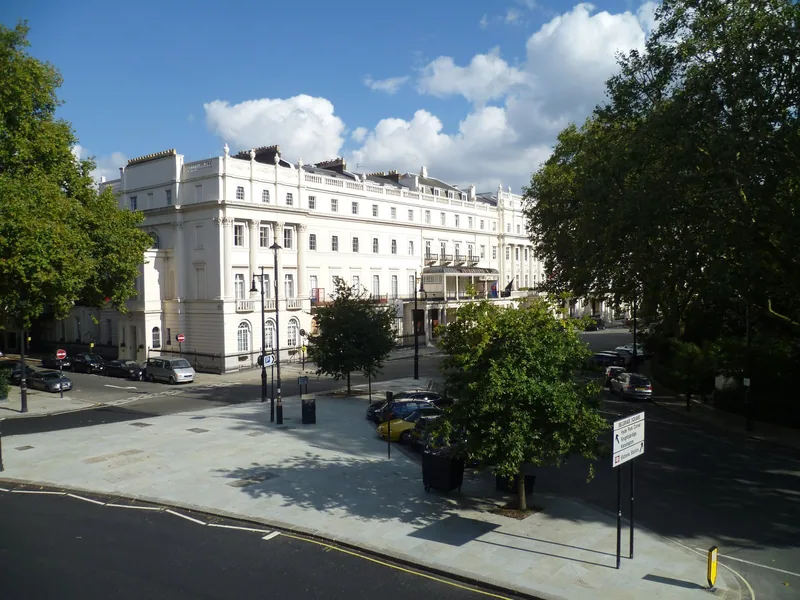
Photo: Philafrenzy · CC BY-SA 4.0 · Wikimedia Commons · resized
Belgrave Square and the embassy quarter
Belgrave Square is the centrepiece, a huge square of four grand terraces, with large detached houses at its corners, around a private garden. The terraces on the north-west side are listed at Grade I and were designed by Basevi in about 1825, with giant Corinthian columns across the centre and ends.
Houses this size, with rooms for entertaining on the first floor and servants' quarters below and above, became too expensive to run as homes in the 20th century, and many were taken over by foreign governments. They suit an embassy well: reception rooms for official functions, offices behind, and an address near Buckingham Palace and Whitehall. In the London Diplomatic List revised in November 2026, 13 countries give Belgrave Square as their main address, including Germany, Norway, Portugal, Saudi Arabia, Malaysia, Ghana and Trinidad and Tobago, and about 30 have their main office in the SW1X postcode.
You will see the national flags, the brass plates and, outside some buildings, armed police officers guarding diplomatic premises. Photographing the architecture from the pavement is normal; photographing security arrangements or staff is not, and officers may ask you to stop.
Belgravia's squares are private gardens. The railed gardens in the middle of Belgrave Square, Eaton Square and Chester Square belong to the residents, who hold keys. Some open to ticket holders for one June weekend a year during London Open Gardens, the event once called Open Garden Squares Weekend. The rest of the year, walk five minutes north to Hyde Park to sit down.
The Pantechnicon on Motcomb Street
On the north side of Motcomb Street stands a long stucco front with a row of giant Greek Doric columns and the word "PANTECHNICON" moulded across the top. Historic England dates it to about 1830, probably designed by Joseph Jopling and built by Seth Smith. It was a vast store where wealthy families kept their furniture, carriages and goods while they were away. It burned in 1874, and everything except the front was rebuilt.
The building gave the English language a word: a "pantechnicon" is still the name for a large furniture removal van. Today the building holds shops and restaurants, and Motcomb Street and the little streets off it, including Halkin Arcade, are one of the two small shopping areas in Belgravia.
Elizabeth Street and the southern streets
The other is Elizabeth Street, which runs from Eaton Square down to Buckingham Palace Road, near Victoria Coach Station. It is the most village-like street in Belgravia, with independent food shops, cafés and boutiques in low terraced buildings. We do not recommend individual businesses here; if you eat, look the place up on the Food Standards Agency register first by name and postcode.
From Elizabeth Street it is a short walk to Chester Square and to Pimlico and Victoria, which Cubitt also built, on reclaimed marshy ground to the south. The difference in scale between the two tells you who each district was built for.
Knightsbridge: the road and the shops
Knightsbridge itself is the name of the main road running west from Hyde Park Corner along the edge of the park, and of the district around it. It continues as Brompton Road, where the big shops are. Harrods is on Brompton Road, Harvey Nichols faces the Sloane Street junction, and Sloane Street, running south towards Chelsea, is lined with international fashion houses.
Behind the main roads are quieter streets of small 19th-century houses: Montpelier Square, Trevor Square and Ennismore Gardens are a few minutes' walk and give you an idea of the village that Knightsbridge was before the shops arrived. For shopping further south, see our guide to the King's Road and Chelsea.
Hyde Park Barracks and the Household Cavalry
The tall, thin concrete tower you can see from almost anywhere in Hyde Park belongs to Hyde Park Barracks, the London home of the Household Cavalry Mounted Regiment. There has been a cavalry barracks on this site since the 1790s. The present buildings were designed by Sir Basil Spence, the architect of Coventry Cathedral, and built between 1967 and 1970. The Survey of London records that they were planned for 273 horses and that the tower was controversial from the start, because it was the first building of such height on the edge of a royal park.
You cannot go inside, but you can watch the horses leave. Each morning the guard rides out of the barracks and across Hyde Park Corner towards Whitehall for the 11:00 change. The ride is described in detail on our pages about the Changing of the Guard and Horse Guards and Whitehall. Standing on the park side of the road at Hyde Park Corner gives a good view without the crowds of Horse Guards.
The cavalry ride past Hyde Park Corner is free and uncrowded. Most people wait at Horse Guards Parade. Stand by the barracks on South Carriage Drive, or at Hyde Park Corner, a few minutes before the guard leaves, and you will see the full mounted troop from a few metres away.
Brompton Oratory at the western end
Where Knightsbridge becomes Brompton Road, beside the V&A, stands the great domed Catholic church known as Brompton Oratory. Strictly it is just over the boundary in Kensington, but it is the natural end of any walk through Knightsbridge, and it is free to enter outside services. Historic England dates the church to 1884, by Herbert Gribble, in an Italian Baroque style. Our page on Brompton Oratory covers what to look for inside and which services are worth timing a visit for, and our guide to South Kensington picks up from its steps.
A walk through both
Start at Hyde Park Corner station, with Apsley House and Wellington Arch on the roundabout. Walk down Grosvenor Crescent into Belgrave Square and round it, then along Motcomb Street past the Pantechnicon. Turn into Lowndes Square and up to Knightsbridge, cross to the park edge to look at the barracks, then walk west along Brompton Road past Harrods to the Oratory. This takes about an hour at an easy pace and ends near South Kensington station for the museums.
On a Sunday, Belgravia is very quiet and the shops on Knightsbridge open later. On weekday afternoons in December the pavements outside Harrods are some of the most crowded in London. In late November and December, Winter Wonderland in Hyde Park adds large crowds at Hyde Park Corner.
Getting there, and the stations
The Piccadilly line stop for the shops, a few minutes from both department stores, has been step-free since April 2025. Because it is on the Piccadilly line, it has direct trains from Heathrow. Hyde Park Corner, one stop east, is best for Belgrave Square and the start of the walk above. For southern Belgravia and Elizabeth Street, use Sloane Square or Victoria.
Staying here
Knightsbridge and Belgravia have some of London's most expensive hotels and almost nothing at the budget end. If you want to stay in the area at a lower price, look at South Kensington or Victoria, both within walking distance. Our page on London's grand hotels covers the top end, and staying in Kensington and Chelsea covers the alternatives nearby.
Frequently asked questions
What is the difference between Knightsbridge and Belgravia?
Knightsbridge is the main road along the south side of Hyde Park and the shopping district around Harrods and Sloane Street. Belgravia is the residential estate to its south-east, built from the 1820s around Belgrave Square and Eaton Square, with few shops and many embassies.
Why are there so many embassies in Belgravia?
Its large 19th-century houses were built for wealthy families with servants. When they became too costly as homes, foreign governments bought or leased them, because they offer reception rooms and offices close to Buckingham Palace and Whitehall. Thirteen missions are on Belgrave Square itself.
Can you go inside Brompton Oratory?
Yes. It is a Catholic parish church, free to enter outside services; during Mass, visitors may attend but should not walk around. Service times are on the Oratory's own website, and our separate page on the Oratory describes the interior.
Where can I see the Household Cavalry in Knightsbridge?
The guard leaves Hyde Park Barracks each morning at 10:28 and rides past Hyde Park Corner and down Constitution Hill to Horse Guards Parade (checked November 2026). Watching from the edge of Hyde Park near the barracks is free and usually uncrowded.
Is Belgravia worth visiting?
For architecture, yes: nowhere else in London shows a complete Regency estate so unchanged. There is little to do indoors, so treat it as a walk of about an hour combined with Knightsbridge, Hyde Park or Victoria.
Sources
- Grosvenor - Our history (checked November 2026)
- GOV.UK - Foreign embassies in the UK: London Diplomatic List, revised November 2026 (checked November 2026)
- Historic England - 1-11 Belgrave Square, list entry 1066455 (checked November 2026)
- Historic England - 103-118 Eaton Square, list entry 1066851 (checked November 2026)
- Historic England - Pantechnicon, 19 Motcomb Street, list entry 1223569 (checked November 2026)
- Historic England - The Oratory, Brompton Road, list entry 1358123 (checked November 2026)
- British History Online - Survey of London vol. 45, Knightsbridge Barracks: The New Barracks, 1967-70 (checked November 2026)
- The London Oratory - Brompton Oratory (checked November 2026)