
London's autumn runs from a September that is still summer to a November that is properly dark, and the numbers move faster than in any other season: sunshine drops from 157 hours in September to 71 in November, while October and November are the two wettest months of the year. The compensation is the light, the emptier galleries, and the cheapest fortnight of the autumn in early November.
Our month pages carry the events calendar and we have not repeated it: London in September, London in October and London in November. This page is about the season as a whole, which in autumn mostly means what is closing down around you and what opens in its place.
Three months in numbers
Met Office 1991 to 2020 averages, measured at Heathrow on the western edge of the city. Central London runs slightly warmer, so read these as the low end.
| September | October | November | |
|---|---|---|---|
| Mean daily maximum | 20.2°C | 15.8°C | 11.5°C |
| Mean daily minimum | 11.6°C | 8.8°C | 5.3°C |
| Sunshine hours in the month | 157 | 115 | 71 |
| Rainfall | 49.6mm | 65.1mm | 66.6mm |
| Days with 1mm of rain or more | 7.9 | 10.8 | 11.2 |
| Days of air frost | 0 | 0.3 | 2.7 |
The row that decides your trip is the sunshine one. November gets less than half of September's sunshine, and only ten hours more than January. The rainfall row is the other surprise: London's two wettest months are October and November, wetter than January and considerably wetter than any summer month.
September, in other words, is not really autumn. It averages a daily maximum of 20°C, fewer wet days than May, and no frost at all. If you want the season without the darkness, that is the month.
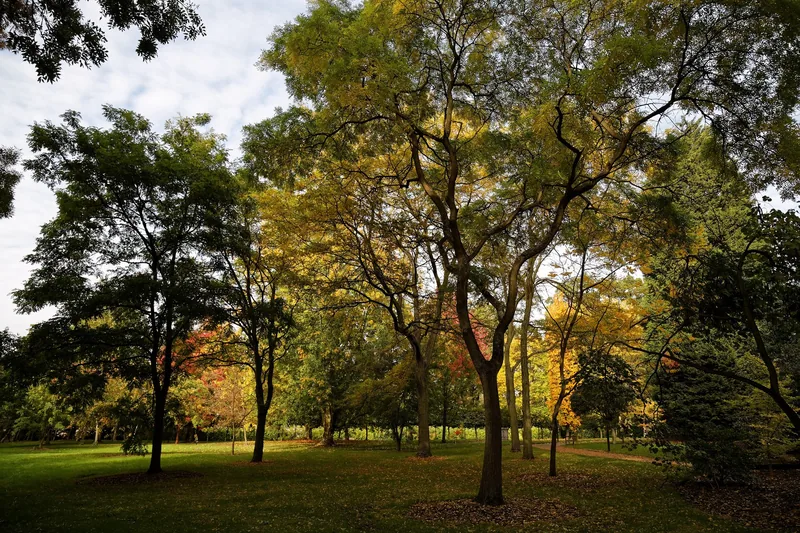
Photo: Acabashi · CC BY-SA 4.0 · Wikimedia Commons · resized
The hour the season turns
Clocks go back one hour at 2am on the last Sunday in October: 25 October in 2026 and 31 October in 2027. Nothing about the weather changes overnight, but the afternoon ends an hour earlier, and from that Monday the city feels like a different place after work.
Plan around it rather than through it. Before the change, a 4pm start still gives you usable daylight for a park or a viewpoint. After it, 4pm is the end of the afternoon, and anything outdoors needs to happen before lunch.
The park gates close on dusk, and dusk moves weekly. Most of the Royal Parks and the big cemeteries lock at or shortly after sunset rather than at a fixed hour, so a closing time you read in September will be wrong by the end of October. Check the day you go.
Why we think the light is the best of the year
This is a judgement rather than a measurement, but it is one worth acting on. In late October and November the sun never gets high, so what would be midday glare in July becomes a low raking light across the whole afternoon, and London's stone and brick take it well. Combine that with 71 hours of sunshine spread thinly across November and you get a small number of afternoons that are genuinely spectacular and a lot that are flat grey.
The practical consequence is that autumn rewards flexibility more than any other season. Keep the viewpoint, the park and the river walk as the things you do when the forecast turns good, and keep the galleries for the rest.
What closes, month by month
Autumn is when London's seasonal layer shuts. For a 2026 visit the list is long and specific.
| Date | What changes |
|---|---|
| 27 September 2026 | Buckingham Palace's summer opening of the State Rooms ends. Only occasional guided tours run from October. |
| 28 September 2026 | Kew Palace and the other Historic Royal Palaces sites inside Kew close until spring 2027. |
| 1 October 2026 | Swimming at the Hampstead Heath ponds becomes cashless only. The single swim stays £5. |
| 25 October 2026 | Clocks go back. Kew's closing time drops to 4pm, and the Royal Mews shortens to 4pm for its final week. |
| 1 November 2026 | The Royal Mews season ends. Bus and tram single fares rise from £1.75 to £1.85 and the daily bus cap from £5.25 to £5.55. |
| 2 November 2026 | The Royal Observatory at Greenwich closes for rebuilding; the Meridian Courtyard is due back in summer 2027. Dover Castle goes to weekends only until 20 December. Kew's Lion Gate becomes weekends only. |
| 12 November 2026 | Kew's closing time drops again, to 3.15pm. |
The Observatory closure is the one that changes an itinerary rather than a detail. If Greenwich is on your list and you are travelling after 2 November 2026, read our page on the Royal Observatory and Cutty Sark before you plan the day, because the rest of Greenwich is unaffected and still worth a morning.
What gets cheaper
Two large attractions cut their prices in autumn, and both changes are published rather than negotiable.
Kew Gardens moves to off-peak pricing on 1 November: an adult ticket booked online falls from £25 to £17, or £20 at the gate instead of £28. Kew also runs £10 Tuesdays from 8 September to 29 December 2026. The shorter afternoon is the trade, since the gardens close at 4pm and then 3.15pm.
Kensington Palace drops from £24.70 to £19.00 for an adult from 11 November 2026, when the exhibition that the higher price covered comes down. If you do not specifically want that exhibition, waiting a fortnight saves £5.70 a head.
Early November is the cheapest fortnight of the autumn. Half-term has finished, the Christmas season has not started, and hotel demand sits at its lowest point between January and March. We cannot publish reliable average room rates, but the pattern is consistent year to year. When to book a London hotel covers how far ahead to commit.
The galleries in autumn, and two paintings that are not there
Autumn is when the big paid exhibitions open and when the free collections are at their most comfortable: school groups aside, a Tuesday in November is the emptiest a national gallery gets outside January.
Two things to check before you build a day around a specific picture. At the National Gallery, Van Gogh's Sunflowers is on loan to Philadelphia until 11 October 2026 and Constable's The Hay Wain is in Ipswich until 4 October 2026. Building works also mean some rooms are shut and some paintings have moved.
At Tate Britain, the Millbank entrance is closed until 2027, so you enter from Atterbury Street, and Millbank Pier is temporarily not step-free. That second point matters if you were planning to take the boat between the two Tates: the crossing to Tate Modern still runs, but not step-free from the Millbank end.
Colour, deer and the two outdoor things autumn does best
The leaves are a separate subject and we have given them their own page: autumn colour in London names the individual trees worth crossing the city for and explains how to tell, before you travel, whether the turn is early or late.
The other one is the deer rut, from September to November in Richmond Park and Bushy Park. The Royal Parks ask visitors to keep at least 50 metres from deer all year, and at least 100 metres during the rut if a male seems active. Feeding them is illegal. It is the most dramatic wildlife in London and the easiest to get wrong: use a long lens, stay on the path, and do not walk between two animals.
Half-term, Halloween and fireworks
The late-October half-term week is the busiest week of the autumn at every indoor attraction, and it lands when the weather has already turned. There is no single national list of English term dates, so check the borough or the school if you need the exact week.
Bonfire Night is the other thing to plan around, and in 2026 neither of London's big displays is on 5 November: Battersea Park and Alexandra Palace both run on 7 and 8 November. Both are ticketed in advance. Bonfire Night in London has the times and the prices.
Packing for a season that halves
The gap between a September afternoon and a November one is nine degrees, and no single packing list covers both. September needs what May needs. November needs a waterproof outer layer rather than an umbrella, because the wind on the bridges makes an umbrella useless, and shoes that cope with wet pavement.
The one item people forget is a warm layer for the evening in September, when the daily minimum still averages 11.6°C but a clear night by the river feels colder than that. Our seasonal packing notes sit in London in spring for the other end of the year, and the quiet-hours advice in how to avoid the crowds applies twice over in half-term week.
Frequently asked questions
Is autumn a good time to visit London?
September is one of the best months of the year: 20°C average highs, 157 hours of sunshine and fewer wet days than May. October is a fair trade of weather for smaller crowds. November is dark and wet but the cheapest part of the season, and the museums and theatres do not care about the weather.
Which is the wettest month in London?
November, at 66.6mm and 11.2 days with 1mm of rain or more, with October only marginally behind at 65.1mm. Both are wetter than January. September, at 49.6mm, is drier than every month from October to March.
When do the clocks go back in London?
At 2am on the last Sunday in October, which is 25 October 2026 and 31 October 2027. The afternoon then ends an hour earlier, and park gates that close at dusk move with it.
Is November cheap in London?
The first two weeks are the best value of the autumn, after half-term and before the Christmas lights. From the third week the festive season starts and prices climb again. Two attractions also cut their published prices in November: Kew Gardens and Kensington Palace.
What is closed in London in autumn 2026?
Buckingham Palace's State Rooms close for the year on 27 September, Kew Palace on 28 September, the Royal Mews on 1 November and the Royal Observatory at Greenwich on 2 November. Dover Castle drops to weekends only from 2 November. Kew's own closing time falls to 4pm and then 3.15pm.
Sources
- Met Office - long-term averages, Heathrow, 1991 to 2020 (checked September 2026)
- GOV.UK - When do the clocks change (checked September 2026)
- Royal Botanic Gardens Kew - Tickets and off-peak prices (checked September 2026)
- Historic Royal Palaces - Kensington Palace tickets and prices (checked September 2026)
- Royal Museums Greenwich - Royal Observatory transformation (checked September 2026)
- The Royal Parks - Deer safety advice (checked September 2026)
- National Gallery - Plan your visit (checked September 2026)
- Mayor of London - MD3517, July 2026 fare changes (checked September 2026)