
Spring in London is not one season but three months that behave differently: March is winter with more daylight, May is arguably the best month of the year to visit, and April is a genuine gamble. The averages hide that, which is why a single "spring" packing list is useless and a month-by-month one is not.
The month pages own the events calendar, day by day, and we have not repeated it here: see London in March, London in April and London in May for what is on. This page is about the season itself, which means the weather, the light, what reopens after the winter, what comes into flower, and what all of that does to prices.
Three months in numbers
These are Met Office 1991 to 2020 averages for the Heathrow station, on London's western edge. Central London runs a little warmer, so treat them as the low end for the city rather than the middle.
| March | April | May | |
|---|---|---|---|
| Mean daily maximum | 11.7°C | 15.0°C | 18.4°C |
| Mean daily minimum | 4.1°C | 6.0°C | 9.1°C |
| Sunshine hours in the month | 124 | 177 | 207 |
| Rainfall | 38.8mm | 42.3mm | 45.9mm |
| Days with 1mm of rain or more | 8.5 | 8.8 | 8.0 |
| Days of air frost | 2.9 | 0.8 | 0.03 |
Two things in that table are worth more than the temperatures. The first is sunshine: May gets two-thirds more sunshine hours than March, and the jump from March to April is the biggest month-on-month increase in the year. The second is frost. March still averages nearly three nights below freezing; by May, frost has effectively gone.
Note what does not change. Rainfall is almost identical across the three months, and the number of wet days barely moves. Spring is not drier than winter in London, it is sunnier. Our full-year figures are in London weather and what to pack.
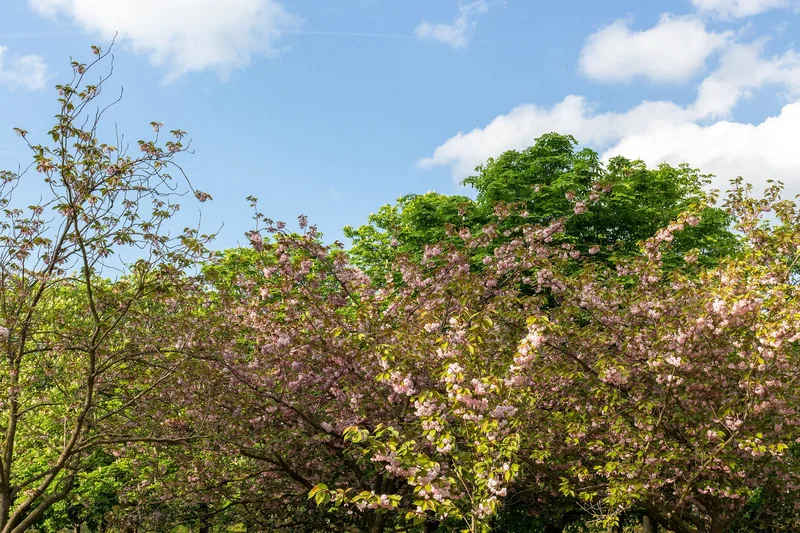
Photo: The wub · CC BY-SA 4.0 · Wikimedia Commons · resized
The evening that arrives overnight
Clocks go forward one hour at 1am on the last Sunday in March: 29 March in 2026 and 28 March in 2027. Nothing about the weather changes, but the usable evening lengthens by an hour in a single night, and London responds to it immediately. Park gates stay open later, pub gardens fill, and the river walks become an evening activity rather than a daytime one.
If you are choosing between the last week of March and the first week of April, that one hour is a real argument for April.
In 2027 the clocks change on Easter Day itself. Easter Day falls on Sunday 28 March 2027, which is also the night the clocks go forward. Large shops may not open at all on Easter Day, and the trains will be running a Sunday service an hour adrift from the body clock of anyone who arrived the day before.
What reopens in spring
This is the part of spring nobody writes down, and for a 2027 visit it matters more than usual. A run of London closures are all scheduled to end in "spring 2027", without dates.
- Kew Palace and the other Historic Royal Palaces sites inside Kew Gardens closed on 28 September 2026 and are due to reopen in spring 2027.
- The Queen's State Apartments at Kensington Palace closed for re-presentation and are due back in spring 2027.
- The Mantegna Gallery at Hampton Court Palace is closed until spring 2027, with two of the Triumphs of Caesar shown elsewhere in the palace meanwhile.
- The Royal Academy's Burlington Gardens entrance is closed until spring 2027.
- Swimming bookings on Hampstead Heath reopen in spring 2027; until then every swim is pay on arrival. The paddling pool is also closed until spring 2027.
Two things are not spring reopenings, and it is an easy mistake. The Royal Observatory at Greenwich closes on 2 November 2026 and its Meridian Courtyard is due back in summer 2027, with tickets from January. The V&A's Fashion Gallery is closed until autumn 2028, which is not a spring problem but a three-year one.
Going the other way, the Royal Mews at Buckingham Palace opens for its season from early March, closed on Tuesdays and Wednesdays, and the Serpentine Lido in Hyde Park usually starts weekend sessions from the middle of May before opening fully in June.
What is actually in flower, and when
Spring flowering in London comes in waves rather than one peak, which is why "when is the blossom out" has no single answer. Our guide to cherry blossom in London breaks it into three separate flowerings and names the trees worth crossing town for.
After the blossom, the sequence that most visitors miss runs like this. Bluebells appear in the woods on the edge of the city through late April. The azaleas and rhododendrons in the Isabella Plantation inside Richmond Park peak in May and are the single best free flower display in London. The roses in Regent's Park follow at the very end of the month.
The one ticketed spring garden event is the RHS Chelsea Flower Show, which runs from 18 to 22 May in 2027, with members' days on the Tuesday and Wednesday and public days from the Thursday. Tickets go on sale in October. Our page on the Chelsea Flower Show has the detail, including how to see the flowers without paying for the show.
From 1 May, dogs must be on a lead everywhere in Richmond Park. The rule runs to 31 July and exists because the deer are giving birth. Keep at least 50 metres from deer at any time of year, and walk away rather than round them. Richmond Park has the full guidance.
Two races that close the roads
Spring holds London's two big spectator races, and both are free to watch from the street. The Oxford and Cambridge Boat Race is on Sunday 11 April in 2027, with the two races at 3.40pm and 4.40pm, on the Championship Course between Putney and Mortlake.
The TCS London Marathon in 2027 runs over two days, Saturday 24 and Sunday 25 April, which the organisers describe as a one-off for the race's hundredth edition. Two days means two days of road closures across the centre and east of the city, and it is the single biggest thing to check before booking an April weekend. We cover watching each of them on our pages for the Boat Race and the London Marathon.
Easter, half-term and the price of spring
Spring contains the two most expensive weeks of the first half of the year, and they move. In 2027, Good Friday is 26 March and Easter Monday is 29 March, so the Easter holidays fall largely in March; in 2026 they fell in April. That shift alone changes which month is the crowded one.
The May bank holidays in 2027 are Monday 3 May and Monday 31 May, and the second of those sits at the start of the late-May half-term week. There is no national list of school term dates in England, so the exact half-term differs between boroughs.
We cannot give reliable average hotel prices, because they change with events and with the day of the week. The pattern across spring is consistent, though: early March is among the cheapest weeks of the year, Easter and the two May bank holiday weekends are among the dearest, and the middle of May is expensive without being a holiday because it is simply the nicest week. The best time to visit London sets that against the rest of the year, and London in autumn is where to look if price is your main concern.
What spring does to a day plan
The practical effect of spring is that outdoor plans become possible but not reliable. A March morning can be 4°C and a March afternoon 14°C, and the same day can hold both sunshine and a squall. Three habits deal with it.
- Keep the indoor option for each day unspent until you see the morning. A museum does not need booking; a park does not need weather.
- Layer rather than pack for a temperature. The gap between the average minimum and maximum in April is nine degrees.
- Check park closing times rather than assuming they lengthen with the clocks. Most Royal Parks close at dusk, which moves weekly through spring, and Greenwich Park in particular is gated.
Frequently asked questions
Is spring a good time to visit London?
May is the best month of the year for a first visit: 18°C average highs, over 200 hours of sunshine, long evenings and no frost. March is cheap but still cold at night, and April is genuinely unpredictable. If you can only travel in spring, aim for the first two weeks of May or the second half of April.
How warm is London in spring?
Average daily maximums run 11.7°C in March, 15.0°C in April and 18.4°C in May at the Met Office's Heathrow station, with overnight minimums from 4.1°C to 9.1°C. March still averages almost three nights of air frost; May averages none.
Does it rain a lot in London in spring?
Less than in autumn, but not dramatically less than in winter. March, April and May each average around eight days with at least 1mm of rain and between 39mm and 46mm of rainfall. Spring's advantage is sunshine hours rather than dry days.
When do the clocks change in London in spring?
At 1am on the last Sunday in March: 29 March 2026 and 28 March 2027. Clocks go forward one hour, so the evening gains an hour and the morning loses one. In 2027 that night is also Easter Day.
Which spring week should I avoid in London?
The Easter weekend, the late-May half-term week, and in 2027 the marathon weekend of 24 and 25 April, when road closures run across the centre for two days rather than one. Early March is the quietest and cheapest part of the season.
Sources
- Met Office - long-term averages, Heathrow, 1991 to 2020 (checked September 2026)
- GOV.UK - When do the clocks change (checked September 2026)
- GOV.UK - UK bank holidays (checked September 2026)
- The Boat Race - 2027 date and race times (checked September 2026)
- London Marathon Events - TCS London Marathon 2027 (checked September 2026)
- Royal Horticultural Society - RHS Chelsea Flower Show 2027 (checked September 2026)
- Royal Botanic Gardens Kew - Opening and closing times (checked September 2026)
- City of London - Booking for swimming at Hampstead Heath (checked September 2026)