
London Design Festival runs for nine days every September, and in 2026 it was the 24th edition, from Saturday 12 to Sunday 20 September. Almost all of it is free to walk into. The parts that charge are the trade fairs and the talks programme, and you can have an excellent day without either.
It is not a festival with a site, a gate or a wristband. It is an umbrella over roughly 350 separate events, run by other people in their own buildings across the whole city. The organisers commission a handful of large public installations, the districts and showrooms do the rest, and the visitor's job is to choose.
That structure is why a lot of people have a disappointing time. They arrive expecting an exhibition and find a map. This page explains what the four parts of the programme actually are, why the districts do not all open on the same days, and which installations are worth crossing London for.
The festival in brief
- 2026 dates
- 12 to 20 September, the 24th edition
- Founded
- 2003, by Sir John Sorrell and Ben Evans
- Scale
- Around 350 events; a record 600,000 visitors in 2019
- Design Districts
- Eleven, from Park Royal in the west to Blackhorse Lane in the east
- Cost
- Installations, districts and showrooms free; fairs and the forum ticketed
The four things the programme is made of
The official programme filters into a small number of categories, and knowing them saves an hour of scrolling.
LDF Projects are the commissioned installations, usually placed in landmark public spaces. These are the free, unmissable part, and they are what most people mean when they say they have been to the festival.
V&A x LDF is the museum strand, covered below. The Partner Programme is everything else: showroom openings, studio tours, product launches, workshops and exhibitions, mostly free, mostly run by the businesses themselves. Design Fairs and the Global Design Forum are the ticketed end, aimed largely at the trade.
The festival website lets you filter by date, by discipline, by type of event and by area of London, which is the only sane way to use it. Pick a day and an area first, then look at what is on.
The installations, and why they outlast the festival
The commissioned projects in 2026 were a good illustration of the range. The Pangolin Shield, by Studio Saar and Atelier One, stood on the pedestrianised stretch of Strand Aldwych for the full nine days: a bamboo grid shell layered with traditional Indian shields and woven farmers' rain covers, arranged like a pangolin's scales into a canopy you could sit under.
At St Paul's Cathedral, the Ukrainian studio Expolight installed two light and media works in the churchyard, Soul showing from 8pm to 11pm and The Point of Unity from 10am to 11pm. Both ran until 26 September, six days after the festival officially closed. Out east, the disused Hydraulic Power Station on Wapping Wall held two spatial sound installations by Max Cooper and Chris Watson for five days, free but requiring a booked ticket. Our page on Wapping and Rotherhithe explains what else is down there.
Some of the best work is still up after the nine days end. Installations in cathedrals, museums and public squares often run for weeks longer than the festival itself. If you arrive in late September, check the individual listing rather than assuming you have missed everything.
The lesson for planning: the installations are scattered, they are free, and their hours differ from one another. Two or three of them plus a district makes a full and satisfying day. Trying to see all of them means a day on the Tube.
The V&A is the one museum to build a day around
The V&A in South Kensington has been the festival's museum partner for years, and its contribution is the most reliable single stop. In 2026 the strand was called Awakenings: a series of commissioned installations placed among the permanent collection, all free, and running until 18 October, a month after the festival closed.
The museum publishes a self-guided trail linking ten of the pieces, which takes about 25 minutes of walking. That is the most efficient design experience in London during the festival, and it costs nothing. The Digital Design Weekend, held over the final weekend of the 2026 festival, added workshops and demonstrations across the museum, again free and without tickets except where individually stated.
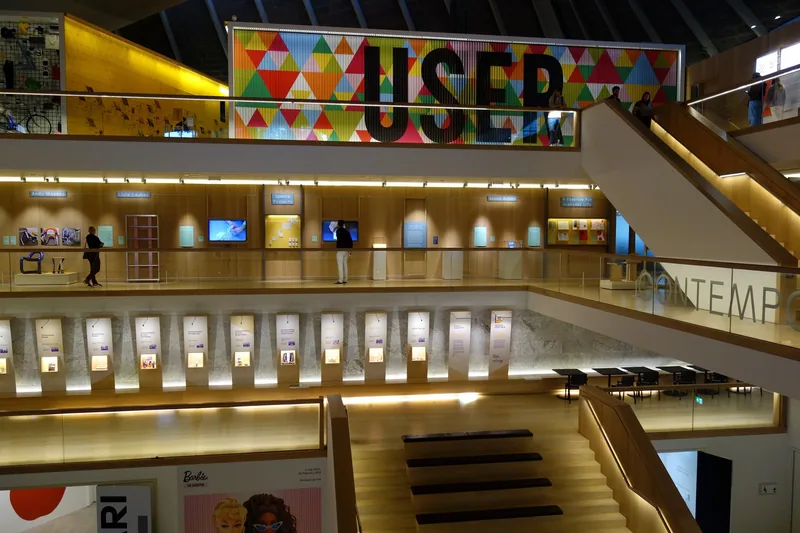
If you want design in a building dedicated to it rather than scattered through a collection, the Design Museum in Kensington has a free permanent gallery and paid exhibitions alongside it. Somerset House, which runs an exhibition programme of its own, stands on the Strand a couple of minutes from the Aldwych installation site.
The eleven districts, and the dates trap
The Design Districts are self-organising clusters, each with its own coordinator and its own sub-programme. The important and badly publicised fact is that they do not all run for the full nine days.
| District | Where it is | 2026 pattern |
|---|---|---|
| Shoreditch Design Week | Shoreditch and Hoxton | 15 to 20 September; over 60 showrooms; four main venues in the first three days |
| Park Royal | West London's largest industrial estate | 11 to 12 September only, as a new festival called Manufactory |
| Blackhorse Creates | Blackhorse Lane, Walthamstow | 18 to 19 September, as an open weekend of workshops |
| Brompton | Around the V&A and Brompton Road | Curated exhibitions across the festival week |
| Bankside | Borough Yards to Coin Street | Run by the Better Bankside business district |
| EC1 | Farringdon and Barbican | Architecture practices and trade showrooms |
| Mayfair, Soho, Chelsea | Central showroom districts | Largely weekday showroom openings |
| Fleet Street Quarter | Fleet Street and St Paul's | Host to the cathedral installations in 2026 |
| Dalston to Stokey | Dalston and Stoke Newington | Independent studios and small galleries |
Shoreditch is the largest district and the easiest to do on foot; our guide to Shoreditch covers the same streets the rest of the year. Park Royal, in west London, has more than 250 creative studios and opens them for a single weekend, which is the only time most of them are accessible. Walthamstow's Blackhorse Lane does the same on the following weekend.
Showrooms close at the weekend, and studios only open at it. The Mayfair and Chelsea districts are trade showrooms keeping office hours; Park Royal and Blackhorse only open on their one weekend. A Saturday in Mayfair and a Tuesday in Park Royal are both wasted journeys.
What actually costs money
Three things. The design fairs are trade and consumer exhibitions with their own ticketing, held in large venues during the festival week. The Global Design Forum is the talks programme, and tickets are priced accordingly. A minority of workshops and masterclasses in the partner programme charge as well.
Everything else, which is the overwhelming majority of 350-odd events, is free to walk into. Some free events still require a booked ticket because the space is small, as the Wapping sound installation did. The listing for each event says which, and free-but-ticketed places go quickly once the festival is reviewed in the press.
For nine days in September the festival is among the strongest things on our free things to do page, provided you plan around the districts rather than wandering.
There is a further cost that nobody prints: distance. The districts are far apart, and a day spent chasing listings across four of them can burn an hour and a half on the Tube. Park Royal and Blackhorse Road are both Zone 3 stations. Combine either with the centre and your pay-as-you-go travel stops at the Zones 1 to 3 cap of £10.50, provided every touch in and out that day is made on one card or one device.
What a district visit is actually like
Expectations matter here more than in almost any other London festival, because the word "district" covers two completely different experiences.
A showroom district, which is what Mayfair, Chelsea and much of Clerkenwell-adjacent EC1 amount to, means walking into a furniture or lighting company's own shop during its working week. Somebody will offer you a coffee, there will be a new chair on a plinth, and there may be a short talk in the afternoon. It is pleasant, it is free, and it is thin unless you buy furniture for a living.
An open-studio district, which is what Park Royal, Blackhorse Lane and the Dalston cluster amount to, means going into a working workshop and watching someone make something. There is sawdust, there are half-finished objects, and the people talking to you are the people who made them. For a visitor with a general curiosity rather than a professional one, the open-studio weekends are the better half of the festival by a distance, and they are the half that happens on only one or two days.
Between the two sit the big cultural venues, where the work is curated and permanently staffed, and those are the safest bet if you have one afternoon and cannot risk a closed door.
Two days that work
A weekday, central. Start at the V&A in the morning for the commissioned trail, walk or take the Tube to the Brompton showrooms around it, then go east to Strand Aldwych for whatever the year's landmark installation is. Finish in the City at dusk if the year has a light piece at the cathedral, since those only come alive after dark.
A weekend, east. Shoreditch on the Saturday, on foot, with a break at Tate Modern or around Bankside if you want to cross the river to the Bankside district. Blackhorse Lane or Park Royal on the Sunday, depending on which weekend you are here, for the open studios that only happen once a year.
What does not work is trying to combine the two halves of the city in a day. The districts are genuinely spread out, from Park Royal in the far west to Walthamstow in the north-east.
Not to be confused with Clerkenwell Design Week
London has two large design weeks, and they are separate events run by separate organisations. Clerkenwell Design Week takes place in May, is concentrated in the showrooms and studios around Clerkenwell, and is more heavily focused on furniture and interiors for the trade. London Design Festival is in September and is city-wide.
The EC1 Design District, part of the September festival, covers roughly the same Farringdon streets, which is where the confusion starts. If a travel article tells you to visit Clerkenwell for London Design Festival, check the month it was written for.
The other self-guided weekends
The festival belongs to a family of London events that hand you a map and let you get on with it. Open House Festival, in the same month, opens private buildings. London Open Gardens in early June opens locked gardens on a single ticket. Chelsea in Bloom in May is a free floral trail around a single district, and works in much the same way as a design district does.
Our month guide to London in September sets the festival alongside everything else in the diary, including the free outdoor performance festival that runs in the south-east at the start of the month.
Frequently asked questions
When is London Design Festival 2027?
No 2027 dates had been announced by our September 2026 check. Nine days in the second half of September, beginning on a Saturday, is the settled pattern. The organisers put the dates on their own site well over a year ahead, and the full programme goes live during the summer before.
Is London Design Festival free?
Most of it is. The commissioned installations, the district programmes, the showroom openings and the V&A strand are all free to enter, though a few of the free events need a booked ticket because of limited capacity. The design fairs and the Global Design Forum talks are ticketed and priced for a professional audience.
Where is the best place to start if I only have one day?
The V&A in South Kensington, then whichever district is running that day. The museum's commissioned installations are free, concentrated in one building, and signposted as a short trail, which makes them the most reliable part of the whole festival for a visitor with limited time.
Do I need to work in design to enjoy it?
No for the installations and the museum strand, which are made for a general public. The trade showrooms and the EC1 district are a different matter: they are aimed at architects and specifiers, and a visitor with no professional interest will find them dry.
Can children come?
Yes, and the public installations and the V&A weekend programme suit them well, since both are physical, large and hands-on. The showroom districts do not. Nothing about the festival is designed around families, so treat it as an adult day with some good stops rather than a children's outing.
Sources
- London Design Festival - dates and 2026 programme (checked September 2026)
- London Design Festival - history and scale (checked September 2026)
- London Design Festival - Shoreditch Design Week district (checked September 2026)
- London Design Festival - Park Royal Design District (checked September 2026)
- London Design Festival - The Pangolin Shield, Strand Aldwych (checked September 2026)
- London Design Festival - The Point of Unity and Soul, St Paul's (checked September 2026)
- Victoria and Albert Museum - V&A x LDF: Awakenings (checked September 2026)