
Ely Place is a gated cul-de-sac off Charterhouse Street in Holborn that has never been an ordinary London street, and at number 14 stands St Etheldreda's, built in about 1290 and described by the Diocese of Westminster as the oldest Roman Catholic church in England. Both are free. Twenty minutes covers the street and the chapel; an hour if you go down into the crypt and sit for a while.
The street matters because of what it is not. It is privately managed rather than maintained by the council, it is closed at one end by gates, and for centuries it was legally treated as a piece of Cambridgeshire that happened to sit in London, because the land belonged to the Bishops of Ely. Parish constables from the City had no business here. Something of that oddity survives in the fact that a short row of Georgian terraces in the middle of Holborn has almost no traffic on it.
The chapel is the last fragment of the bishops' London palace, which once covered about 58 acres of orchards, vineyards and gardens running down towards the Fleet. Everything else went. This one building survived because it was too useful to knock down, and it is one of only two structures left in London from the reign of Edward I.
Ely Place and St Etheldreda's at a glance
- Address
- St Etheldreda's Church, 14 Ely Place, Holborn Circus, London EC1N 6RY
- Admission
- Free. The parish takes donations but sells no tickets
- Open
- The Diocese of Westminster states that the church is open every day. Hours are not published online, so phone 020 7405 1061 if you are making a special journey
- Mass
- Sunday 9am and 11am (the 11am is Sung Latin); Monday to Friday at 1pm. Confession Monday to Friday at 1.20pm
- Built
- About 1290, for John de Kirkeby, Bishop of Ely and Treasurer of England
- Nearest stations
- Chancery Lane (Central line) and Farringdon (Elizabeth line, Thameslink and four Underground lines), both five to seven minutes on foot
- How long
- Twenty minutes to an hour
Finding the entrance, which is the hard part
Ely Place does not announce itself. From Holborn Circus, walk east along Charterhouse Street with the jewellery shops of Hatton Garden on your left. About a hundred metres along, on the north side, a narrow opening between buildings is closed off by iron gates and a low kerb. That gap is the street. Most people walk past it twice.
Coming the other way, from Farringdon station, follow Charterhouse Street west past the Smithfield market buildings and the gates appear on the right before you reach the traffic lights at the Circus. The church is a third of the way up on the left-hand side, behind an unremarkable doorway between two brick houses. The only clue is a small notice board.
The doorway at number 14 looks like a private house, because it was one. The chapel sits above and behind the street frontage, reached through a short passage. If the outer door is open, walk in; nobody will stop you and there is no desk to check in at.
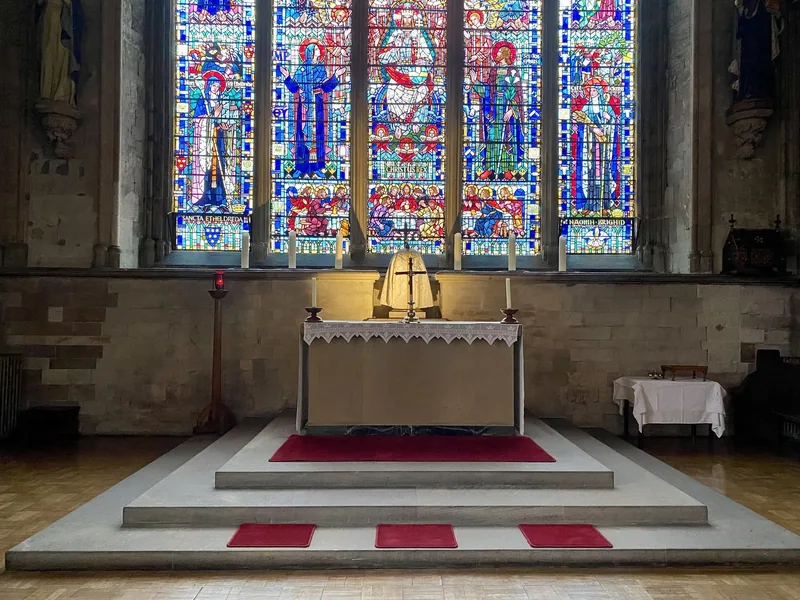
Photo: No Swan So Fine · CC BY-SA 4.0 · Wikimedia Commons · resized
What a private street means for someone walking down it
You are free to walk in. The gates at the Charterhouse Street end are closed to vehicles at night rather than to people, and there is no charge or permission required to stand in the street, look at the houses and read the plaques.
What you will notice is the absence of things. No parked cars from outside, no delivery vans cutting through, no bus stop, no council street furniture. The road surface and the lighting are maintained privately, under a local Act of Parliament passed in 1842 that set up a body of commissioners to run the street. Historically, the commissioners employed beadles, uniformed officers who kept the gates and called the hours through the night. The parish's own history records the cry — eleven o'clock and all's well — as something heard here within living memory of the 1920s.
Whether anyone is on duty when you visit is a matter of luck. There is a small lodge at the entrance, and the office of beadle has not been formally abolished, but the street publishes nothing about its own arrangements and we could not confirm on any official source that the post is filled today. Treat the beadles as a good story rather than a guaranteed sight.
Inside the upper church
The interior is one tall room, and the first impression is of glass. The great east window, by Joseph Edward Nuttgens, was finished in 1952 to replace what a bomb destroyed. Christ is enthroned at the centre, with Mary and Joseph beside him, the Dove above, the four evangelists below and the nine orders of angels filling the upper tracery. It is far brighter and more confident than most postwar church glass, and it is the reason to come in on a sunny morning rather than an overcast afternoon.
Along both side walls stand statues of English martyrs of the Elizabethan persecution, several of them people who lived in these streets. Swithin Wells, a layman with a house near the chapel, let priests say Mass there and was hanged for it in 1591 along with the young priest Edmund Gennings. The statues are not great art. They are there to make a specific point about this specific parish, and they do it.
To the right of the high altar is a jewelled casket holding a relic: part of a hand attributed to St Etheldreda herself, the seventh-century princess of East Anglia who founded the religious house at Ely and gave both the diocese and this chapel their name. Her feast day is 23 June.
The crypt, and why it is the older room
Steps lead down from the back of the upper church into the undercroft, a low, wide, stone-vaulted space that predates the chapel above it. It is used today for weekday services and parish events, and it is usually the quieter of the two rooms.
Its history is less pious than you might expect. During Sir Christopher Hatton's tenancy in the late sixteenth century, part of the undercroft was let as a tavern, and the parish's own account is that singing and brawling downstairs regularly interrupted the services overhead. Archaeologists digging near the pantry in the 1990s turned up Flemish floor tiles from the original thirteenth-century cloister, which had been buried for hundreds of years.
From bishops' palace to auction lot and back
The sequence is worth holding in your head as you look around, because it explains why so little else survives.
| Period | What was happening here |
|---|---|
| c.1250–1290 | The Bishops of Ely acquire land in Holborn and build a London palace. John de Kirkeby builds the chapel in about 1290 |
| 1300s–1400s | The estate grows to some 58 acres. John of Gaunt lives at Ely House after the Savoy is burnt in the Peasants' Revolt of 1381 |
| 1576 | Elizabeth I forces Bishop Cox to lease most of the grounds to her favourite Sir Christopher Hatton for £10, ten loads of hay and one red rose a year |
| 1570s–1600s | Hearing Mass becomes a capital offence. Swithin Wells is hanged outside his own front door nearby in 1591 |
| 1620 | The Spanish ambassador, the Count of Gondomar, moves into Ely Place. Because an embassy counts as foreign soil, Mass is legally said here again, and Londoners flock to it |
| 1642 | Parliament takes over Ely House and the chapel as a prison and a hospital |
| 1666 | The Great Fire burns to within a short distance of the chapel before the wind turns |
| 1772 | An Act of Parliament lets the bishop sell the site to the Crown. The buyer, Charles Cole, pulls down every building except the chapel and lays out the terrace you walk along today |
| 1874 | The chapel is bought at auction by the Rosminian order, under Father Lockhart, and restored |
| 23 June 1878 | Solemn High Mass is sung here for the first time in more than two hundred years |
| May 1941 | A bomb tears a hole in the roof and destroys what glass remained. Repairs take seven years |
The 1874 auction is the hinge. It is what allows the diocese to make the claim on its parish page that this is the oldest Roman Catholic church in England, and it is also why that claim needs a qualification: the building is very old, but its return to Catholic use is Victorian. For a comparison of what an unbroken medieval parish church looks like, St Bartholomew the Great is ten minutes' walk east and is the older building of the two.
The strawberries, and the line from Shakespeare
The bishops' gardens here were famous for strawberries, and the reason everybody knows that is a single line in Richard III, where Gloucester interrupts a council meeting to tell the Bishop of Ely that he saw good strawberries in his garden in Holborn. Shakespeare used Ely House twice: John of Gaunt's speech about "this sceptred isle" in Richard II is set here too.
The strawberry connection is still marked with a fayre held in the street in early summer, organised by the local business district rather than by the church. Dates are announced only a few weeks ahead and were not published for next year when we checked, so ask locally in May rather than planning a trip around it.
Weekday lunchtimes are when this corner comes alive. Leather Lane market, two minutes west, trades Monday to Friday and is busiest between 10am and 4pm, with street food stalls along its whole length. At weekends the market is gone, the offices are empty, and Ely Place is almost silent — which some visitors prefer.
Eating and drinking within three minutes' walk
The obvious answer is the tiny pub in the alley that runs between Ely Place and Hatton Garden. It is genuinely old, genuinely small, and covered in our guides to London's oldest pubs and to walking routes between them, so we will not repeat the history here. The practical point is that it keeps office hours and is heaving between 5pm and 7pm on weekdays.
The better lunch is Leather Lane. Camden Council runs it as a street market Monday to Friday; traders may set up any time from 7am, but the reliable window is 10am to 4pm, and it is a lunch market first and foremost, with hot food from a dozen cuisines, plus fruit, flowers and clothes. It has traded on this ground since the seventeenth century and is the largest street market Camden still runs. Where it sits against the alternatives is set out in our guide to eating cheaply in the capital.
Hatton Garden itself, the street immediately west, is the centre of the British jewellery trade rather than a place to eat. It is worth two minutes of your time for the shopfronts alone.
What to combine it with
This is a fifteen-minute stop, so build it into a walk. Going east, you reach Smithfield, the Charterhouse and the Museum of the Order of St John inside twenty minutes, which gives you four medieval survivals in a single afternoon. Going west and south, the Royal Courts of Justice and the Inns of Court continue the theme of enclosed, semi-private London.
Our guide to Clerkenwell covers the district immediately north, and the one to the City explains the boundary that Ely Place sat outside for so long. Two other pages of ours go into buildings that reward the same kind of attention: the old church and burial ground behind St Pancras, and London's interwar architecture. Hardly any of them charges for entry, so they all appear in our round-up of what London gives away.
If you want to see the private courtyards of Holborn that are normally locked, aim for the September week of the Open House festival. And note that Farringdon is now one of the best-connected stations in London: the Elizabeth line puts Heathrow within fifty minutes of this doorstep.
Frequently asked questions
Is St Etheldreda's Church free to enter?
Yes, and nothing is sold at the door: no admission charge, no ticketing of any kind. A donation box stands near the door and the parish relies on it, but visitors are welcome whether they give or not. Services are also open to anyone who wants to sit at the back.
Can you walk into Ely Place, or is it closed to the public?
You can walk in. The street is privately managed and gated against through traffic, but pedestrians are not stopped during the day. It is a public thoroughfare in practice even though it is not a public highway in law, and the church at number 14 depends on people being able to reach it.
Why is St Etheldreda's called the oldest Catholic church in England?
The building dates from about 1290 and was the chapel of the Bishops of Ely, so the fabric is older than any other church in Catholic use in the country. The qualification is that it spent roughly three hundred years out of Catholic hands after the Reformation and was bought back at auction in 1874, so the continuity is in the stones rather than in the worship.
What is the best day to visit Ely Place?
A weekday, if you want the area alive and Leather Lane market trading. A Saturday or Sunday, if you want the street to yourself. Sunday morning is the one time you will hear sung Latin in the chapel, at the 11am Mass.
How do I get to Ely Place by Tube?
Chancery Lane on the Central line and Farringdon are both within about seven minutes' walk. Farringdon is the more useful of the two, because it is served by the Elizabeth line, Thameslink and four Underground lines, and it is step-free. From Farringdon, walk west along Charterhouse Street and the gates are on your right.
Sources
- Diocese of Westminster – About the Parish of Ely Place (checked September 2026)
- Diocese of Westminster – Parish history of St Etheldreda's (checked September 2026)
- Diocese of Westminster – Mass times at Ely Place (checked September 2026)
- Diocese of Westminster – St Etheldreda, the patron saint (checked September 2026)
- Camden Council – Visit Camden's markets, including Leather Lane (checked September 2026)