
East of Tower Bridge there are no bridges, and four ways to cross the river for nothing: two Edwardian foot tunnels, a working car ferry and, since 2025, a free bus that carries cyclists through the Silvertown Tunnel. All four are run by public bodies, none takes a fare, and two of them are open around the clock.
The reason for the gap is the Port of London. Downstream of Tower Bridge the Thames had to stay open for shipping, so nobody was allowed to build across it. Instead the authorities went under, or floated a ferry. The result is a set of crossings that feel like nothing else in the city: a tiled Edwardian tube running under the riverbed, and a free boat that still carries lorries.
They are practical rather than quaint. Each one links two places a visitor might actually want to join up, and using them properly turns two separate half-days into one continuous walk.
The four free crossings
- Greenwich Foot Tunnel
- 370 metres, opened 1902, about 10 minutes end to end. Island Gardens to Cutty Sark. Open 24 hours
- Woolwich Foot Tunnel
- 504 metres, built 1912, about 15 minutes end to end. North Woolwich to Woolwich. Open 24 hours
- Woolwich Ferry
- 06:00 to 22:00 every day. Every 15 minutes until 21:00, then 21:20, 21:40 and 22:00. People, bicycles and vehicles
- Silvertown Tunnel cycle shuttle
- 06:30 to 21:30 daily except 25 December, roughly every 12 minutes. People with a cycle only
- What they cost
- Nothing. There is no card to touch and no ticket to buy
- What is not free
- The London Cable Car (£7.00 one-way for an adult) and the river bus
The Greenwich Foot Tunnel, and what to do when the lift fails
The southern entrance is the round brick building with a glass dome beside the Cutty Sark; the northern one stands in Island Gardens, at the tip of the Isle of Dogs. Inside is 370 metres of white-tiled passage that opened in 1902, with a lift and a spiral staircase at each end. Our guides to Greenwich and the Isle of Dogs cover the two ends; this is about the crossing itself.
Walk it from north to south if you can choose. Coming up the steps at Greenwich into the masts of the Cutty Sark is a better arrival than coming up into a small park. Going the other way, though, gives you the reason most people make the trip: from Island Gardens you can see the whole composition of the Old Royal Naval College, the Queen's House and the Observatory on the hill behind, which you cannot see while standing in it.
The lifts are old, they are large enough for bicycles and pushchairs, and they fail. If the lift is out at one end, the staircase is the only alternative, and it is a long spiral. Two answers. The Royal Borough of Greenwich, which manages both tunnels, publishes a live status page for the tunnels and their lifts; check it before you commit, particularly with luggage or a wheelchair. And if the crossing is unusable, the DLR covers the same gap from Island Gardens to Cutty Sark in a few minutes; see how the DLR and the Overground lines work.
Cyclists must dismount for the whole length. Visit Greenwich puts it as "without exception", and at commuting times the tunnel is busy enough that it is not worth testing. Taking a bicycle through on foot is entirely normal and nobody minds.
The tunnel is 24 hours but the lifts are the weak link. Check the borough's live tunnel status page the morning you plan to use it, and have the DLR as a backup if either lift is out of service.
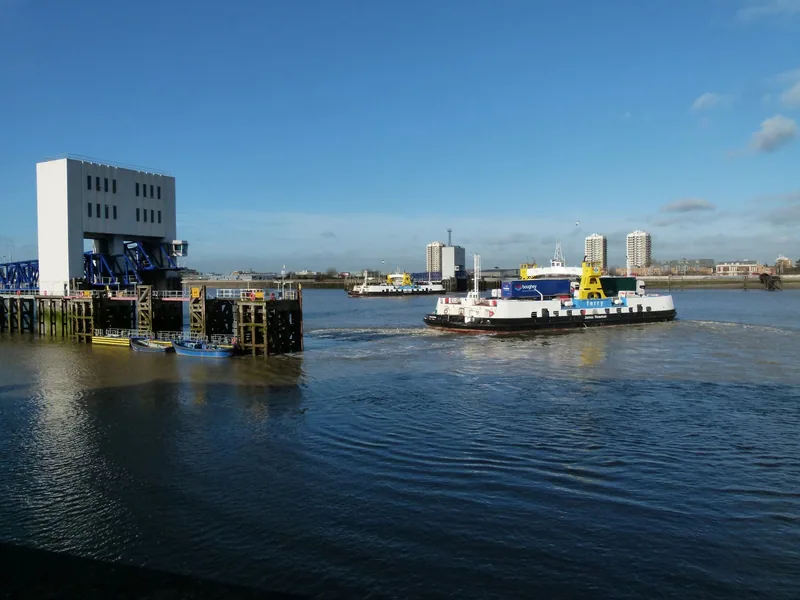
Photo: Kleon3 · CC BY-SA 4.0 · Wikimedia Commons · resized
The Woolwich Foot Tunnel, which almost no visitor uses
Ten years younger and a third longer, the Woolwich Foot Tunnel runs 504 metres from Woolwich High Street on the south bank to North Woolwich. It was built in 1912 by the London County Council to get dockworkers to the yards on the north side in any weather, and its southern rotunda is a listed building. It is open 24 hours, with stairs and a lift at each end, and the same rule about pushing bicycles applies.
It is emptier, plainer and slightly eerier than Greenwich, and that is the appeal. It is also the point where the Thames Path National Trail crosses the river and connects onwards to the England Coast Path, as our guide to London's long-distance walking routes explains.
Be realistic about the lifts here. They have a poor record, the tunnel has closed at short notice for drainage work in the past, and the borough's status page is the only reliable guide. If you are making a plan that depends on getting across at Woolwich, the ferry terminal is a couple of minutes away on the same bank, and far more dependable.
The Woolwich Ferry: a free boat with lorries on it
This is the oddest free thing in London. TfL owns and operates a pair of ferries between Woolwich, on the south bank, and North Woolwich. They carry pedestrians, cyclists, cars, vans and lorries, and none of them pays anything. There is no ticket office, no reader to touch, and no queue for foot passengers.
The service runs from 06:00 to 22:00 seven days a week, with departures every 15 minutes until 21:00 and then at 21:20, 21:40 and 22:00. The timetable is identical on Saturdays, Sundays and public holidays, which is unusual for anything in London.
As a passenger you walk on, stand at the rail or sit inside, and step off on the other bank. The crossing is short. What makes it worth doing is the view: this is the working river, with the Thames Barrier upstream, cranes and aggregate wharves on both sides, and container traffic heading for the estuary. It is the opposite of the tourist stretch between Westminster and Tower Bridge.
Two things suspend it. TfL says the ferry is not usually affected by tides, but the service is stopped at extremely high tides, and it is also stopped in dense fog. Check the TfL river status page if the weather is thick. Vehicles have size limits, 4.7 metres high and 3.5 metres wide, and anything displaying Hazchem signs is refused. If you are driving in London at all, the rules on the Congestion Charge and the ULEZ matter far more than the ferry does.
The ferry is the only crossing here that never needs a lift. Step-free from the road on both banks, no stairs and no spiral, which makes it the sensible choice with a pushchair, a wheelchair, a heavy suitcase or a bicycle you would rather ride than push.
The newest one: the Silvertown cycle shuttle
When the Silvertown Tunnel opened on 7 April 2025 it came with a problem: you cannot walk or cycle through a road tunnel. TfL's answer was a dedicated shuttle bus that carries people with bicycles across, and it is free to use until further notice.
It runs every day except Christmas Day, from 06:30 to 21:30, roughly every 12 minutes, and the trip through the tunnel takes 10 to 12 minutes. The stops are purpose-built shelters on Seagull Lane in the Royal Docks and Millennium Way on the Greenwich Peninsula, both connected to cycle routes. There is nothing to book and nothing to touch; you turn up and get on.
The rules are worth reading before you rely on it. Only people with a cycle may board, plus anyone accompanying a child cyclist or an adult who needs help. Pedestrians without a bike cannot use it. The cycle bay and the non-standard bay each hold up to four standard bicycles, up to seven folding cycles go in the luggage bays, and you strap your bike in yourself; the driver will not set off until everything is buckled. E-scooters are not allowed. Hired bikes, including Santander Cycles, are fine.
For a visitor this matters most if you are cycling the Thames on the north bank and want to reach Greenwich without a long detour. Our guide to cycling in London covers the routes either side, and taking a bike on public transport covers the alternatives.
What the free crossings are not
Two nearby services look like free ways across and are not.
The London Cable Car flies between the Greenwich Peninsula and the Royal Docks, close to the cycle shuttle's route, and has charged an adult £7.00 for a single trip since 1 March 2026. It takes contactless and Oyster, but the fare sits outside the daily cap, so you pay it in full however much else you have done that day.
The Uber Boat river bus crosses the river at several points, including a short Canary Wharf to Rotherhithe link. It is pay as you go, it is not capped either, and it is a better sightseeing trip than a shortcut. Our comparison of the river bus and the sightseeing cruises sets out which is which.
Further west, of course, every bridge is free to walk across. The bridges of London are a walk in their own right, and Tower Bridge is the last of them going east.
Stringing them into one day
The crossings sit in a line down the river, which makes an obvious route.
- Start at Cutty Sark, walk the Greenwich riverfront, then take the foot tunnel north to Island Gardens for the view back.
- Return through the tunnel, or take the DLR one stop, and walk east along the Greenwich Peninsula past the O2.
- From North Greenwich, travel to Woolwich by bus, DLR or Elizabeth line.
- Cross on the Woolwich Ferry, look at the working river, and come back on the next one. It costs nothing and takes about half an hour including the wait.
- Walk five minutes upstream to the Thames Barrier, which is the reason the estuary looks the way it does.
Getting to the ends is straightforward. Cutty Sark and Island Gardens are DLR stations. Woolwich is on the Elizabeth line and Woolwich Arsenal on the DLR, both a few minutes from the ferry and the foot tunnel; King George V DLR serves the north side. All of it counts towards one daily cap, as our page on the zone system explains, and none of the four crossings adds anything to it.
Lifts, buggies and getting across late
The ferry is the accessible option and the reliable one. Both foot tunnels have lifts, and both sets of lifts break. If step-free access is essential, plan around the ferry's hours rather than the tunnels' theoretical 24. Our guide to the step-free network has the wider picture.
After 22:00 the ferry and the shuttle have stopped, and the tunnels are what is left. They are lit, they have help points monitored around the clock, and people do use them at night. They are also long, empty and echoing, and if you would rather not, the DLR runs late from Island Gardens and Woolwich Arsenal; see first and last trains and our advice on getting home late in London.
Frequently asked questions
How long does it take to walk through the Greenwich Foot Tunnel?
Visit Greenwich gives a typical duration of 10 minutes for the 370-metre crossing, and 15 minutes for the 504 metres at Woolwich. Add several minutes at each end for the lift or the spiral staircase, and more if a lift is out of service.
How much does the Woolwich Ferry cost?
Nothing. TfL operates it as a free service for pedestrians, cyclists and vehicles alike. There is no ticket and no card to touch. It runs from 06:00 to 22:00 every day of the week, with boats every 15 minutes for most of that time.
Can you cycle through the Thames foot tunnels?
You may take a bicycle through both the Greenwich and Woolwich tunnels, but you must get off and push it. The rule applies for the whole length with no exceptions. The lifts are big enough for a bicycle, and at busy times the tunnels are too narrow to ride in safely anyway.
Can pedestrians use the Silvertown Tunnel cycle shuttle?
No. The shuttle is only for people travelling with a cycle, plus anyone accompanying a child cyclist or an adult who needs support. Walking and cycling through the tunnel itself is not possible, so pedestrians crossing here need the Woolwich Ferry, a foot tunnel or a bus.
Why are there no bridges east of Tower Bridge?
Because the river below Tower Bridge had to stay navigable for ocean-going ships serving the docks. Crossings were built underneath instead, or provided by ferry. That is why this stretch has foot tunnels, road tunnels and a free ferry rather than bridges.
Sources
- Transport for London - Woolwich Ferry (checked September 2026)
- Transport for London - Woolwich Ferry timetable (checked September 2026)
- Transport for London - Silvertown Tunnel cycle shuttle (checked September 2026)
- Transport for London - Silvertown Tunnel (checked September 2026)
- Visit Greenwich - Greenwich Foot Tunnel (checked September 2026)
- Visit Greenwich - Woolwich Foot Tunnel (checked September 2026)
- Royal Borough of Greenwich - Foot tunnel and lift status (checked September 2026)
- National Trails - Woolwich Foot Tunnel (checked September 2026)