
The Liberty line is three stations long: Romford, Emerson Park, Upminster. A single train shuttles back and forth every half hour, the ride takes nine minutes and costs £2.20 off-peak, and the whole thing shuts down at about a quarter to ten at night and does not start until nearly nine on a Sunday morning. It is the shortest of the six London Overground lines, and almost the only reason a visitor would use it is to avoid a 56-minute detour through east London.
The name came in November 2024 with the other five, and refers to the historic liberty of Havering; our page on the six Overground line names explains it. This page is about the service, because the service has two genuine quirks and one trap that nobody publishes.
The Liberty line in numbers (September 2026)
- Route
- Romford to Upminster, calling at Emerson Park. Three stations, two stops
- Journey time
- 9 minutes end to end
- Frequency
- Two an hour, every 30 minutes, all week
- Weekday service
- First from Romford 06:12, last 21:41; first from Upminster 06:26, last 21:55
- Sunday service
- First from Romford 08:41, last 19:41; first from Upminster 08:55
- Fare
- £2.20 off-peak, £2.30 peak, pay as you go
- Step-free
- All three stations
- If it is not running
- Romford to Upminster the long way round takes 56 minutes and two changes
Three stations, and a timetable that only one train can be working
Romford and Upminster are both substantial stations on main railways. Emerson Park, in the middle, has a single platform on a single track and nothing else. That is the whole line.
The timetable tells you how it is worked. A train leaves Romford at 11 and 41 minutes past the hour, arrives at Upminster nine minutes later, leaves Upminster at 25 and 55 minutes past, and is back at Romford at 34 and 04. Add it up and one train fills the entire half-hour cycle with no room for a second: nine minutes out, five at the far end, nine back, seven waiting. When people say the Liberty line is one train going up and down, the published timetable is the evidence.
It also explains the frequency. Two trains an hour is not a lack of ambition, it is the maximum a single-track branch with one unit can do. A cancellation is a 30-minute gap, and there is no second train behind it.
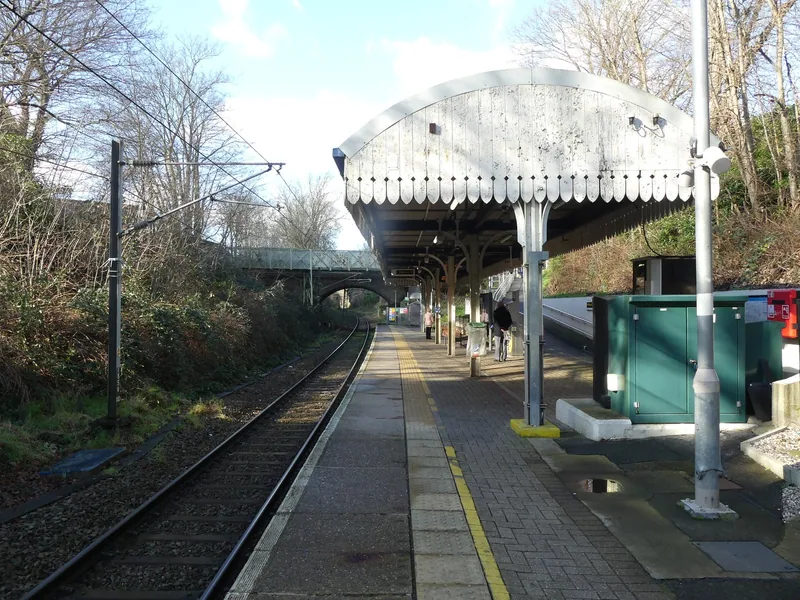
Photo: Sunil060902 · CC BY-SA 4.0 · Wikimedia Commons · resized
The trap: it closes early, and on Sunday it opens late
This is the fact worth knowing before you plan anything around the Liberty line. On a weekday the last direct train leaves Romford at 21:41 and Upminster at 21:55. On a Sunday the first direct train does not leave Romford until 08:41, or Upminster until 08:55, and the last one leaves Romford at 19:41.
Outside those hours the journey still exists, but it goes the long way. National Rail's journey planner offers Romford to Upminster in 56 minutes with two changes before the branch opens on a Sunday morning, routed in towards London and back out again. The nine-minute ride and the 56-minute one are the same two stations.
Do not count on the Liberty line after about 21:45, or before 08:45 on a Sunday. The branch simply stops running, and the alternative is nearly an hour with two changes. If you are coming back from central London late, get off at Upminster or Romford and take a bus or a taxi for the last two miles instead.
What the ride is like
Short, level and unremarkable, which is the honest description. A four-carriage electric train with walk-through carriages and no toilet, running through the back of Romford, across the Ingrebourne valley and into Upminster. Emerson Park, the only intermediate stop, is a suburban halt with one platform, a shelter and a footpath.
There is one thing to look out for. The branch is the last piece of the old Romford to Upminster railway, and at Emerson Park the single track and single platform make it obvious that this was built as a country line rather than a suburban one. It is a two-minute curiosity, not a reason to make the trip.
What the name changed, and what it did not
Nothing about the ticket. Contactless and Oyster work exactly as they do everywhere else, the fare counts towards the same daily and weekly caps, and both ends are in fare Zone 6. Our explainer on how the caps work covers the mechanics, and the zones page explains where Zone 6 stops.
What changed is the information. Before 2024 a problem on this branch was announced as a problem with "the London Overground", alongside 110 other stations. Now it is announced as a problem with the Liberty line, which tells the few thousand people who use it exactly what they need to know and tells everyone else to ignore it. For a two-stop shuttle, that is a bigger improvement than it sounds.
One correction worth making, because it is repeated everywhere including in our own round-up: the Liberty is the shortest of the six Overground lines, but it is not the shortest line on the TfL network. The Waterloo & City line has two stations to the Liberty's three.
Step-free, with one gap
All three Liberty line stations have a step-free route from street to platform in TfL's detailed station dataset. Romford and Upminster both do it by lift; Emerson Park is simply at street level with a level path to its one platform, which makes it one of the easier small stations in London to use with a wheelchair or a pushchair.
The gap is at Upminster, where the dataset records no boarding ramp held at the Overground platform. Step-free to the platform is not the same as step-free onto the train, and this is one of the places where the difference shows. Our page on accessible transport explains how to arrange help in advance.
Both ends are more useful than the line
Romford is the reason the Liberty line still matters. It is an Elizabeth line station, so from Romford you are 30-odd minutes from Liverpool Street, Farringdon, Tottenham Court Road and Bond Street without changing; our guide to how the Elizabeth line works has the frequencies. Romford also has the market, and it is the northern end of the Superloop route SL12, which runs from Gants Hill to Rainham through Romford and Elm Park; see the Superloop and outer London.
Upminster is the eastern terminus of the District line and a c2c station as well, so it is the point where three different railways and the Liberty line all meet. If you are heading into central London from Upminster, the District line is slow but direct and the c2c trains to Fenchurch Street are quick; our District and Circle line page covers the Upminster branch.
Ten minutes' walk from Upminster station, on St Mary's Lane, stands Upminster Windmill, a smock mill listed at Grade II* since January 1955 and one of very few surviving windmills inside Greater London. It opens on limited days rather than daily, so check before you go rather than after. Our guide to Romford and Havering covers what else is out here.
When you would actually use it
Three situations, and they are the only three. You are staying in Romford or Upminster and want to get between them. You have come out on the Elizabeth line to Romford and want the District line or a c2c train, or the reverse. Or you are going to Upminster Windmill or the Hornchurch end of Emerson Park and the bus is slower.
Outside those, the honest answer is that a visitor to London will never need the Liberty line, and that is fine. It exists because 4,000-odd local people a day need it, and it now has a name because every Overground route got one. If you want an Overground line that is worth riding for its own sake, the Mildmay line across north London is the one, and the Suffragette line is the one that leads to the best dinner.
What goes wrong
With one train and one track, everything is a single point of failure. A fault with the train, a trespasser on the line or a problem at either junction removes the whole service, and there is no partial service to fall back on. The replacement is a bus or a long way round.
The other common problem is the assumption that a TfL line runs late because most of them do. It does not. Check the last departure before you build an evening around it.
On a half-hourly shuttle, one missed train is the whole of the delay that Overground compensation requires before it pays out, which makes this the easiest line in London to claim on and the one where hardly anybody does. Complaining in Britain explains the process and the time limit.
Frequently asked questions
How many stations are on the Liberty line?
Three: Romford, Emerson Park and Upminster. That is two stops from end to end, and nine minutes. No Overground line is shorter, though the Waterloo & City beats it on the wider network with two stations.
How often does the Liberty line run?
Every 30 minutes, at 11 and 41 minutes past the hour from Romford and at 25 and 55 past from Upminster. The pattern is the same every day of the week. The timetable is worked by a single train, which is why there are only two an hour.
What time does the Liberty line stop running?
The last train leaves Romford at 21:41 and Upminster at 21:55 on a weekday. On a Sunday the service runs only from about 08:41 to 19:41. Outside those hours the same journey takes 56 minutes with two changes, going in towards London and out again.
Is the Liberty line step-free?
Yes, at all three stations. Romford and Upminster use lifts and Emerson Park is at street level. The one qualification is that TfL's data records no boarding ramp at Upminster's Overground platform, so the step from platform to train there is not covered.
Is the Liberty line worth riding as a visitor?
Only if you have a reason to be at one end. It is a local shuttle through outer east London with one intermediate halt, and there is nothing to see from the window. Use it to connect the Elizabeth line at Romford with the District line and c2c at Upminster, or to reach Upminster Windmill, and not otherwise.
Sources
- Transport for London Unified API - Liberty line stop sequence, three stations (checked September 2026)
- Transport for London Unified API - single fares, Romford to Upminster (checked September 2026)
- National Rail Enquiries - Romford to Upminster departures, first and last trains and the journey via London (checked September 2026)
- Transport for London - detailed station data: lifts, ramps, same-level paths and boarding ramps (checked September 2026)
- Historic England - Upminster Windmill, list entry 1079878, Grade II* (checked September 2026)
- Transport for London - London Overground (checked September 2026)