
Romford has held a market since 1247 and still holds it three days a week: Wednesday and Friday from 9am to 4.30pm, and Saturday from 9am to 5pm. It is twenty-nine minutes from Liverpool Street on the Elizabeth line, and it is a shopping town rather than a sight. What makes the borough of Havering worth a day is what lies beyond it: the London boundary runs through fields, and Havering has more open countryside in it than any other London borough except one.
We will be honest about the proportions. Romford town centre is a large, busy, entirely modern retail centre with a medieval market place embedded in it, a Grade II* church, two listed pubs and the remains of a brewery. That is a good two hours. The marshes, the country parks and the hilltop village north of the town are the rest of the day, and they are the better half.
Our guide to the six Overground line names explains what the Liberty line is, and the Liberty line covers the two-station shuttle from Romford that most visitors never notice. Rainham Marshes owns the nature reserve in the south of the borough.
Romford and Havering at a glance
- Romford station
- Zone 6. Elizabeth line, London Overground (Liberty line) and Greater Anglia. Two lifts and four ramp routes per TfL's station data
- Journey
- 29 minutes to Liverpool Street, 35 to Tottenham Court Road, direct on the Elizabeth line. £4.00 off-peak, £5.90 peak
- Fare cap
- Zone 6 lifts your daily cap to £16.30, from £8.90 for Zones 1 and 2
- Market
- Market Place, RM1 3ER. Wednesday and Friday 9am-4.30pm, Saturday 9am-5pm. Havering Council gives the walk from the station as seven minutes
- Market charter
- 1247, by royal order in the reign of Henry III, originally for sheep and cattle
- Liberty of Havering
- Created by royal charter in 1465, which is where the borough's name comes from
The market, and the three days it trades
Havering Council runs the market and publishes the hours, which are the first thing to get right: Wednesday 9am to 4.30pm, Friday 9am to 4.30pm, Saturday 9am to 5pm. There is no market on Monday, Tuesday, Thursday or Sunday, and a Thursday visit to Romford is a visit to a shopping centre.
The council's own history is worth repeating because it is unusually precise. The market was first opened in 1247 by royal order during the reign of Henry III, selling sheep and cattle, and it became a supplier of goods to London. Havering's conservation area appraisal adds that the town grew up around common ground beside the Great Essex Road, that a chapel dedicated to St Edward the Confessor was built on the Market Place in 1410, and that by 1670 about 323 houses formed a linear town along the Market Place and the High Street.
What trades there now is a general market rather than a food market: clothing for men, women, babies and children, nightwear, jewellery and accessories, homeware and furniture, household goods, toys and books, tools, plants and garden furniture, fruit and vegetables, a fishmonger, a butcher and street food. The traders differ from day to day and casual traders join, so no two Saturdays are identical. Pitches start at £20 a day for a casual trader, which tells you what kind of market it is: a working one, not a curated one.
Dogs are welcome on the market if they are well behaved and on a lead, which is not true of most covered markets in London. The stalls line Market Place and it can be entered from St Edwards Way, Market Link, Laurie Walk, Swan Walk, the High Street, South Street, North Street and Mercury Gardens.
Come on a Friday if you want both halves of the day. Friday gets you the market from nine, and then enough afternoon to reach the countryside north or south of the town before the light goes. A Saturday market is bigger and busier but the buses out to the villages are thinner, and on a Wednesday the town is at its quietest.
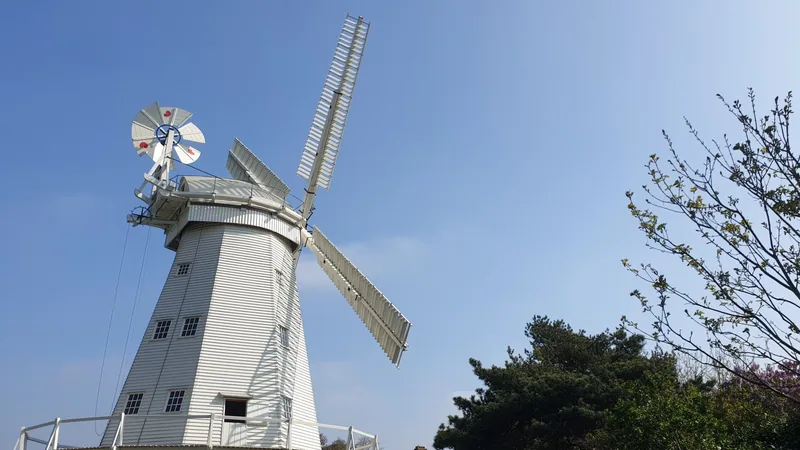
Photo: JRennocks · CC BY-SA 4.0 · Wikimedia Commons · resized
What survives of old Romford, in one walk of forty minutes
The conservation area was designated in 1968 and is one of eleven in Havering. Within a few minutes of the market place:
- The parish church of St Edward the Confessor, listed Grade II* on 4 July 1952. The appraisal records that the medieval chapel of 1410 was rebuilt as the parish church in 1849, and its spire is the landmark you use to orient yourself in the town centre. Church House beside it is listed Grade II, also on 4 July 1952.
- Two listed pubs on the market place and the High Street. The Lamb at 5 Market Place and The Golden Lion at 2 High Street are both listed Grade II, both added on 14 September 1979. Each held a five-star hygiene rating at its last inspection when we checked in September 2026 — The Lamb in April 2026 and The Golden Lion in July 2025 — which is why we are willing to name them. Ratings change at every inspection, so check the current figure on the Food Standards Agency register. Our guides to historic pubs in London and pub etiquette cover the rest.
- Medieval burgage plots. The appraisal notes that the long, narrow medieval plot boundaries remain legible in part along the southern side of Market Place and on the High Street. Once you know to look for them, the rhythm of narrow shopfronts on wide-set buildings is visible all the way along.
- Salem Chapel, listed Grade II on 14 July 1979, and the Roman Catholic church of St Edward the Confessor, listed Grade II as recently as 23 February 2010.
The brewery, which is both there and not there
Romford was a brewing town, and the story is specific. Havering's conservation area appraisal dates the beginning to 1709, when a brewery was established behind the Star Inn — the forerunner of Ind Coope & Sons, which became one of the largest breweries in the country and for two centuries was the biggest employer in the town.
The brewery has been closed and demolished, and a shopping and leisure centre called The Brewery was built on the site south-west of the crossroads. So the name survives on a retail park, which is the outcome most visitors assume is the whole story.
It is not. The appraisal is explicit that Victorian industrial prosperity is represented in the conservation area by surviving brewery buildings as well as by the rebuilt parish church, and it identifies them in the view east along the High Street, next to a pub that has itself changed name. If you want to see the actual brewery rather than the shopping centre named after it, walk east along the High Street and look up at the buildings on the south side. That is the sort of thing a page like this exists to tell you.
Where the countryside starts, and it is not where the trains stop
We need to correct a common impression. The Elizabeth line does not end at Romford and it does not end at the edge of London: its eastern terminus is Shenfield, which is in Essex, well beyond the Greater London boundary, and Romford is four stops short of it. What is true is that Havering is where London runs out, and the open country begins inside the borough rather than beyond the last station.
Four places are worth the bus or the short train ride:
| Where | What it is | How to reach it |
|---|---|---|
| Havering-atte-Bower | A hilltop village on the northern edge of the borough, with a green, a village stocks and views south across London | Bus north from Romford |
| Hornchurch Country Park and the Ingrebourne valley | Marsh, grassland and reed bed on the site of a First and Second World War airfield, with a visitor centre | Bus from Romford, or Hornchurch station on the District line |
| Rainham Marshes | A large RSPB reserve on the Thames, the best bird-watching inside London | Rainham or Purfleet station, then a walk. See our Rainham Marshes page |
| Upminster | The end of the District line, with a preserved windmill and a tithe barn | Liberty line shuttle from Romford, or District line |
Because most of this involves buses, the Hopper fare matters: unlimited bus journeys within one hour of touching in, for a single fare. Our guide to London buses explains it, and the Superloop and outer London buses covers the express routes that make journeys like these bearable.
Saturday morning, if you would rather run than shop
Three free timed 5km parkruns are within reach of Romford on a Saturday at 9am: Raphael parkrun in Raphael Park, which is a little over a kilometre from the market place; Harrow Lodge parkrun in Hornchurch, which also has a junior 2km for children on Sundays; and Ingrebourne Hill parkrun in the valley to the south. Our guide to running routes in London explains the single worldwide registration and the barcode rule that a visitor cannot skip.
Getting here, and whether to bother
Romford is in Zone 6, which is the thing to weigh. The Elizabeth line takes twenty-nine minutes from Liverpool Street and thirty-five from Tottenham Court Road with no change, and the fare is £4.00 off-peak or £5.90 at peak times with contactless or Oyster. Because Zone 6 is involved, a day out here lifts your daily cap from £8.90 to £16.30, so for two people it is about £15 more than a day in the centre before you have bought anything.
The station is one of the better ones in outer London for anyone with luggage or a pushchair: TfL's station data records two lifts and four separate ramp routes from the platforms and the south entrance. Havering Council gives the walk from the station to the market as seven minutes. Our page on how the Elizabeth line works covers the trains and the ticketing.
The verdict. Romford is not a sight and we would not send a first-time visitor to London here. It earns a day from three kinds of traveller: anyone who enjoys a genuine working street market and wants to see one that is neither a tourist market nor a food market; anyone interested in how a medieval market town was swallowed by London, which Romford shows more clearly than most because the plot boundaries survive; and anyone heading for the marshes, the Ingrebourne valley or the villages, for whom Romford is the junction. Compare it with a closer market town before you commit: Walthamstow has a longer street market and is half the distance.
Frequently asked questions
What days is Romford Market open?
Wednesday and Friday from 9am to 4.30pm, and Saturday from 9am to 5pm, according to Havering Council. It does not trade on Monday, Tuesday, Thursday or Sunday. The market is in Market Place, RM1 3ER, which the council gives as a seven-minute walk from Romford station.
How old is Romford Market?
Its charter dates from 1247, granted by royal order in the reign of Henry III, and it began as a sheep and cattle market. The town grew up around common ground beside the Great Essex Road, and a chapel was built on the market place in 1410. The market has been on roughly the same ground for nearly eight hundred years.
Is there still a brewery in Romford?
Not a working one. A brewery was established behind the Star Inn in 1709 and became Ind Coope & Sons, the town's largest employer; it was later closed and demolished, and a shopping centre called The Brewery was built on the site. Some of the brewery buildings survive on the High Street and are named in the borough's conservation area appraisal.
Does the Elizabeth line end at Romford?
No. Its eastern terminus is Shenfield in Essex, four stops beyond Romford and outside Greater London. Romford is in Zone 6 and is twenty-nine minutes from Liverpool Street. Romford is also the western end of the Liberty line, the two-station London Overground shuttle to Upminster.
Is Romford worth visiting?
Only for a specific reason. It is a large modern shopping town with a genuine eight-hundred-year-old market inside it, a Grade II* church and two listed pubs, and it is the gateway to the countryside and marshes of Havering. If you have three days in London, spend them elsewhere. If you like markets or you are going on to the marshes, it works.
Sources
- London Borough of Havering - Romford Market, opening times, history and stalls (checked September 2026)
- London Borough of Havering - Romford Conservation Area Appraisal and Management Plan (brewery, burgage plots and town chronology) (checked September 2026)
- Historic England - Parish Church of St Edward the Confessor, Romford, list entry 1358535, Grade II* (checked September 2026)
- Historic England - National Heritage List for England, Romford Market Place and High Street listed buildings (checked September 2026)
- Food Standards Agency - food hygiene rating register (The Lamb, 5 Market Place RM1 3AB; The Golden Lion, 2 High Street RM1 1HR) (checked September 2026)
- Transport for London - detailed station data (Romford fare zone, lifts and ramp routes) (checked September 2026)
- Transport for London - daily and weekly fare capping (checked September 2026)