
The Waterloo & City line has two stations, Waterloo and Bank, no intermediate stops and no weekend service whatsoever. The journey takes four minutes one way and three the other, it costs the ordinary Zone 1 fare of £3.00 off-peak, and up to nineteen trains an hour run at the morning and evening peaks. Londoners call it the Drain. Unless you are going from a Waterloo train to an office in the City on a weekday, you will never need it.
It is the smallest line on the Tube map and the only one that exists for a single purpose: getting commuters off main-line trains at Waterloo and into the banking district, and back again in the evening. Everything about the service follows from that, including the hours. Our guide to using the Underground covers fares, maps and etiquette; this page is what the line is actually like.
The Waterloo & City line in numbers (September 2026)
- Stations
- Two: Waterloo and Bank, both Zone 1
- Journey time
- 4 minutes Waterloo to Bank, 3 minutes Bank to Waterloo
- Days
- Monday to Friday only. TfL publishes no Saturday or Sunday timetable
- First and last
- 06:00 to 00:20 from Waterloo; 06:06 to 00:26 from Bank
- Frequency
- Every 3 to 7 minutes from 07:00 to 22:59; every 6 to 10 minutes from 23:00
- Busiest hour
- Nineteen departures from Waterloo in the 07:00 and 17:00 hours
- Fare
- £3.00 off-peak, £3.10 peak, and it counts towards the daily cap
- Walking the same route
- 37 minutes, by TfL's own measure
Two stations, and what the timetable actually says
TfL's timetable data for this line contains exactly one schedule, headed Monday to Friday. Nothing for Saturday, nothing for Sunday, not even a thinned-out version: the gates stay locked. Two out-of-date claims circulate about it, that it runs a cut-down Saturday service and that it shuts in the early evening, and neither is true.
Within the week it is a serious railway. From Waterloo there are nineteen departures in the 07:00 hour and nineteen again at 17:00, which is a train every three minutes or so, and twelve an hour through the middle of the day. TfL's own frequency bands are every three to seven minutes from 07:00 to 22:59, and every six to ten minutes in the last hour before midnight.
Our page on first and last Tube trains lists the same hours alongside every other line, which is the place to look if you are comparing.
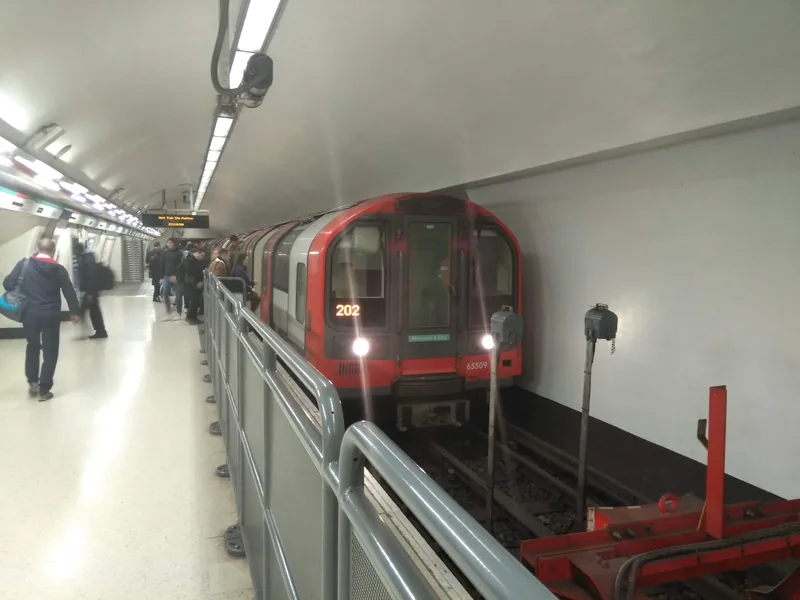
Photo: Hammersfan · CC BY-SA 4.0 · Wikimedia Commons · resized
Three minutes one way, four the other
The station-to-station times in TfL's timetable are not symmetrical: four minutes from Waterloo to Bank, three minutes from Bank to Waterloo. It is the same tunnel; the difference is the gradient, because the line dips between the two stations and the climb out at the Waterloo end is the gentler one.
Nothing happens in between. There are no intermediate stations, no junctions and no views, and the trains run in a pair of narrow deep tubes under the river. A four-minute ride with nothing to look at is the whole experience.
Waterloo has separate arrival and departure platforms
This is the line's real oddity, and it explains the layout if you have ever wondered why you arrive at Bank on one side and leave from somewhere else. At Waterloo the Waterloo & City has two distinct platforms recorded in TfL's station data as arrival and departure rather than as eastbound and westbound, both one level below the main concourse. You get off a train on one and walk round to board on the other.
At Bank the two Waterloo & City platforms sit at the same depth as the Central line. The Northern line at Bank is two levels below that and the DLR one level below again, which is worth knowing because the popular assumption that the Drain is the deepest thing at Bank is wrong. Our page on the Royal Exchange and Bank junction covers the dozen exits at street level, and our Waterloo station guide covers the three separate descents to the Underground there.
Step-free, and that surprises people
Reading TfL's detailed station dataset rather than the network map, both ends of the Waterloo & City line have a step-free route from street level to the platform. At Waterloo the departure platform is reached by a ramp from the Underground booking hall, and the arrival platform has a lift. At Bank the dataset records a two-lift route from a street-level entrance down to the Waterloo & City platforms.
Lifts and ramps are not the same as level boarding, and the step from platform to train is still there, though the data shows a manual boarding ramp available at three of the four platforms. If step-free travel matters, our page on accessible transport sets out how to ask for help without booking, and it is worth telling staff at Waterloo which platform you need, because the two are not interchangeable.
One thing this line does not have is anywhere to put a pushchair: the trains have no multipurpose area, which our page on London with a toddler flags alongside the Central and Bakerloo lines.
The fare, and why it is never worth a separate ticket
Waterloo to Bank is an ordinary Zone 1 single: £3.00 off-peak and £3.10 at peak times with contactless or Oyster, and it counts towards the Zone 1 daily cap of £8.90. There is no special fare and no premium for the shortest ride in London.
The arithmetic that matters is against the alternatives. Walking from Waterloo to Bank takes 37 minutes by TfL's own walking measure, across Waterloo Bridge and through the City. On a weekday the train does it in four. That is the case for the Drain, and it is a strong one for somebody with a meeting.
At a weekend, when the line is shut, TfL's journey planner sends you Bakerloo line to Embankment and Northern line to Bank, which takes eleven to thirteen minutes including the change. That is still faster than walking, and it is the route to use rather than standing at a closed gate. Our comparison of Tube stations it is quicker to walk between covers the cases where the opposite is true.
At the weekend, go Bakerloo then Northern and change at Embankment. Waterloo to Bank takes eleven to thirteen minutes that way, against 37 minutes on foot. The Waterloo & City gates are locked on Saturdays and Sundays and there is no replacement bus, because the line has only two stations and both of them are served by other lines.
Who it is really for
The Waterloo & City line exists because Waterloo is the wrong side of the river for the City. A commuter arriving from Surrey or Hampshire at 08:20 needs to be at a desk near Bank junction by 08:40, and this is the only direct connection. In the evening the flow reverses completely. Between about 10:00 and 16:00 the same trains run half empty.
For a visitor the useful case is narrow but real: you are staying near Waterloo or on the South Bank, it is a weekday, and you want the City early. Four minutes to Bank puts you within a few minutes' walk of the Bank of England, the Royal Exchange, Leadenhall Market and the Lloyd's building. Our guides to the City of London and the Bank of England Museum cover what to do when you get there, and staying on the South Bank covers the Waterloo end.
Outside that, take the Jubilee line from Waterloo, which runs seven days a week and reaches London Bridge, Canary Wharf and Westminster, or walk. The Drain is not a sight, it is a tool.
Where the nickname comes from
Nobody at TfL calls it the Drain and every sign says Waterloo & City, but the nickname is universal among the people who use it: a single tube under the Thames with water at both ends of the day and a river over the top of it. Say "the Drain" at Waterloo and you will be understood; say it to a member of staff and you may get a look.
It is the only Tube line with a nickname in general use, which is a fair measure of how much the people who ride it every day think about it.
What goes wrong
With two stations and one pair of tunnels there is no partial service. When the Waterloo & City closes, it closes completely, and because both its stations are major interchanges there is no replacement bus: you are expected to use the Jubilee, Bakerloo or Northern lines instead.
The line also closes for engineering more often than its length suggests, partly because the only access for heavy maintenance is from the Waterloo end. Summer closures of several weeks have happened before, so check the status page if a four-minute journey is load-bearing in your plans.
Finally, the obvious one: a visitor who arrives at Waterloo on a Saturday and plans on the Drain has lost twenty minutes before they start. There is no sign at the ticket barrier that says "closed all weekend" in a way anyone reads. Our page on the Liberty line makes the same point about a different small line with short hours.
Frequently asked questions
Does the Waterloo & City line run at weekends?
No, and not in any reduced form either: the only schedule TfL publishes for it is headed Monday to Friday. Anything that offers you a Saturday timetable and a Sunday closure is describing an arrangement that no longer exists. Travel Bakerloo line to Embankment and Northern line onwards instead, eleven to thirteen minutes.
How long does the Waterloo & City line take?
Four minutes from Waterloo to Bank and three minutes from Bank to Waterloo, with no stops in between. Trains run every three to seven minutes from 07:00 to 22:59, and there are nineteen departures from Waterloo in the busiest morning and evening hours.
Why is the Waterloo & City line called the Drain?
It is a commuters' nickname, not an official one, and it comes from the line's character: a single narrow tube under the Thames, with no intermediate stations, that fills and empties twice a day. Every sign and announcement calls it the Waterloo & City line.
Is the Waterloo & City line step-free?
TfL's station data shows a step-free route from street level to the platforms at both ends: a ramp and a lift at Waterloo, and a two-lift route at Bank. There is still a step from the platform into the train, and a manual boarding ramp is recorded at three of the four platforms. The trains have no space for a pushchair.
Should a visitor bother with the Waterloo & City line?
Only on a weekday, and only to get from Waterloo into the City. Walking the same route takes 37 minutes, so the four-minute train is genuinely useful if you are going to Bank junction. For anywhere else from Waterloo, the Jubilee and Northern lines run every day of the week and go further.
Sources
- Transport for London Unified API - Waterloo & City timetable from Waterloo: Monday to Friday only, first and last trains, frequency bands (checked September 2026)
- Transport for London Unified API - Waterloo & City line stop sequence and station intervals (checked September 2026)
- Transport for London Unified API - single fare, Waterloo to Bank (checked September 2026)
- Transport for London - detailed station data: platform levels, lifts, ramps and boarding ramps at Waterloo and Bank (checked September 2026)
- Transport for London - daily and weekly capping (checked September 2026)
- Transport for London - live line status and planned closures (checked September 2026)