
The Suffragette line crosses north London from west to east without touching the centre: Gospel Oak at the foot of Hampstead Heath to Barking Riverside on the Thames, thirteen stations, four trains an hour, 40 minutes end to end and £2.40 off-peak. It is almost entirely a local line, and there are exactly two reasons a visitor would get on it.
The name came with the other five in November 2024 and honours the East End movement for votes for women; our page on the six Overground line names covers that. This page is the railway: the thirteen stations, the trains, the interchanges that are really walks, the weekend service, which of the thirteen stations you can actually get into, and the two journeys worth making.
Fares and caps are the same as on the Tube. Our guide to the DLR and the London Overground explains the network as a whole.
The Suffragette line in numbers (September 2026)
- Route
- Gospel Oak to Barking Riverside, 13 stations, no branches
- End to end
- 40 minutes
- Frequency
- Four an hour every day, departing at 09, 24, 39 and 54 past the hour
- First and last from Gospel Oak
- 06:09 and 23:31, arriving 00:11
- Fare, end to end
- £2.40 off-peak, £3.20 peak with contactless; £7.00 for a paper single
- Zone 1
- None of it
- Step-free
- 8 of the 13 stations, two of them by a side entrance
- Newest station
- Barking Riverside, opened 18 July 2022
Thirteen stations, and not twelve
West to east the order is Gospel Oak, Upper Holloway, Crouch Hill, Harringay Green Lanes, South Tottenham, Blackhorse Road, Walthamstow Queen's Road, Leyton Midland Road, Leytonstone High Road, Wanstead Park, Woodgrange Park, Barking and Barking Riverside. That is thirteen, and it is worth counting because the line is often described with twelve: the extension to Barking Riverside added one at the eastern end in 2022 and older descriptions have not all caught up.
There are no branches and no decisions to make. Every train runs the full length, four times an hour, in a pattern you can memorise: nine, twenty-four, thirty-nine and fifty-four minutes past the hour from Gospel Oak.
Most of its interchanges are walks, and the walks are short
Only three stations on the line are proper interchanges. Gospel Oak has lifts and is a real change onto the Mildmay line across north London; the two railways share no other station. Blackhorse Road is a genuine change onto the Victoria line, and it is step-free. Barking is a genuine change onto the District and Hammersmith & City lines and onto c2c services towards Essex; see the District and Circle lines.
Everything else is a walk, and TfL's own walking times make them more useful than they look on a map:
| Suffragette station | Walk to | Minutes |
|---|---|---|
| Upper Holloway | Archway (Northern line) | 6 |
| South Tottenham | Seven Sisters (Victoria line and Weaver line) | 4 |
| Walthamstow Queen's Road | St James Street (Weaver line) | 9 |
| Leytonstone High Road | Leytonstone (Central line) | 7 |
| Woodgrange Park | Manor Park (Elizabeth line) | 5 |
| Crouch Hill | Finsbury Park (Piccadilly, Victoria and National Rail) | 12 |
TfL also notes that Wanstead Park station is a short walk from Forest Gate on the Elizabeth line, which is the quickest connection from this line into central London at its eastern end. None of these walks is signposted as an interchange and none of them gets you an interchange fare automatically, so touch out and touch in as normal and expect to be charged for two journeys. The Weaver line covers the Walthamstow end from the other direction.
What the trains are like
The same units as every other Overground line, which our page on the six lines describes carriage by carriage. The thing worth knowing about this one is how empty it is. Forty minutes end to end, and in the middle of the day you will have a stretch of carriage to yourself in a way that never happens on the Weaver or the Windrush — this is a line of short local hops rather than a commuter run into the centre, so the loading never builds.
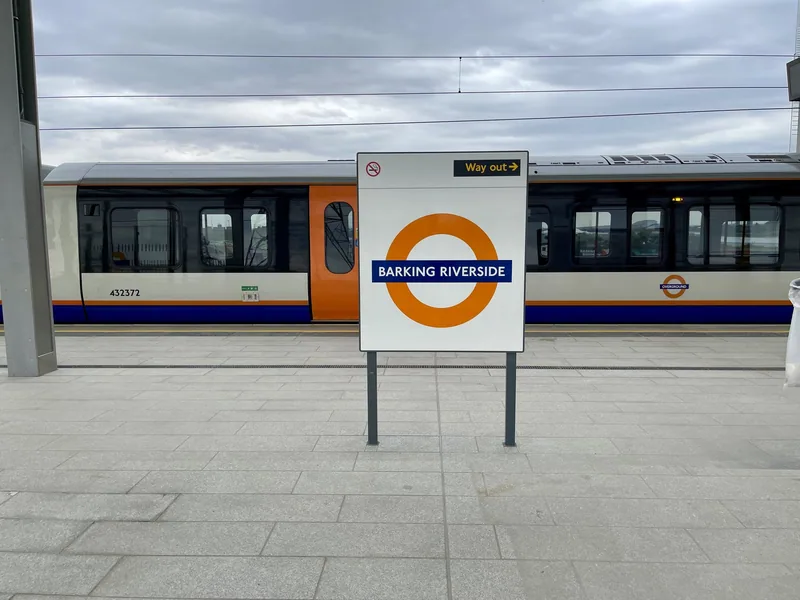
It runs above ground throughout, largely in cutting through north London and then out across the Lea valley and the flatter east. The last few minutes, along the new track to Barking Riverside, are the most interesting: the railway runs on an embankment above new housing with the Thames beyond it, which is not a view you get anywhere else on the network.
The two ends are unlike each other in a way worth knowing before you commit. Gospel Oak is inner north London; Barking Riverside is a new-build riverside development that is still being built. Neither end is a destination in itself, which is the honest position on this line.
Weekends: the one line that does not thin out
The Suffragette runs four trains an hour on a Sunday as well as a weekday, and TfL's Journey Planner gives the same 40 minutes end to end and the same nine, twenty-four, thirty-nine and fifty-four minute departures. There is no reduced weekend timetable, which makes it the most predictable of the six Overground lines across a whole week.
Evenings are the limit. The last train from Gospel Oak leaves at 23:31 and arrives at Barking Riverside at 00:11, after which nothing runs until morning on any night of the week; the Windrush line holds the Overground's only overnight trains. The corridor is covered by buses after that, which take considerably longer.
There is no Tube running alongside this railway for most of its length, so a closure here leaves a genuine hole. Replacement buses between Gospel Oak and Barking follow ordinary roads through Tottenham and Leyton and can take twice as long as the train.
Step-free access: eight of thirteen, and two with a catch
Eight of the thirteen stations can be reached from the street without a stair, on TfL's own station-by-station record of lifts, ramps and level paths: Gospel Oak, Upper Holloway, Harringay Green Lanes, South Tottenham, Blackhorse Road, Walthamstow Queen's Road, Barking and Barking Riverside.
At Upper Holloway and Harringay Green Lanes the step-free route uses one specific entrance rather than the obvious one, so check the station plan before you arrive rather than after. Barking Riverside was built step-free from the start: TfL's press release for the opening described it as fully step-free and said it took the Overground network past sixty step-free stations.
The five that are not step-free are Crouch Hill, Leyton Midland Road, Leytonstone High Road, Wanstead Park and Woodgrange Park, and none of those five holds a boarding ramp at the platform either. Assistance at the eight that do work is turn-up-and-go and needs no booking; our guide to step-free travel explains how to ask.
The journey this line owns: Green Lanes for dinner
Harringay Green Lanes station is on Green Lanes, and Green Lanes is the best stretch of Turkish and Cypriot cooking in London: charcoal grills, bakeries and restaurants that run for the better part of a mile in both directions from the station entrance. The line puts you in the middle of it, four trains an hour, for the price of one capped fare, and it is the only railway that does. From Gospel Oak it is three stops and about nine minutes.
Our guides to Turkish food in London and Greek and Cypriot food in London say which places to go to and what a meal costs, and the Turkish breakfast is a separate and cheaper proposition earlier in the day. The station is step-free by one entrance, which matters on a street this long.
Harringay Green Lanes is the station, Harringay is not. There are two stations with almost the same name in the same neighbourhood, on different railways. Harringay Green Lanes is the Suffragette line station on Green Lanes itself; Harringay, without the Green Lanes, is a Thameslink station several minutes away on the other side of the Ladder. Type the full name into the journey planner.
The other journey: seven minutes to Barking Riverside
The eastern extension is the newest railway in this guide and it does something specific: it connects Barking Riverside to Barking town centre in seven minutes, where the alternative used to be a 25-minute bus. TfL opened it on 18 July 2022 along 4.5 kilometres of new track.
For a visitor, the reason to go is the pier rather than the station. Barking Riverside is the eastern end of the Uber Boat river bus network, so you can arrive by train and leave by boat down the Thames to Greenwich, Tower Bridge and Westminster, or the reverse. Our page on the Thames Clippers river bus has the fares and the caution that boat fares sit outside the daily cap, and Barking and Dagenham covers what is at that end. It is a long way out, and it is honestly a transport curiosity rather than a sight.
Both ends of the line, and what is near them
Gospel Oak is five minutes' walk from the southern edge of Hampstead Heath and the Parliament Hill path, which is the best thing anywhere near either terminus. One stop east, Upper Holloway is six minutes from Archway and the climb to Highgate; two stops east, Crouch Hill is the station for the Parkland Walk and Crouch End, though it has stairs only.
At the Walthamstow end, Blackhorse Road and Walthamstow Queen's Road both put you within walking distance of the Walthamstow Village and market, and Blackhorse Road is the step-free one and the Victoria line change.
What goes wrong
Single-track sections and level crossings along the eastern half mean that one late train tends to make the next one late too, and with four trains an hour a cancellation is a fifteen-minute wait at best. The line also crosses several busy freight routes, and a freight delay in the Lea valley shows up as a Suffragette delay.
The other common problem is human rather than mechanical: because most of the connections on this line are walks rather than interchanges, journey planners sometimes offer a two-station walk in the rain as though it were a platform change. Read the plan before you accept it.
Because the knock-on effect tends to run through a whole afternoon rather than hitting one train, journeys on this line reach the half-hour mark at which Overground compensation becomes claimable more often than the timetable suggests. See complaining in Britain for how and by when.
Frequently asked questions
How many stations are on the Suffragette line?
Thirteen: Gospel Oak, Upper Holloway, Crouch Hill, Harringay Green Lanes, South Tottenham, Blackhorse Road, Walthamstow Queen's Road, Leyton Midland Road, Leytonstone High Road, Wanstead Park, Woodgrange Park, Barking and Barking Riverside. Descriptions that say twelve predate the Barking Riverside extension of July 2022.
How long does the Suffragette line take end to end?
Forty minutes from Gospel Oak to Barking Riverside, and the same coming back, with four trains an hour at nine, twenty-four, thirty-nine and fifty-four minutes past. The pattern is identical on Sundays. Pay as you go costs £2.40 off-peak and £3.20 at peak times.
Does the Suffragette line connect to the Tube?
Directly at two stations: Blackhorse Road for the Victoria line and Barking for the District and Hammersmith & City lines. Elsewhere the connection is a short walk, from Upper Holloway to Archway in six minutes, South Tottenham to Seven Sisters in four, and Leytonstone High Road to Leytonstone in seven.
Is the Suffragette line step-free?
At eight of its thirteen stations. Crouch Hill, Leyton Midland Road, Leytonstone High Road, Wanstead Park and Woodgrange Park are not step-free and have no boarding ramp. Upper Holloway and Harringay Green Lanes are step-free only from one particular entrance, so check the station layout before travelling.
Which station do I use for the Turkish restaurants on Green Lanes?
Harringay Green Lanes, three stops and about nine minutes east of Gospel Oak. The station entrance is on Green Lanes itself, in the middle of the restaurants and bakeries. Do not confuse it with Harringay station, which is on a different railway several minutes away.
Sources
- Transport for London Unified API - Suffragette line stop sequence, thirteen stations (checked September 2026)
- Transport for London - Barking Riverside station to open 18 July (press release, 11 July 2022) (checked September 2026)
- Transport for London Unified API - single fares, Gospel Oak to Barking Riverside (checked September 2026)
- Transport for London - detailed station data: lifts, ramps, same-level paths and boarding ramps (checked September 2026)
- Transport for London - London Overground (checked September 2026)
- Transport for London - about the River Bus, including Barking Riverside pier (checked September 2026)