
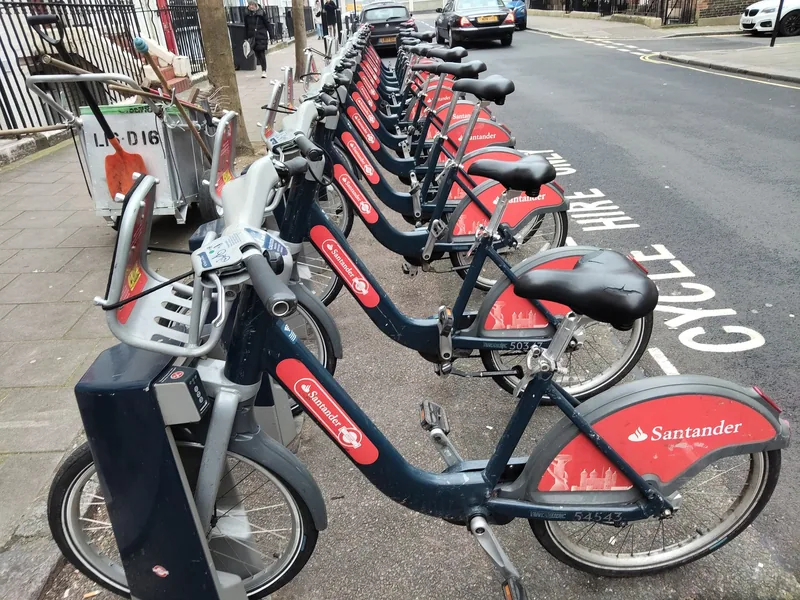
A Santander Cycle costs £1.65 for a ride of up to half an hour, or from £3.50 for a Day Pass that gives you unlimited hour-long rides for 24 hours. You take a bike from a docking point, ride it, and push it into a free docking point somewhere else. The only thing that catches visitors out is the clock: every ride has a time limit, and the charge restarts the moment you go past it.
Our wider guide to cycling in London covers the road rules, safety in traffic and the Cycleway network. This page is about operating the machine: how to get a bike out, what happens when the dock is full, which button to press when something is broken, and how to avoid the charges that turn a £1.65 ride into £10.
Santander Cycles: the numbers that matter
- Single ride, pedal bike
- £1.65 for up to 30 minutes, then £1.65 for every extra 30
- Day Pass
- From £3.50 for 24 hours of rides up to 60 minutes each; £1.65 per extra 60 minutes
- E-bike surcharge
- £3 per 30 minutes on a single ride, or £1 extra per journey on a pass
- Maximum hire
- 24 hours; a bike not returned, or returned damaged, can cost up to £300
- Membership key
- £3, ordered by phone on 0343 222 6666 and registered online
- Help line
- 0343 222 6666, for docking failures and wrong charges
Prices checked on the TfL website in September 2026.
Hiring at a docking station terminal
Every docking station has a squat grey terminal with a screen. It takes debit and credit cards, including contactless phones and watches, and it sells single rides and Day Passes. It does not hire out e-bikes, which is the one thing worth knowing before you walk up to it.
Pick the option to hire a cycle, work through the screens, pay, and the machine prints a slip carrying a five-digit release code. Then pick a bike, type the code into the keypad beside it, and wait. A green light means the bike has been released, and you pull it out of the dock by the saddle rather than the handlebars.
Where this goes wrong is predictable. A docking point showing a red light holds a bike that has been reported faulty, and no code will release it, so choose a different one. A code that does not work at the first bike will usually work at the next, and the printed slip normally carries more than one code so that a group can take several bikes at once. Up to four bikes can be hired on one card at a time.
Check the bike before you accept it, not after. Squeeze both brakes, look at the tyres, and ring the bell. These are heavy machines in constant use, and a soft tyre or a slack brake is common enough. If something is wrong, put it back and take another; you have only been charged for the hire, not for that specific bike.
The app, and why e-bikes need it
The Santander Cycles app does three things the terminal cannot. It shows how many bikes and how many free spaces each docking station has, in real time. It marks e-bikes with a lightning symbol so you can see which stations have one. And it is the only way, apart from a membership key, to hire an e-bike at all.
About one bike in six is electric. The motor assists up to 25 km/h and makes a real difference on the slope up from the river or into Islington, but it costs £3 per half hour instead of £1.65, or £1 extra per journey if you have bought a pass. For a flat ride along the Embankment it is not worth the money; for anything north of Oxford Street it often is.
Download the app before you need it rather than standing at a terminal in the rain. Our list of apps worth having in London covers what else to install.
The clock is the only thing that costs you money
A single ride buys 30 minutes. A pass buys 60 minutes per ride. Going one minute over either limit starts a new charging period at the full rate, so the difference between a well-timed ride and a badly timed one is not small.
| What you do | Single ride | On a Day Pass |
|---|---|---|
| 25 minutes across town | £1.65 | Included |
| 35 minutes, one stop for a photograph | £3.30 | Included |
| Three separate rides of under 30 minutes | £4.95 | Included |
| Two hours without docking | £6.60 | £1.65 |
| A full day of hopping between sights | Expensive | From £3.50 |
The trick with a pass is to dock the bike whenever you stop for more than a few minutes. Docking ends the ride; taking a bike out again starts a fresh hour. Build the day around the docks rather than around the coffee, and the pass never really runs out. Two Day Passes for a couple cost from £7.00, which is less than one adult's daily Tube cap in Zones 1 and 2; our guide to seeing London cheaply has more ideas in that vein, and how the fare caps work explains the comparison.
When the dock is full, and when it is empty
This is the real failure mode of any bike-share scheme, and central London has a strong daily pattern. Docking stations near the big railway termini fill up on weekday mornings and empty in the evening. Stations at the park gates empty on a warm weekend afternoon. If you ride to Waterloo at half past eight on a Tuesday, expect to find nowhere to put the bike.
There are three things to do about it, in order of usefulness:
- Check the app before you set off. It shows free spaces at the far end as well as bikes at your end.
- If you arrive and the station is full, go to the terminal and choose "No docking point free". Follow the instructions and you are given an extra 15 minutes at no charge to reach another station.
- Ask the terminal where to go. The option "Status of nearest docking station" on the same screen tells you which stations nearby have space.
Docking stations in central London are rarely more than a few hundred metres apart, so 15 minutes is usually generous. Further out it can be tight, which is an argument for not riding a hire bike to the edge of the scheme late in the day.
No green light means you are still being charged. Push the bike firmly into the docking point and wait for the green light before you walk away. If it does not appear, the system still thinks the bike is out with you, and the meter is running. Call TfL on 0343 222 6666 from the docking station rather than dealing with it later.
Reporting a broken bike properly
If a bike turns out to be unsafe, there is a specific procedure and a very short window for it. Dock the bike, then press the "Fault" button on the docking point within ten seconds. Then turn the saddle backwards, which is the informal signal Londoners use to warn the next person off a bad bike.
Both steps matter. The button takes the bike out of service so nobody else hires it and so the fault is logged against the dock rather than against you. The reversed saddle is what people actually look for. If you only do one, do the button.
Where a first-time visitor can actually ride
The bikes are heavy, upright and stable, with three gears and lights that come on by themselves. They are forgiving to ride. London traffic is not, and the honest answer for a nervous rider is to stay off the main roads entirely for the first hour.
The easiest riding in central London is inside the royal parks. Hyde Park and Kensington Gardens have wide shared routes and docking stations at most gates, and Regent's Park has an outer road that is a genuine pleasure on two wheels. Cycling in the parks is allowed only on marked routes, so read the sign at the gate. Further south, Battersea Park makes a good start for a ride along the river.
Off the parks, the segregated Cycleways along the north bank of the Thames and north to south across the centre are the routes to aim for: they are physically separated from traffic, which is the only thing that really matters. Our guide to the bridges of London will help you choose a crossing, and the riverside walkway on the South Bank is for walking, not riding, however tempting it looks.
Check the forecast before a long ride. Wet London roads are slippery, painted lines and metal covers more so, and our notes on London weather explain how quickly it changes.
Rental e-scooters are legal. Your own is not.
This is the rule that catches visitors hardest, because it is the opposite of the law in many other countries.
Riding a privately owned e-scooter on a public road, pavement, cycle lane or in any other public place in the UK is against the law. An e-scooter counts as a motor vehicle, and riding one without insurance carries a fixed penalty of £300 and six points on your driving licence. Riding any powered vehicle on the pavement is a separate offence. Buying an e-scooter in a British shop is legal; using it anywhere except private land with the owner's permission is not.
Rental e-scooters are the single exception, because they operate under a Department for Transport trial. In London the trial is run by two operators, Lime and Voi, and it covers a limited list of boroughs: Camden, the City of London, Ealing, Hammersmith & Fulham, Kensington and Chelsea, Lambeth, Richmond upon Thames, Southwark, Tower Hamlets, Wandsworth and Westminster. To ride one you must be 18 or over, hold at least a provisional driving licence, register in the operator's app and complete its in-app safety training before your first ride. The scooters are limited to 12.5 mph and their lights stay on throughout the hire.
E-scooters of any kind, rented or owned, folded or not, are banned from every Transport for London service and station, after fires caused by faulty lithium batteries. The penalty for ignoring that ban can reach £1,000, according to TfL. Non-motorised kick scooters can still be carried. Our separate guide to e-scooters and e-bikes in London goes into the rules in more detail, and taking a bike on London transport covers what you can bring on board.
Dockless e-bikes: the other red bikes
Alongside Santander Cycles you will see e-bikes from private operators, left on pavements rather than in docks and hired through their own apps. They are legal, they are often quicker to find than a docking station, and they cost considerably more per minute.
The catch is where you may leave them. Several London boroughs now require dockless bikes to be parked in marked bays, and the operator's app will charge you a penalty if you end the hire outside one. Check the map in the app before you finish the ride, not after. Leaving a bike across a pavement is both a fine and a genuine obstruction for people who cannot easily step round it.
No hire scheme in London supplies a helmet, and British law does not oblige any of them to. Riders who have only ever cycled on the right-hand side of the road find the first half-dozen junctions the hardest part of the day; our guide to road rules for foreign drivers explains left-hand traffic and roundabouts, and if the whole idea stops appealing, walking in London is often faster than it looks.
Frequently asked questions
How do I hire a Santander Cycle without the app?
Use the terminal at any docking station. Select the option to hire a cycle, pay with a debit or credit card or a contactless phone, and collect the slip the machine prints. Enter the code on the keypad beside a bike and take it out once the light turns green. E-bikes are not sold at the terminal.
What happens if the docking station is full?
Go to the terminal and select "No docking point free". You are given an extra 15 minutes free of charge to reach another station, and the terminal can also show you which nearby stations have space. In central London another docking station is usually only a few minutes away.
Is a Day Pass better than single rides?
A Day Pass costs from £3.50 and a single ride £1.65, so the pass pays for itself on the third ride of the day. It also raises the free ride length from 30 minutes to 60. If you plan one ride across a park, buy a single; if you expect to hop between sights, take the pass at the start of the day.
Can I ride my own electric scooter in London?
No. In the UK, an e-scooter you own yourself may not be ridden on a public road, a pavement or a cycle lane. Riding one uninsured carries a £300 fixed penalty and six points on your licence. Only rental e-scooters from Lime or Voi, in the participating boroughs, are legal to ride in public.
Do I need a helmet to use a hire bike in London?
British law does not oblige cyclists to wear one, and the hire bikes are supplied without. TfL suggests you think about wearing your own. The bikes themselves have lights that switch on as you pedal, three gears and a bell, so the equipment the law does require is already fitted.
Sources
- Transport for London - Santander Cycles: how it works (checked September 2026)
- Transport for London - Santander Cycles: what you pay (checked September 2026)
- Transport for London - Using Santander Cycles e-bikes (checked September 2026)
- Transport for London - E-scooters and the rental trial (checked September 2026)
- Transport for London - Cycles and e-scooters on public transport (checked September 2026)
- GOV.UK - E-scooter trials: guidance for users (checked September 2026)