
Almost nothing on the Underground is enforced. Nobody will tell you off for standing on the wrong side of an escalator, and nobody will explain why the carriage went quiet when you answered your phone. What you get instead is a sigh, a shuffle and a faint sense of having done something wrong. This page explains what the rules are for, which of them are actually law, and what happens if you break each kind.
Our guide to British etiquette lists the conventions, and the visitor's guide to the Tube covers how to make a journey. This page goes behind them: the reasoning, the grey areas and the small number of rules that carry a £100 penalty.
Why Londoners are so rigid about it
The Underground was built for a smaller city and it now carries several million journeys a day through tunnels that cannot be widened. At Oxford Circus in the evening peak, a train arrives roughly every two minutes and has about twenty seconds at the platform. Everything Londoners do on the Tube is aimed at those twenty seconds.
That is the key to the whole subject. The rules are not about politeness in the abstract. They are about throughput: how many people get through a door, up a staircase or onto a train before it leaves. A visitor who understands that will work out the etiquette from first principles without needing a list.
It also explains why the same behaviour is fine at 11am and irritating at 8.30am. Nothing about standing still in a doorway matters when the carriage is half empty. Our guide to avoiding the rush hour is, among other things, a guide to avoiding the whole problem.
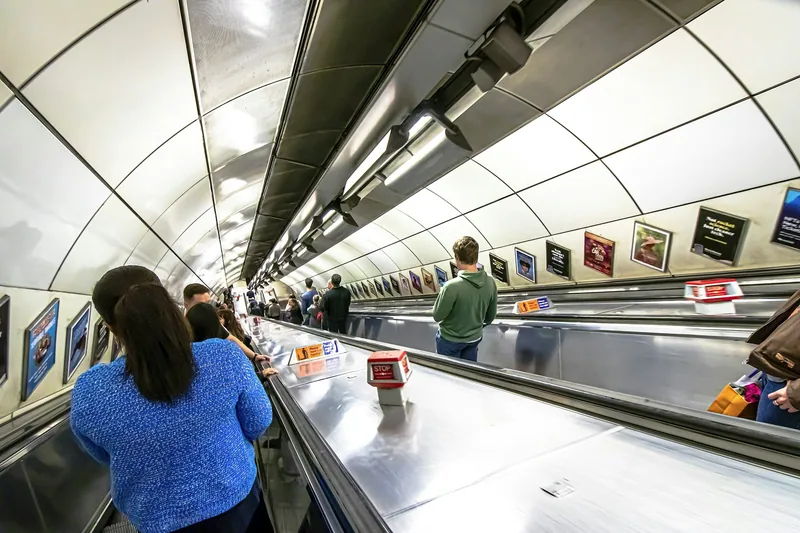
The escalator rule has an arithmetic behind it
You already know to stand on the right. What is less obvious is why Londoners care so much, and the answer is that an escalator is a pipe with a fixed capacity. Keeping the left side clear turns one moving queue into two: one for people who are happy to be carried, one for people in a hurry. It roughly halves the wait at the bottom during the peak.
The practical points that follow from it are the ones visitors get wrong. Stand on the right means all the way to the right, with your shoulder near the handrail, not in the middle. A companion stands behind you, not beside you. A suitcase goes on the step in front of you or behind you, never at your side. A group of four occupies four steps in single file, not two rows of two.
Londoners walking down the left are not being aggressive; they are doing what the arrangement is for. If you hear "excuse me" behind you on an escalator, it means you are on the left, and the correct response is simply to step across.
At the top of an escalator, keep moving for ten paces. The single most disruptive thing a visitor does is stop at the top to look at a map or wait for the rest of the group. Everyone behind is delivered into your back at a fixed rate and cannot stop. Walk clear of the escalator first, then stand against a wall and work out where you are going.
The platform, the doors and the twenty seconds
Stand to the side of the doors, not in front of them. On platforms with markings, stand behind them. Let everyone off before anyone gets on, which is not a courtesy so much as the only physically possible order of events.
Two subtler habits are worth copying. First, spread out along the platform: most people cluster at the entrance, so the carriages at the far ends are often half empty. Second, look at where you want to be at the other end. On long interchanges the difference between the front and the back of the train can be three minutes of walking, and regular travellers position themselves accordingly.
When the train is full and you are at the doors, step off onto the platform to let people out, then step back on. Londoners do this automatically and it looks alarming the first time, as though they are abandoning the train. Stay by the door and you become a cork in a bottle.
Inside the carriage
A rucksack takes the space of a person. Take it off and hold it at your feet, or in front of you if you are standing by the doors. The same applies to a shoulder bag swung behind you, which hits people you cannot see.
Move down inside the carriage. This is the instruction that appears on announcements more than any other, and it exists because a Tube carriage fills at the doors and empties in the middle. If there is space in front of you, walking three steps into it lets two more people board.
On the long bench seats, sit in the middle of a space, not on the edge of it, so the gap left over is usable. Keep your knees to yourself. If you have luggage, keep it between your feet rather than on the seat beside you; our guide to luggage on the Tube covers the physical problem of getting it there at all.
Priority seats and the badges
Every train, bus and tram has marked priority seats near the doors. The convention is not that you may never sit in them, but that you should sit there ready to stand up. If someone appears who plainly needs the seat more than you, you offer it without being asked.
Not everyone who needs a seat looks as though they do. TfL issues two badges for exactly this reason: a "Please offer me a seat" badge for people with a condition that is not visible, and a "Baby on board" badge for pregnant passengers. If you see either, offer the seat.
The offer itself is short. "Would you like this seat?" while standing up is the whole script, and a refusal is not a rebuke. Older visitors sometimes find that they are offered seats more often than they expect, which our guide to London for older visitors touches on. Families with pushchairs have their own set of conventions, set out in our guide to travelling with a pushchair.
Silence, phones and what you may actually do
The quiet on a London Tube carriage surprises visitors from almost everywhere else. It is not hostility, and it is not a rule. It is a habit that comes from a very old, very crowded railway where strangers sit closer together than they would anywhere else, and looking past each other is how people give each other room.
Practical translations: headphones, always, and quiet enough that the person next to you cannot hear the beat. Phone calls are technically possible now that many central stations and tunnels have mobile coverage, and they are still the fastest way to annoy a carriage. Conversation between people travelling together is entirely normal, just at a lower volume than you would use in a cafe.
Things visitors worry about unnecessarily: eating a sandwich is fine, hot food with a strong smell is not; reading over someone's shoulder is universally ignored; and nobody minds if you stare at the map. Talking to strangers is unusual but not forbidden, and asking a stranger for directions almost always works. Londoners are reserved, not unfriendly, which our guide to pub etiquette makes the same point about.
The rules that are law, not manners
A short list of things on the Underground carries a real penalty rather than a sigh.
- Travelling without a valid fare. If you have not touched in correctly, have no valid ticket, have insufficient credit or your phone battery dies before you touch out, you can be issued a penalty fare of £100, reduced to £50 if you pay within 21 days. You can appeal within 21 days.
- Alcohol. Drinking alcohol and carrying open containers of it have been banned across TfL services since 1 June 2008. This is the rule visitors break most often, usually by carrying an open can from a park.
- Smoking and vaping. Both are prohibited on all TfL vehicles and premises, including stations that are open to the sky.
- E-scooters. Banned from every TfL service and station, even folded, after battery fires. TfL says the fine can reach £1,000.
Our pages on alcohol laws in London and on smoking and vaping rules cover where these apply above ground, and our explainer on touching in and out covers the mistakes that lead to a penalty fare rather than a maximum fare.
A flat phone battery is a penalty fare, not an excuse. If you pay with a phone, TfL's conditions require the device to have enough battery to last the journey. Arriving at the barrier with a dead phone leaves you with no valid ticket. If your battery is low, buy a paper ticket or use a plastic card instead.
Buskers, photographs and the grey areas
The musicians you see at marked pitches on the Underground are licensed by TfL and are not begging; a coin is welcome and is in no way expected. People who move through carriages asking for money are a different matter, and Londoners neither give nor engage.
Photography for your own use is common and generally untroubled, but there are sensible limits. Never photograph on an escalator or near the platform edge, do not use flash, and if a member of staff asks you to stop, stop. Filming other passengers, particularly children, is the thing most likely to cause a confrontation.
Queuing, as everywhere in Britain, is treated seriously. At a ticket machine or a busy lift there will be a queue even when it does not look like one, so ask "are you in the queue?" rather than stepping around someone who appears to be standing about.
What happens if you get it wrong
Almost nothing, and that is the confusing part. Londoners very rarely correct strangers out loud. The feedback is non-verbal: a tut, a sigh, an exaggerated step round you, or a carriage that pointedly does not look at you. Visitors often leave London not knowing they did anything.
Staff, by contrast, are approachable and are there to be asked. A member of staff at a gate line will tell you which platform, which exit and whether your card worked, and will do it politely. That is the difference worth internalising: the other passengers will not help you and will not scold you, and the staff will help you if you ask.
Late at night the tone changes. Carriages are louder, people talk to each other, and the unwritten silence relaxes considerably; our guide to night buses describes the same shift above ground, and first and last Tube trains tells you when the last one goes. If the Tube is not running at all, our notes on walking in London and the bus network cover the alternatives, and step-free travel explains how staff assistance works for anyone who needs it. If you ever feel uncomfortable, the advice in our guide to how safe London is applies underground as well as above.
Frequently asked questions
Why do Londoners stand on the right on escalators?
Because it creates two queues instead of one: a standing queue on the right and a walking lane on the left. During the rush hour that roughly halves the wait at the bottom of a busy escalator. Stand fully to the right, with bags in front of or behind you rather than beside you.
Is it rude to talk on the Tube?
No, but volume matters. Conversation between people travelling together is normal at a low level. Phone calls in a crowded carriage are the quickest way to irritate everyone around you, and music without headphones is worse. The silence is a habit of a crowded railway, not hostility.
Can you drink alcohol on the London Underground?
No. Drinking alcohol and carrying open containers of alcohol have been banned on all Transport for London services since 1 June 2008. Smoking and vaping are also prohibited on every TfL vehicle and every part of its premises, including open-air platforms.
What happens if I forget to touch in on the Tube?
You may be issued a penalty fare of £100, reduced to £50 if you pay within 21 days, and you can appeal within the same 21 days. Your ticket or pay as you go credit must cover the whole journey, and if you pay by phone it must have enough battery to last the trip.
Should I give money to buskers on the Underground?
Only if you want to. Musicians at the marked pitches are licensed by Transport for London and nobody expects payment. People walking through carriages asking for money are not part of that scheme, and Londoners generally do not respond to them.
Sources
- Transport for London - Penalty fares and how to pay them (checked September 2026)
- Transport for London - Conditions of Carriage (PDF) (checked September 2026)
- Transport for London - Alcohol ban on the Tube, trams and buses from 1 June 2008 (checked September 2026)
- Transport for London - E-scooters are not allowed on any TfL service (checked September 2026)
- Transport for London - Help from staff and priority seating badges (checked September 2026)