
Greenwich+Docklands International Festival is London's largest free outdoor performance festival, and it is not ten days long. In 2026 it ran for seventeen, from Friday 21 August to Sunday 6 September, and almost every performance was free, unticketed and outdoors.
The shorthand version, "free theatre in Greenwich", is also wrong in the other direction. The 2026 programme took in Woolwich, Greenwich Park, the Greenwich Peninsula, Thamesmead, East Ham, Stratford and Romford Market. Several of the best shows were nowhere near Greenwich at all.
The festival is produced by the arts charity FESTIVAL.ORG and forms part of the Royal Greenwich Festivals, the Royal Borough of Greenwich's annual programme. It began in 1996, which made 2026 its thirtieth year. If you want the town rather than the festival, our guide to Greenwich covers it properly.
What to expect
- 2026 dates
- 21 August to 6 September, seventeen days
- Cost
- Free. The great majority of events are also unticketed
- Where
- Greenwich, Woolwich, Thamesmead, Newham and beyond
- Form
- Outdoor theatre, dance, circus and installations
- Access
- The first UK festival to reach Platinum on the Live Events Charter
- Booking
- Not required for most shows; you turn up
What "free and unticketed" means when you get there
It means exactly what it says: no box office, no wristband, no email confirmation. You walk into a square or a park and stand where you can see. The festival's own phrasing across the programme is "just show up".
The practical consequence is that the constraint is sightlines, not availability. A large-scale opening piece in a town-centre square will draw several thousand people, and the good vantage points go early. For a headline show, half an hour before the advertised start is about right; for a smaller street piece repeated twice in an afternoon, five minutes is enough, and the second showing is almost always quieter than the first.
Some indoor or capacity-limited pieces do carry a free ticket. Those are flagged on the individual show listing, and they are the exception rather than the rule. A small number of the festival's partner events elsewhere in the programme are paid, but you would have to look for them.
Nothing here competes with your museum budget. Seventeen days of international dance, circus and outdoor theatre cost nothing to watch, which makes this the largest free cultural event in the London calendar and one of the strongest entries anywhere on our free things to do page.
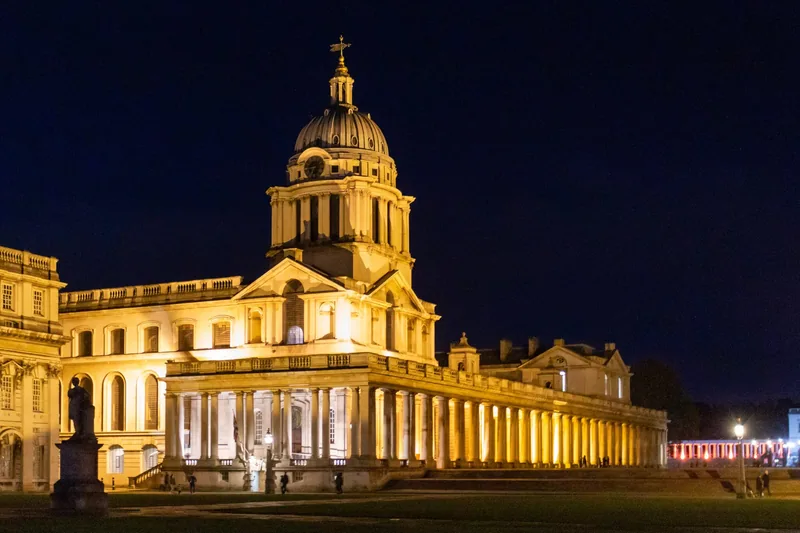
Photo: The wub · CC BY-SA 4.0 · Wikimedia Commons · resized
Where it actually happens
The festival moves across the east and south-east of the city in a rough sequence, and the venues are ordinary public places rather than arts buildings. The 2026 map gives a fair picture of a typical year.
| Place | What happens there | Nearest station |
|---|---|---|
| General Gordon Square, Woolwich | The opening and closing large-scale pieces | Woolwich (Elizabeth line), Woolwich Arsenal |
| Greenwich Park | Greenwich Fair, the family weekend | Cutty Sark DLR, Greenwich |
| Greenwich Peninsula | Large outdoor spectacle on the open ground | North Greenwich |
| Beresford Square, Woolwich | Street theatre in the market square | Woolwich Arsenal |
| Queen's Market Square, East Ham | Work made with and for the Green Street community | Upton Park |
| Tump 53 Nature Reserve, Thamesmead | Site-specific work in a former military earthwork | Abbey Wood, then bus |
| Queen Elizabeth Olympic Park | Dancing City, the outdoor dance day | Stratford |
| Romford Market | One touring piece, well outside the usual footprint | Romford (Elizabeth line) |
Woolwich has become the centre of gravity, partly because the Elizabeth line made it easy to reach from the West End. Stratford and the Olympic Park are the other anchor, and our guide to Stratford covers what else is there on the same day.
Greenwich Fair, the weekend to bring children to
If you only do one part of the festival with a family, make it Greenwich Fair. It takes over the top of the hill in Greenwich Park for one weekend near the start, running across General Wolfe Piazza, the Pavilion Lawn and the Avenue, with several short shows repeating through the afternoon so that missing one does not matter.
In 2026 it ran on Saturday 22 and Sunday 23 August. Shows started at 1pm and the last ones began shortly before 5pm, with each piece typically performed twice, about two hours apart. Food traders were on site from 1pm to 8pm on both days, and both were vegetarian and vegan friendly, which is worth knowing before you carry a picnic up the hill.
The setting does most of the work. You are on the grass with the whole of the river bend and the towers of Canary Wharf below you. The walk up from the Cutty Sark end is steep; the gates on the Blackheath side at the top of the hill save the climb, and our Greenwich Park page explains which gate to use.
Come up the hill from Blackheath, not from the river. The park rises about 30 metres from the Cutty Sark gate to the top, and with a pushchair in August that is a real climb. Blackheath station puts you on the flat at the top, a few minutes from the fair.
Dancing City, and the last weekend
Dancing City is the festival's annual outdoor dance day, and since the festival expanded into Newham it has been staged in the Olympic Park. In 2026 it filled a single Saturday, 5 September, from 1pm to 6pm, with eight or nine separate pieces across the park's squares, lawns and waterfront, all free and unticketed.
It is the densest day in the programme: if you want to see a lot of work in one afternoon without travelling between boroughs, this is the day to pick. The Olympic Park is flat, step-free throughout and has plenty of shade and seating, which makes it easier with small children or a wheelchair than a town-centre square.
The festival then closes back in Woolwich with a large participatory piece involving community performers. The opening night, two and a half weeks earlier, is in the same square. Those two evenings are the biggest crowds of the festival.
What the shows are actually like
Outdoor performance is its own form, and it is not theatre moved outside. Nothing has a fourth wall, most pieces last between twenty minutes and an hour, and a good many use no words at all. The 2026 theme, WE MOVE, was built around resilience and community, which is typical: the festival commissions work that reads across languages and cultures rather than work that depends on a script.
Four kinds of thing turn up every year. Large-format opening and closing spectacles, often with dozens of performers, fill a town square after dark. Aerial and circus work uses cranes, buildings and trees, and is the most weather-dependent part of the programme. Street theatre in markets and shopping squares is short, repeated and deliberately placed where people already are. And site-specific work takes over an unlikely location, such as a nature reserve built on a former military earthwork.
The 2026 programme carried three world premieres, five UK premieres and ten London premieres, drawn from more than 25 companies, a good number of them from outside Britain. That is an unusually high proportion of new work for a festival that charges nothing at the gate.
Access, which is the reason this festival has a reputation
GDIF was the first UK festival to be awarded Platinum level under Attitude is Everything's Live Events Charter, and the provision is unusually concrete rather than aspirational.
A large proportion of the work is speech-free, which removes the language barrier entirely for visitors whose English is limited as well as for deaf audiences. Shows that do use speech or text provide printed copies in the accessible viewing areas, and at least one performance of each carries British Sign Language. Some shows have live audio description through a headset and others have it pre-recorded. Easy Read visual guides are downloadable in advance and available in print at the access information point on site. Assistance dogs are welcome.
The detail differs show by show rather than being uniform across the festival, and each show's listing states what it offers. If access is a deciding factor, read the individual listings rather than the festival's general page.
Getting to the venues, and getting home
Woolwich has two stations next to each other. The Elizabeth line calls at Woolwich, which is the quickest way in from the West End or from Paddington; Woolwich Arsenal, a minute away, is served by the DLR and by Southeastern trains from London Bridge and Cannon Street. For Greenwich, take the DLR to Cutty Sark, or a train to Greenwich or Maze Hill. North Greenwich, for the Peninsula, is on the Jubilee line.
The pleasant way to arrive in Greenwich is by boat, from the central piers on the river bus. Be aware that its fares do not count towards your daily cap, which makes the trip dearer than the equivalent journey underground. The cable car crosses beside the Peninsula venue and is a short walk from the Jubilee line at North Greenwich. Woolwich itself is in Zone 4, so a day built around the festival will cost more in fares than a day in the centre.
Evening shows in Woolwich finish late enough that the journey back matters. Look up your last train before the performance starts rather than after it ends, and have the night bus number written down: the routes along the Woolwich Road run when the trains have stopped, and they are slow but reliable. Our page on getting home late in London covers the rest.
What to bring, and the weather problem
Everything is outdoors and most of it has no seating. Bring something to sit on for the park shows, a layer for after sunset, and water. Late August evenings in London cool quickly once the sun goes down, and a large-scale evening piece can run for an hour with you standing still.
Rain is the real risk. Outdoor shows with rigging, aerial work or projection can be cancelled at short notice for wind or weather, and the festival announces changes on the day rather than in advance. Have an indoor alternative in mind: in Greenwich that means the Old Royal Naval College and the covered part of Greenwich Market; in Stratford, the shopping centre and the museums on the East Bank.
Where it sits in the calendar
The festival straddles the end of August and the start of September, which puts it against two much better-known events. Notting Hill Carnival falls on the August bank holiday weekend at the other end of the city, and Totally Thames occupies September along the river. All three are largely free, and a well-planned late-August trip can take in all three without a single ticket.
Our month guides to August and September put the dates side by side, and London's food festivals covers the eating end of the same fortnight, including the fire-cooking festival that opens in Wapping in the first week of September.
Frequently asked questions
How long does the festival last?
Longer than most listings say. The 2026 edition ran for seventeen days, from 21 August to 6 September. Plenty of travel articles still describe it as a ten-day event, and that does not match recent programmes. Check the current year's dates on the organiser's own site before planning a trip around it.
Do I need tickets for Greenwich+Docklands International Festival?
Not for most of it. The great majority of shows are free and unticketed, and you simply arrive. A small number of capacity-limited performances issue free tickets in advance, and those are marked on the individual listing. There is no festival-wide pass and nothing to buy.
Is the festival only in Greenwich?
No. Greenwich Park and the Greenwich Peninsula host part of it, but Woolwich has the two biggest nights, and recent programmes have also used Thamesmead, East Ham, the Queen Elizabeth Olympic Park in Stratford and Romford Market. Check where each show actually is before setting off.
Is it suitable for children?
Yes, particularly Greenwich Fair, which is built around family street theatre and circus and repeats its shows through the afternoon. Much of the work is speech-free, which helps with young children and with visitors who do not speak English. The festival publishes a separate list of shows that suit children each year.
What happens if it rains?
Outdoor shows can be cancelled at short notice, especially those involving aerial work, rigging or projection, and decisions are usually made on the day. Nothing moves indoors. Keep an eye on the festival's own channels on the morning of a show, and have a museum or a market in reserve.
Sources
- FESTIVAL.ORG - Greenwich+Docklands International Festival 2026 programme and dates (checked September 2026)
- FESTIVAL.ORG - about the festival and the Royal Greenwich Festivals (checked September 2026)
- FESTIVAL.ORG - Greenwich Fair 2026, times and food traders (checked September 2026)
- FESTIVAL.ORG - Dancing City 2026 and access provision (checked September 2026)
- The Royal Parks - Greenwich Park (checked September 2026)