
The city's public celebration, Diwali on the Square, fills Trafalgar Square for six hours on Sunday 25 October 2026, starting at 1pm. Nobody pays and nobody books. It is also not held on Diwali itself, which in 2026 falls on 8 November.
That gap is the first thing to understand. The Mayor of London's event is always fixed to a Sunday so that the largest number of people can come, and the date it lands on may be a week or three weeks before the festival it celebrates. The temples, by contrast, mark the day itself, whichever day of the week that turns out to be.
So there are two different Diwalis available to a visitor in London, and they are not interchangeable. One is a stage, a market and a crowd of tens of thousands under Nelson's Column. The other is a lamp-lit temple out towards the North Circular, packed with families, on whatever evening the lunar calendar happens to land on. This page covers both, and says which to pick if you can only be here for one of them.
Diwali on the Square 2026 in brief
- Date and time
- Sunday 25 October 2026, 1pm to 7pm
- Where
- Trafalgar Square, WC2N 5DN
- Cost
- Free, with no booking
- Organised by
- The Mayor of London, with the Diwali in London committee
- Security
- Bag searches at every entrance
- Diwali itself in 2026
- Sunday 8 November
Why the lunar calendar moves the date every year
Diwali is set by the Hindu lunar calendar and falls on the new moon of the month of Kartik. In practice that places it somewhere between the middle of October and the middle of November, and it shifts by two or three weeks from one year to the next. Nothing about the Gregorian date is fixed.
This matters for planning in a way that the date of, say, Bonfire Night does not. If you are booking a trip six months ahead and you want to be in London for Diwali, check the date for your year before you book the flight, because last year's date is no guide. Both our October guide and the equivalent for November carry the current year's dates alongside everything else happening in those weeks.
It is also worth knowing that Diwali is not only a Hindu festival. Jain communities mark the same night, and Sikhs celebrate Bandi Chhor Divas, which commemorates the release of the sixth Guru from imprisonment, at the same time. That is why the gurdwaras in west London are as busy as the mandirs, and why the Trafalgar Square stage carries performers from all three communities.
What actually happens in Trafalgar Square
The afternoon opens with a mass dance sequence involving around 200 dancers, which is the single best-attended moment of the day and the reason to arrive before 1pm rather than at 3pm. After that the main stage runs a rolling programme of music, dance and performance drawn from London's Hindu, Sikh and Jain communities until early evening.
Around the edges of the square there is a market and a run of food stalls. The food is entirely vegetarian and vegan, which is normal for the festival and catches out visitors who turn up expecting street food in general. We cover where to find good meat-free cooking across the city on a separate page, and our guide to Indian food sorts out the regional differences you will taste at the stalls.
The family programme is the part most people miss because it is not on the stage. Sari and turban tying, yoga and meditation sessions, puppet shows and dance workshops run through the afternoon at separate points around the square. With children, that side of the event is far more rewarding than standing in a crowd watching a stage they cannot see over.
Come for the opening dance, not for the end. The square fills through the early afternoon and thins after about 5pm. If you want space and daylight, arrive by 12.45pm; if you want lamps and atmosphere, come at 5pm and accept that some stalls will have sold out.
Access, crowds and the quiet corner
Trafalgar Square is a hard place to be in a crowd if noise or enclosed spaces are difficult for you, and the organisers have built the event around that. There is a separate viewing area on the north terrace, in front of the National Gallery, fitted with a hearing loop for the main stage and with chairs for anyone who needs to sit, companions included.
The entrance has level access and the whole site is described as wheelchair accessible, with a lift connecting the north terrace to the main square. Every main-stage performance involving speech has a British Sign Language interpreter, shown on the screen to the right of the stage. Ear defenders are available from the information point, and the event is run as a relaxed one, so you can arrive, leave and move about without any expectation of staying still or quiet.
There is a Mobiloo accessible toilet on site with a hoist and a changing table. If you need the hoist you must bring your own sling. Assistance dogs are welcome.
Getting there, and the road that closes
Charing Cross, on the Northern and Bakerloo lines, is the closest Underground station, but there is no step-free route through it. For that you want Westminster, ten minutes away on foot, which is served by the Jubilee, District and Circle lines. Charing Cross mainline station is closer still, 325 metres and about three minutes, and it is step-free. We compare the options across the network on our page about accessible transport in London.
Pall Mall East is closed to all vehicles from 5am to 11pm on the day, which removes the parking spaces along it. Three Blue Badge bays sit on St Martin's Street, beside the National Gallery and some 250 metres from the square. Twelve bus routes stop within a short walk: the 3, 6 and 9; the 11, 12 and 15; the 23, 87 and 88; and the 91, 139 and 176.
Our page on Trafalgar Square covers the square outside event days, including the fountains, the Fourth Plinth and where the toilets are.
Neasden: the temple on the day itself
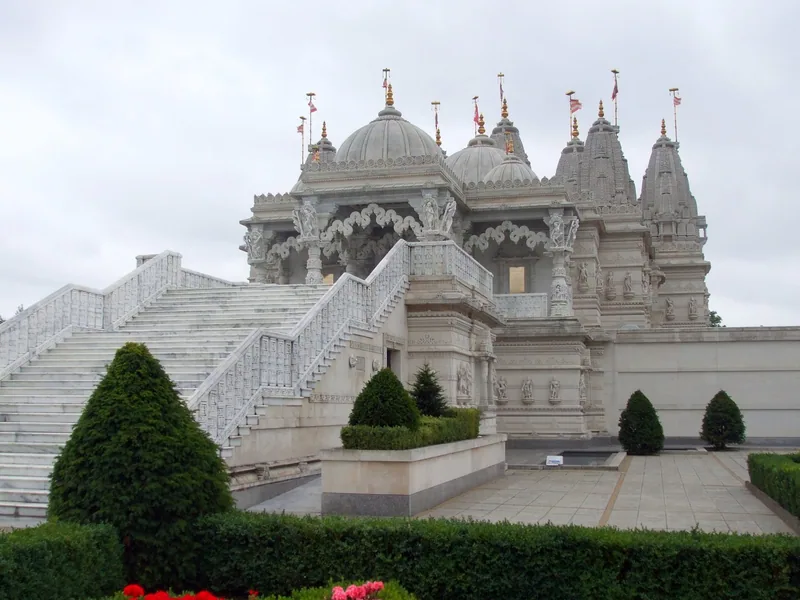
Neasden's BAPS Shri Swaminarayan Mandir is where a large part of London's Gujarati Hindu community actually observes Diwali, and entry is free on any day of the year. The mandir sits on Pramukh Swami Road, NW10 8HW.
On an ordinary day the mandir and haveli are open from 9am to 6pm, bank holidays included, but the sacred images are only on view during set periods: 9am to 11am, 11.45am to 12.15pm, and again from 4pm, or from half past three on weekends and bank holidays, until 6pm. The Rajbhog Arti, the midday ritual with lighted wicks, is at 11.45am. Those windows are the reason people arrive at 1pm and find the shrine closed.
Diwali and the Hindu New Year Annakut are among the major festivals the mandir marks, and the temple's own guidance is that major festivals bring extra evening assemblies, held on the day of the observance and sometimes also on the nearest Saturday or Sunday. Timings change for these, sometimes at short notice, so check the mandir's website in the week before you go rather than relying on the standard table. Expect very large numbers and a long, slow-moving queue.
The mandir is not a sightseeing stop on Diwali evening. On the festival itself it is a working place of worship at its busiest hour of the year. If you want to see the building properly, come on an ordinary weekday morning instead and save the festival evening for the atmosphere, not the architecture.
Southall, Wembley and where the lights actually go up
The public celebration is in the centre of town, but the streets that light up are in west and north-west London. Southall has London's largest gurdwara, open from the small hours until late evening, and it is noticeably busier at Diwali and Bandi Chhor Divas than on an ordinary Sunday. Its own guidance to visitors is to arrive early on festival days. The free community kitchen runs regardless, which means there is a hot vegetarian meal available to any visitor who follows the etiquette described on our Southall page.
Ealing Road in Wembley is the other place to go. The sweet shops sell boxes of mithai by the kilo through the fortnight before the festival, the jewellers and sari shops stay open late, and the street decorations go up well before the day. Neither is a staged event with a programme; they are ordinary shopping streets doing something out of the ordinary, which is either exactly what you want or a disappointment, depending on what you came for.
Fireworks, and what the law allows
Diwali is one of only four occasions in the year when British law relaxes the night-time curfew on fireworks. The general rule bans them between 11pm and 7am. Bonfire Night pushes that back to midnight, and three festivals push it to 1am: New Year's Eve, Chinese New Year and Diwali. Registered sellers may also sell fireworks for private use in the three days running up to the festival, outside the usual autumn and Christmas windows.
That is the law, not a promise of a display. There is no official public Diwali fireworks event in central London, and individual temples make their own arrangements, which vary from year to year. For organised displays in the same part of the autumn, see Bonfire Night; for the other big free street celebration in the calendar, see Chinese New Year.
Choosing between the two dates
If you are travelling with children, or you have one afternoon and want colour, noise and a stage, go to Trafalgar Square. It is free, central, well signposted, and a few steps from the National Gallery if the rain starts. On a short trip it earns its place among the city's best free days out.
If what you want is the festival rather than a festival event, go out to Neasden or Ealing Road on the day itself. It will take longer, it will be crowded, and there will be no programme to follow. It will also be the real thing.
The honest answer for most visitors is that the Trafalgar Square afternoon is the better use of a short trip, and the temples are better if you already know London and want to see a part of it that tourism does not reach. London's other big free-entry events work the same way: the summer festival of free outdoor theatre in Greenwich and Docklands and the city's food festivals both have a ticketed headline and a free edge, and the free edge is usually the better part. The full calendar is on our what's on in London page, and London with kids covers the practical side of a day like this with young children.
Frequently asked questions
Is Diwali on the Square free, and do I need a ticket?
Yes. Entry costs nothing, there is no ticket and there is nothing to book. You walk in from the street. Stewards search bags at every entrance, so allow a few minutes at the barriers and travel light, particularly if you arrive close to the opening dance sequence.
When is Diwali in 2026, and is the Trafalgar Square event on the same day?
Diwali falls on Sunday 8 November 2026. The Mayor of London's Diwali on the Square is on Sunday 25 October 2026, a fortnight earlier. The two are deliberately separate: the public event is scheduled for a convenient Sunday, while temples and households observe the festival on the lunar date.
Can non-Hindus visit a temple during Diwali?
Yes. Both the mandir at Neasden and the gurdwaras in Southall welcome visitors of any faith or none, on festival days as on any other. Dress modestly, cover your head in a gurdwara, remove your shoes where asked, and follow the stewards. Our Neasden page sets out the dress code and the photography rules in detail before you go.
Where can I buy Indian sweets for Diwali in London?
Ealing Road in Wembley and the Broadway in Southall are the two obvious streets, and both have long-established sweet shops that make mithai on the premises. Expect queues in the days immediately before the festival, and expect to buy by weight rather than by the box.
Is Diwali on the Square suitable for a wheelchair user?
The site has level access at the entrance and a lift between the north terrace and the main square. On that terrace there is a dedicated viewing area, fitted with a hearing loop, and elsewhere on site an accessible toilet with a hoist and a changing table. Bring your own sling if you need the hoist. Westminster is the nearest step-free Underground station, about ten minutes away.
Sources
- Mayor of London - Diwali on the Square 2026 (checked September 2026)
- BAPS Shri Swaminarayan Mandir, London - Timings (checked September 2026)
- BAPS Shri Swaminarayan Mandir, London - Festivals (checked September 2026)
- GOV.UK - Fireworks: the law (checked September 2026)
- Visit Leicester (Leicester City Council) - Diwali in Leicester, 2026 date (checked September 2026)
- Mayor of London - Vaisakhi on the Square 2027 (checked September 2026)