
Mayfair is where London keeps its grand hotels, and the rates match: this is the district where a four-star room costs what a five-star room costs elsewhere. Marylebone, ten minutes north across Oxford Street, is the same Zone 1, the same Tube lines and a noticeably lower bill, with the trade-off that its evenings end early.
The two sit either side of Oxford Street and are often lumped together as "the smart bit north of Green Park". They are not the same thing. Mayfair is a small grid of 18th-century squares and mews between Park Lane, Piccadilly, Regent Street and Oxford Street, most of it now offices, galleries, embassies and hotels. Marylebone is a residential district with a working high street, a farmers' market and a hospital quarter.
Our neighbourhood guides to Mayfair and St James's and to Marylebone describe what there is to see in each. What matters when you are choosing between them is narrower: the streets, what the money buys, how the stations differ with a suitcase, and when Mayfair is genuinely worth the premium.
Mayfair and Marylebone side by side
- Fare zone
- Zone 1 for both. Adult daily pay as you go cap £8.90 (2026)
- Mayfair stations
- Green Park (Jubilee, Piccadilly, Victoria; five lifts), Bond Street (Central, Jubilee, Elizabeth line; six lifts), Marble Arch (Central; no lifts)
- Marylebone stations
- Baker Street (five lines, no lifts), Bond Street, Marylebone main line (Chiltern, no lifts)
- Bond Street to Oxford Circus
- Three minutes on foot
- Green Park to Piccadilly Circus
- Eight minutes on foot
- Marylebone's weakness
- Little happens after about 22:30
- Mayfair's weakness
- Nothing cheap, and no food shops worth the name
Where each district's hotels actually are
Both names get stretched, and in Mayfair the stretching is expensive, so learn the edges.
Mayfair has three hotel clusters. Park Lane, facing Hyde Park, holds the large grand hotels and the biggest rooms in the district. The Piccadilly frontage and the streets behind it, around Half Moon Street, Clarges Street and Stratton Street, hold smaller and older hotels a few minutes from Green Park. The third group sits in the mews and side streets around Mount Street, Brook Street and Albemarle Street: boutique in the proper sense, often 30 rooms or fewer, and usually the most characterful choice.
Marylebone puts most of its hotels on the two long north-south roads, Gloucester Place and Baker Street, plus a cluster around Great Cumberland Place and Bryanston Street near Marble Arch, and a handful of small ones in the streets east of the High Street. The Gloucester Place terraces are the district's own version of the London townhouse hotel, with the usual consequences for stairs and lifts.
What is not either district: anything north of Marylebone Road is Regent's Park or St John's Wood, anything east of Great Portland Street is Fitzrovia, and anything the other side of Edgware Road is Paddington. All three are cheaper, and our comparison of the hotel districts shows where they sit.
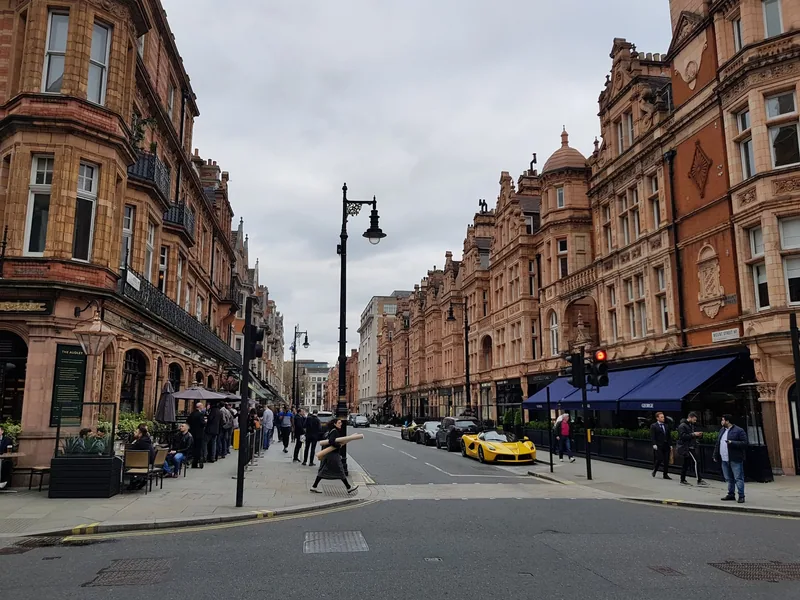
Photo: CVB · CC BY-SA 4.0 · Wikimedia Commons · resized
The price gap, honestly stated
We cannot give you a percentage, because nobody publishes London room rates and any figure we invented would be wrong by the weekend. What we can tell you is the shape of the difference, and it is large enough to change a trip.
Mayfair's floor is high and its ceiling is the highest in Britain. Marylebone has no true luxury tier, which is exactly why it costs less: you are comparing a district whose cheapest hotels are four-star with one whose cheapest are three-star chains. The bands below are our own estimate, from the market in September 2026.
| Band (our estimate, September 2026) | Mayfair | Marylebone |
|---|---|---|
| Under £150 | Essentially nothing | Chain rooms and terrace hotels on Gloucester Place and Baker Street |
| £150 to £300 | A small hotel behind Piccadilly, or an older room in a big hotel | The good end: a well-kept townhouse room or a modern hotel near Marble Arch |
| £300 to £600 | A proper Mayfair four-star, or a mews boutique hotel | The top of the district, usually a suite or an aparthotel |
| Over £600 | Park Lane and the famous names | Not applicable |
The dates that move both districts are the trade fairs and the season rather than the school holidays. Watch the Chelsea Flower Show, 18 to 22 May 2027, and Wimbledon, 28 June to 11 July 2027, and remember that London Fashion Week fills Mayfair specifically. Timing the booking is its own subject, covered in when to book a London hotel.
In Mayfair, ask which building your room is in. Several of the large hotels here occupy a Georgian frontage joined to a 1960s or 1970s extension behind, and the same rate can buy a high-ceilinged room at the front or a low one at the back with a light well for a view. The question to email is simple: which wing, which floor, and what does the window face.
The better night out is Marylebone's, but not in the way you expect
It is tempting to say Marylebone has the livelier evening. It does not. What it has is an ordinary one.
Marylebone High Street and the lanes around it are full of restaurants that a normal person can book a table at, plus bakeries, a cheese shop, pubs and a supermarket, and they are all within five minutes of a bed. That is the real difference. In Mayfair, dinner near your hotel means a restaurant with a dress code and a waiting list, or a hotel dining room, and the nearest place to buy a pint of milk is a walk.
Mayfair's evening strength is the other kind: hotel bars that are among the best in the world, private members' clubs you will not get into, and a ten-minute walk to the theatres of Theatreland. If you are here for a special occasion rather than a week, that is the right trade.
Marylebone's real evening limitation is the clock. Kitchens stop earlier than in Soho, the High Street is quiet by eleven, and on a Sunday the market in the morning is the event of the day. For a late dinner you walk south into Mayfair or east into Fitzrovia, ten to fifteen minutes either way.
Arriving with a suitcase: the station question
This is the practical reason to care which side of Oxford Street you book, and it is not obvious from a map.
Bond Street has six lifts in the detailed station dataset Transport for London publishes, and it is on the Elizabeth line, which reaches Heathrow Terminals 2 and 3 without a change. If you are flying in with luggage, a hotel within ten minutes of Bond Street is the easiest arrival in either district. Green Park has five lifts and three Tube lines, and it is the Mayfair equivalent.
Baker Street and Marble Arch have no lifts at all in the same dataset, despite Baker Street serving five lines, and neither does Marylebone main line station. A room on the northern half of Gloucester Place therefore means stairs on arrival unless you take a taxi from the terminal or from Bond Street. Our comparison of the Heathrow Express and the Elizabeth line sets out the fares, and step-free transport in London explains how the lift map really works.
Bond Street to Oxford Circus is a three-minute walk. Transport for London's own estimate. Both districts sit within a few hundred metres of the busiest shopping street in Europe, so almost nobody staying here needs to use the Tube to reach it, and the Central line between those two stations is the most pointless one-stop journey in London.
What you are within walking distance of
These are Transport for London's walking estimates, which assume a steady pace and stopping at crossings.
| From | To | Walk |
|---|---|---|
| Green Park | Piccadilly Circus | 8 minutes |
| Green Park | Bond Street | 13 minutes |
| Bond Street | Marble Arch | 9 minutes |
| Bond Street | Oxford Circus | 3 minutes |
| Marylebone station | Baker Street | 2 minutes |
| Baker Street | Oxford Circus | 24 minutes |
The last row is the one that surprises people: Marylebone is further from the middle of the West End than it feels, and the top of Baker Street is a long way from a theatre. Mayfair, by contrast, is walkable to Piccadilly, St James's, Green Park and Hyde Park Corner, and the whole of Bond Street and the Mayfair shops is on your doorstep.
Which one suits which trip
Choose Mayfair when
- The hotel is part of the point: an anniversary, a treat, a celebration
- You want quiet, safe, polished streets and a park at the end of them
- You will eat out properly rather than casually
- You are here for two or three nights, not a fortnight
Choose Marylebone when
- You are staying a week and want groceries, laundry and a local pub
- You are travelling with children and want Regent's Park nearby
- You want Zone 1 without the Zone 1 top rate
- You are catching Chiltern trains, for instance to Oxford
The Oxford point is worth a sentence of its own. Marylebone is a small, calm terminus, and Chiltern trains from it reach Oxford in as little as 1 hour 12 minutes, which for a guest staying on Gloucester Place is a shorter total journey than the faster service from Paddington.
Families, and what neither district does well
Marylebone works better than Mayfair for children, mostly because of Regent's Park and because its hotels have more twin and triple rooms. But both districts share the standard central London problem: converted period houses rarely have a family room, a lift or space for a cot, and the newer hotels that do are the expensive ones. Our guides to family rooms and rooms for three and to the best areas to stay with children go through the questions to ask.
Neither district is any use for a car. Both sit inside the Congestion Charge zone at £18 a day, and Mayfair's on-street parking is among the most tightly controlled in the country; see hotels with parking in London for the alternatives. And neither is cheap for the things hotels charge for separately, which our page on hotel extras and hidden costs lists.
Frequently asked questions
Is Mayfair worth the extra cost?
For a short stay where the hotel itself is part of the trip, yes: you get the largest rooms, the best service and quiet, handsome streets between Hyde Park and Piccadilly. For a week of sightseeing it is poor value, because you are paying a premium for an address and then leaving it every morning. Marylebone, Bloomsbury or the South Bank will give you more nights for the same money.
Is Marylebone cheaper than Mayfair?
Consistently, for a comparable room, because Marylebone has no genuine luxury tier and Mayfair has little below four-star. We do not publish a percentage, since London rates move daily with demand. Price both districts for your own dates and compare the total, including breakfast, before deciding.
Is Marylebone a quiet place to stay?
Yes, apart from two roads. The side streets and garden squares are genuinely residential and calm at night. Marylebone Road and, to a lesser degree, Baker Street and Gloucester Place carry heavy traffic, so ask for a room at the back of the building on any of them.
Which station is best for arriving in Mayfair or Marylebone with luggage?
Bond Street, which has six lifts and the Elizabeth line straight from Heathrow, or Green Park with five lifts for the Mayfair side. Transport for London's station data lists no lifts at all at Baker Street, Marble Arch or Marylebone main line station, so avoid those three if you are carrying heavy cases.
Can you walk from Mayfair to the West End theatres?
Easily. Piccadilly Circus is eight minutes on foot from Green Park station and Leicester Square another five, so most Mayfair hotels are 15 minutes from a theatre door. From Marylebone the same walk is closer to half an hour, which is why guests there tend to take the Tube one way and walk back.
Sources
- Transport for London - Detailed station data (lifts, feed published 3 August 2026) (checked September 2026)
- Transport for London - Journey Planner walking times (samples for Thursday 1 October 2026) (checked September 2026)
- Transport for London - Fare capping (checked September 2026)
- Transport for London - Congestion Charge (checked September 2026)
- Chiltern Railways - London Marylebone to Oxford journey times (checked September 2026)
- Royal Horticultural Society - Chelsea Flower Show 2027 dates (checked September 2026)
- Wimbledon - The Championships 2027 dates (checked September 2026)