
The Battle of Britain Bunker is the underground operations room at Uxbridge from which the RAF's No. 11 Group directed its fighters over south-east England in 1940. You can only go down on a guided tour of about an hour, which costs £14 for an adult with under-16s free, and it is worth booking: the room is small and the tours are timed.
It sits under a grassy mound beside a modern visitor centre, a walk of about a mile from Uxbridge station at the western end of the Metropolitan and Piccadilly lines. Hillingdon Council runs it. The bunker itself is 18 metres down and reached only by stairs; everything above ground is step-free. Our guide to Uxbridge and Ruislip covers the town, the building's listing and its machinery rooms; this page is about the visit itself.
Most visitors who come here have already seen the government's bunker in Whitehall. The two make a pair. The Churchill War Rooms show where the war was run from; Uxbridge shows where one battle was fought, minute by minute, on a map table that has been left as it was.
Battle of Britain Bunker at a glance
- Address
- Wren Avenue, Uxbridge. Satnav postcode UB10 0GG
- Open
- Visitor Centre seven days a week, 10:00 to 16:30, last admission 15:30 (checked November 2026)
- Bunker tour and Visitor Centre
- Adult £14, over-65 £11, under-16 free, students and Blue Light £7 (checked November 2026)
- Visitor Centre only
- Adult £8, over-65 £6.50, under-16 free (checked November 2026)
- Tour length
- About 60 minutes, including a 45-minute seated talk in the Operations Room
- Access to the bunker
- 76 steps (77 on one museum page), no lift
- Nearest station
- Uxbridge, Zone 6, then about 16 minutes on foot
- Tour times
- On the booking calendar on the museum's front page
What No. 11 Group did in this room
In 1940 the RAF's fighters were controlled through a chain that ran from the coast to this table. Radar stations and the posts of the Royal Observer Corps reported aircraft. Fighter Command's headquarters at Bentley Priory, in Stanmore, sorted those reports, and the filtered picture went to each Group's operations room at the same time. The Group commander then decided which squadrons to send up, and from which airfields.
No. 11 Group covered London and the south-east, the part of the country closest to the Luftwaffe's bases in France. Its commander was Air Vice-Marshal Keith Park, and its sector stations were Northolt, North Weald, Biggin Hill, Tangmere, Debden and Hornchurch. Historic England's list entry notes that these airfields took some of the heaviest attacks of the battle between 24 August and 6 September 1940.
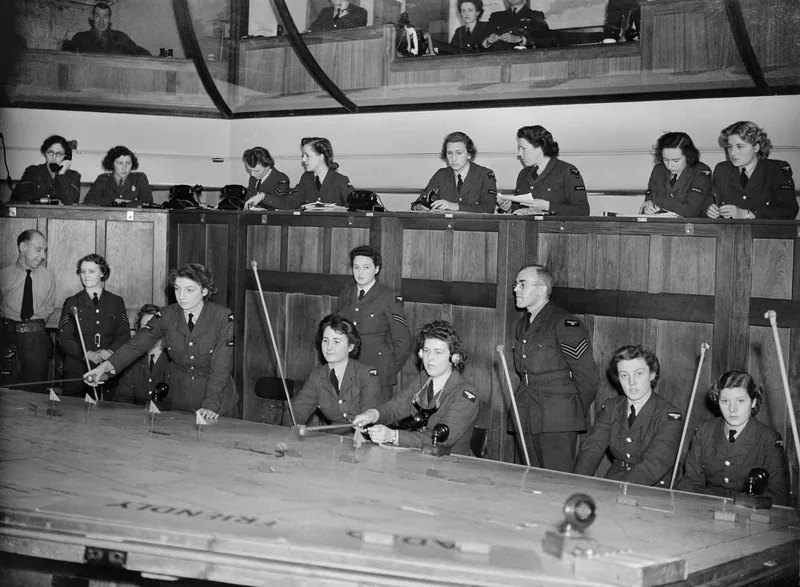
On the floor of the room, plotters moved markers across a large map of south-east England to show each raid: its position, its height and its strength. Controllers on a raised dais looked down on the table and gave orders by telephone. Senior officers watched from glass-fronted boxes above it. When you sit in the room on the tour, you are in the controllers' position, looking at the same table.
The room did not stop working when the battle ended. According to the list entry, it also handled fighter cover for the Dunkirk evacuation in May 1940, the Dieppe raid in 1942, the invasion of Normandy in 1944 and the defence against the V1 flying bombs, and it stayed in use into the early Cold War until it closed in 1958.
Churchill's two visits, and where the famous line really came from
Winston Churchill came to Uxbridge more than once, and two visits matter. On 16 August 1940 he and his chief military adviser, General Hastings Ismay, watched a day of heavy fighting from the room. Ismay's memoirs, as quoted by the Churchill Project at Hillsdale College, say that in the car afterwards Churchill told him not to speak, and some minutes later said: "Never in the field of human conflict has so much been owed by so many to so few." He used the line in the House of Commons four days later, on 20 August, as Hansard records.
His second well-known visit was on 15 September 1940, now marked as Battle of Britain Day, when the Luftwaffe sent two large raids against London. In his own history of the war Churchill described watching Park commit squadron after squadron, and asking what other reserves there were. He was told there were none. The map table is set to show that day.
The museum puts the famous quotation on the wrong date. One of its own pages says Churchill first spoke the "so few" line during the 15 September visit. That cannot be right, because he had already said it in Parliament on 20 August. The phrase belongs to the 16 August visit; the room is set for 15 September. Both visits happened, and the tour guides tell the story of each.
What the tour is like, from the front desk to the map table
You report to the front desk in the Visitor Centre, where staff admit you; there is no need to print a ticket. Tours leave promptly and the museum says latecomers may not be admitted, so arrive with ten minutes to spare. There is no cloakroom and there are no lockers, so bring only what you are happy to carry down the stairs.
A steward walks the group down the stairs and through the corridors to the Operations Room. Most of the hour is a seated talk of about 45 minutes, with a recorded soundscape of the room at work: telephones, voices and orders. There are chairs in the bunker and toilets underground. The talk explains how a raid was tracked and answered, using the boards on the walls.
Private photography is allowed throughout, but filming is not allowed during tours. The soundscape and the exhibition have loud sound effects, though no flashing lights or smoke, and hearing loops are fitted in the Operations Room and the auditorium.
Around the anniversary in mid-September the museum holds an event day with longer special tours and talks sold as packages (in 2026, a 75-minute "15 Nations" tour and a 90-minute tour built on first-hand testimony), so check its What's On page if you plan to visit then.
The exhibition upstairs and the Polish Air Force gallery
The Visitor Centre is a two-storey building of about 2,000 square metres. Its main exhibition traces Britain's air defence from the First World War to the end of the Second, which is the background the tour talk assumes you know. There are recorded first-hand accounts from people who worked in the bunker, pieces of aircraft wreckage, uniforms and the telephone and signals equipment the system relied on.
Two parts are worth seeking out. One is a replica of the 1940 plotting map with hands-on displays that let you try plotting a raid yourself. The other is the Polish Air Force gallery: Polish squadrons flew from Northolt in 11 Group's area, and the gallery tells their story. The museum also lists a Dieppe exhibition about the 1942 raid. Allow 30 to 45 minutes upstairs on top of the tour, more if you have a child who likes buttons.
There is a café with a terrace and a gift shop. Together with the tour, the whole visit takes about two hours.
Booking, and what a family pays
The museum advises booking in advance, especially at weekends and in school holidays. A small number of tour tickets go on sale at the front desk each day, but only while they last, and you can telephone ahead to ask about availability that day.
Two adults and two children under 16 pay £28 for the full visit, and Tube travel from central London adds a Zone 1 to 6 fare each way per adult: £4.00 off-peak with contactless or Oyster in October 2026, according to TfL. Children aged 5 to 10 travel free on the Tube with a fare-paying adult; our guide to the travel zones explains why Uxbridge costs more than a central journey.
If you cannot make your slot, the museum asks you to contact it in advance and says it will try to move the booking to another date or credit your account. That is a stated aim, not a refund guarantee. Carers of disabled visitors go free.
Getting to Uxbridge, and the walk through Dowding Park
Uxbridge is the end of the line for both the Metropolitan and the Piccadilly, which share its platforms. From central London the Metropolitan is usually the quicker choice: TfL's journey planner gives 40 minutes from Baker Street, and about 50 minutes from Piccadilly Circus with a change at Baker Street. Our guide to the Metropolitan line explains which trains run fast. Take the Piccadilly line only if you are starting on it, for example from Earl's Court or Hammersmith, as it is a slower route.
From the station the museum's route goes along the High Street and St Andrew's Road and through Dowding Park, following brown and blue tourist signs. TfL's planner puts the walk at about 16 minutes and 1.2 kilometres. There is a taxi rank at the station if the walk is too far.
By bus, the museum lists the A10 and U3 from Heathrow, and the 427, U1, U4 and U7, to the St Andrew's Church stop, then a walk through the park.
The car park is free for museum and café visitors; the site is inside the ULEZ.
The steps, small children and visitors who cannot go down
The bunker is a Grade I listed structure and there is no lift or ramp. The museum's main pages give the stairs as 76 steps; its accessibility page says 77. Either way, it is a long flight down and the same flight back up, and anyone who finds stairs hard should think about the climb out rather than the descent.
For visitors who cannot manage the stairs, a pre-recorded virtual tour of the bunker, with subtitles, plays in the step-free auditorium and is included in the cheaper Visitor Centre ticket. The exhibition also has a 360-degree touch screen of the Operations Room. Our page on step-free travel in London covers the journey there; check Uxbridge station's own step-free status on TfL before you travel.
The recommended age for the tour is seven and up, and the museum says younger children are welcome but discretion is advised: a 45-minute talk in a dim room is long for a toddler. If a child becomes restless, the steward can take you to a quiet area in the exhibition with books and toys. Upstairs there are children's trails, dressing-up and an under-5s zone. Quiet Bunker Hours and touch tours can be arranged on request. For more ideas that work with children, see museums that hold a teenager's attention.
Uxbridge, the War Rooms or the RAF Museum
The Churchill War Rooms are central, busier and dearer for an adult; Uxbridge has one focused story and a guide in the room with you. With time for only one, the War Rooms are easier to fit in; for the Battle of Britain itself, Uxbridge is the more direct experience.
Out at Colindale, the RAF Museum costs nothing and has the aircraft that Uxbridge does not: the Hurricanes and Spitfires the plotters were directing. The Imperial War Museum in Lambeth tells the wider story of the war, and HMS Belfast on the Thames is the naval counterpart. Further afield, the code-breakers' huts at Bletchley Park make a full day out on the same theme.
A sensible plan is the bunker in the morning, lunch in the café, and back to central London by mid-afternoon. If you like going underground into places built for war and transport, the Hidden London tours of disused stations are the obvious next step.
Frequently asked questions
Can you just turn up at the Battle of Britain Bunker without a ticket?
You can try, but a place is not guaranteed. Entry underground is only by timed tour, and the front desk sells just a few tickets on the day. Tour times are on the booking calendar on the museum's front page, and booking online is the safe choice at weekends.
How long does a visit to the Battle of Britain Bunker take?
The tour lasts about an hour, of which roughly 45 minutes is a seated talk in the Operations Room. With the exhibition and a coffee, allow about two hours, plus around 50 minutes each way on the Tube from central London.
Did Churchill say "never in the field of human conflict" at the Uxbridge bunker?
He first said it after visiting the bunker on 16 August 1940, in the car with General Ismay, according to Ismay's memoirs. He used it in the House of Commons on 20 August. The room is set for his later visit on 15 September 1940, which is why the two dates are often confused.
Can wheelchair users visit the Battle of Britain Bunker?
The Visitor Centre, exhibition, café and auditorium are all step-free, with lifts. The bunker itself is reached only by 76 or 77 steps with no lift. A recorded virtual tour with subtitles is shown in the auditorium and is included in the Visitor Centre ticket, and carers go free.
Sources
- Battle of Britain Bunker (London Borough of Hillingdon) - opening hours, admission fees and getting here (checked November 2026)
- Battle of Britain Bunker - Frequently asked questions (checked November 2026)
- Battle of Britain Bunker - About us and accessibility (checked November 2026)
- Battle of Britain Bunker - The Visitor Centre and exhibition (checked November 2026)
- Historic England - No. 11 Group Operations Room, RAF Uxbridge, list entry 1392556 (checked November 2026)
- The Churchill Project, Hillsdale College - Ismay by Kiszely (the 16 August 1940 visit) (checked November 2026)
- Hansard - House of Commons, War Situation, 20 August 1940 (checked November 2026)
- Transport for London - Journey planner (checked November 2026)