
Uxbridge is the end of two Tube lines, forty minutes from Baker Street. Most visitors have no reason to come, and this page says so plainly. The three reasons that do exist are good ones: the concrete bunker from which the Battle of Britain was directed, a barn built around 1300 that is probably the oldest timber building in Greater London, and several square miles of real woodland where the city stops.
This is the far north-west corner of London, the Borough of Hillingdon, on the Buckinghamshire border. Uxbridge is the borough's town centre. Ruislip, four miles east, is a village swallowed by 1930s suburbia that kept its church, its farmyard and its woods. Between them lies a belt of semi-detached housing, golf courses and a very large building site, which is HS2. Nothing here needs a full day: the bunker plus lunch is a half day, the barn and the woods a second, and the two do not combine well because the bus between them is slow.
Uxbridge and Ruislip at a glance
- Zones
- Zone 6, except Ruislip Gardens and South Ruislip, which are Zone 5
- Journey time
- Uxbridge to Baker Street 40 minutes direct, to King's Cross St Pancras 46 minutes direct (TfL journey planner, October 2026)
- Fare
- £4.00 off-peak, £5.90 peak, pay as you go, Zone 6 to Zone 1
- The one paid attraction
- Battle of Britain Bunker: adult £14, over-65s £11, under-16s free
- Best free thing
- The Great Barn at Manor Farm, and Ruislip Woods National Nature Reserve
- Night service
- None at all, on any line
Which of the eight stations you actually want
Three Underground lines reach this corner and none of them meets another out here. The Metropolitan and the Piccadilly both end at Uxbridge, sharing the same platforms. The Central line runs on a different axis two miles south and ends at West Ruislip. Only buses join them.
| From | To | Time | Off-peak fare |
|---|---|---|---|
| Uxbridge (Metropolitan) | Baker Street | 40 min, direct | £4.00 |
| Uxbridge (Metropolitan) | King's Cross St Pancras | 46 min, direct | £4.00 |
| Ruislip (Metropolitan) | Baker Street | 33-35 min | £4.00 |
| West Ruislip (Central) | Oxford Circus | 36 min, direct | £4.00 |
| South Ruislip (Central) | Oxford Circus | 32 min, direct | £3.80 |
| Uxbridge (bus A10) | Heathrow Central bus station | 28 min | £1.75 |
Two rows are worth pausing on. Uxbridge to King's Cross in 46 minutes without changing is quick for Zone 6, and it is why people live here. And the A10 means this is one of the few outer suburbs from which an airport costs one bus fare; the wider picture is in our comparison of every way in from Heathrow. West Ruislip and South Ruislip also have Chiltern Railways platforms, and a Chiltern train reaches Marylebone from West Ruislip in about 27 minutes, faster than the Tube.
Which Metropolitan train you get matters more than which station, and our guide to the Metropolitan sets out how the all-stations, semi-fast and fast patterns differ. Uxbridge trains leave the main line at Harrow, so the same journey serves the hill and the school at Harrow. The Piccadilly line reaches the same terminus by a longer route; take it only if your destination sits on it. The Central line is the fastest of the three into the West End.
The last train back really is the last train back. The Metropolitan runs no night service on any night, and the Night Tube on the Central line covers Ealing Broadway to Hainault and Loughton but not the West Ruislip branch.
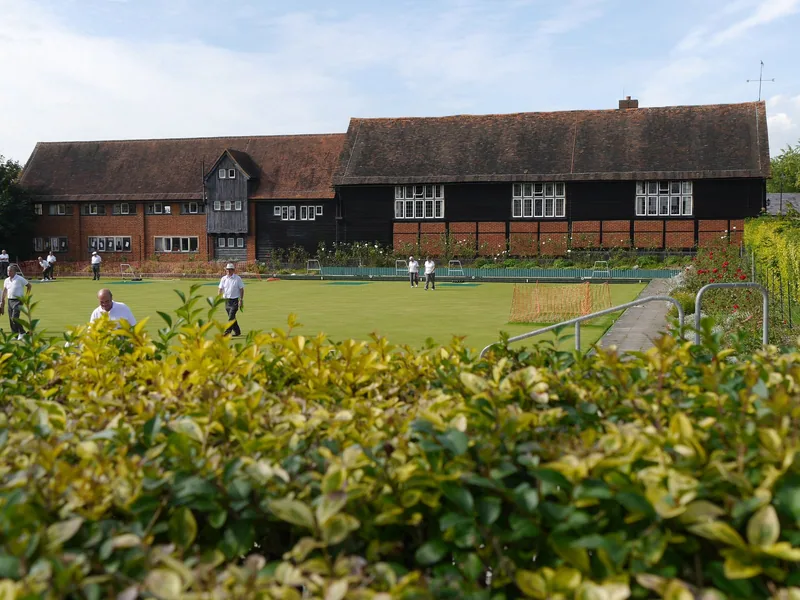
Photo: Edwardx · CC BY-SA 4.0 · Wikimedia Commons · resized
The Battle of Britain Bunker, and the 76 steps
This is the reason to come. Under a mound in Dowding Park, off Hillingdon Road, is the underground operations room of RAF Fighter Command's No. 11 Group, from which the air defence of south-east England was run through the summer of 1940. Historic England lists it Grade I, the top grade, and calls it "remarkably well preserved" (list entry 1392556, listed 1 December 2005).
That list entry tells you what is actually down there. The bunker was begun late in 1938 and finished in August 1939, to designs by Bob Creer of the Air Ministry's Directorate of Works and Buildings: reinforced concrete on steel joists, two levels, about 18 metres down. Plant Rooms X and Y keep their original generating and air filtration machinery, including a filter unit built by the Porton Down Experimental Station with a casing made at Portsmouth Dockyard. The message centre still has its Lampson pneumatic voice tubes.
One caveat the museum's own pages do not make: the Slat Board behind the controllers' dais, which recorded which squadrons were ready to fly, is a reconstruction of about 1968, with blackboarding from the earlier Tote Board surviving behind it. The museum says the room is as Churchill saw it on 15 September 1940; the statutory list is more precise, and both are true of different parts of the room. Air Vice-Marshal Keith Park commanded from here, and if you have done the Cabinet War Rooms in Whitehall, this is the other half of the story and far less crowded.
| Ticket | Adult | Over 65 | Under 16 | Student or Blue Light |
|---|---|---|---|---|
| Bunker tour and Visitor Centre | £14.00 | £11.00 | Free | £7.00 |
| Visitor Centre only | £8.00 | £6.50 | Free | £4.00 |
The practical frame, all from the museum's own pages in September 2026. The only way into the bunker is a guided tour, about an hour long and mostly a seated presentation in the operations room; museum hours are 10:00 to 16:30 and tour times sit on the calendar on its front page. Book ahead, because only a few tickets go on sale at the desk each day. Under-16s are free, so two adults and two children pay £28. The recommended age is seven and up.
The steps are the catch, and the museum gives two numbers for them: 76 on some pages, 77 on others. Either way there is no lift and no ramp. The Visitor Centre above is fully accessible, a recorded tour plays in its auditorium with the cheaper ticket, and carers go free; our page on step-free travel covers getting as far as the door. It is about a mile on foot from Uxbridge station through the town and Dowding Park, signposted in brown, or a bus towards St Andrew's Church. Parking is free; the café was rated 5 on 1 June 2026.
Manor Farm, and the barn that predates nearly everything
Four miles east, at the top of Ruislip High Street, is a 22-acre site with a farmyard in the middle. The Great Barn at Manor Farm is an aisled timber barn of about 1300, seven bays, roughly 102 feet by 32, weatherboarded, on a plinth of brick and flint rubble. Historic England lists it Grade II* and compares it with the great barns at Cressing Temple and Coggeshall in Essex, and the list entry ends with the sentence that makes the journey worthwhile: it is "probably the earliest surviving timber framed building in the Greater London area" (1358359, listed 6 September 1974).
The carpenters' marks are long Roman numerals cut into the timber and the arcade posts have flared heads. The roof was rebuilt at some point and many common rafters were reused where they stood, so part of what you see is seven hundred years old and part three hundred. Hillingdon Council's own page calls the barn Grade II; the statutory list says Grade II*, and the list is the authority.
The barn is a hired venue, so it is not always open to look into. The yard around it is, and is listed too: the Manor Farmhouse, the small barn and two cowsheds each carry their own Grade II entry. The visitor centre is inside the Tudor farmhouse, and there is a free audio guide, a library, and five craft sheds where local makers work and sell.
Come to Manor Farm on the first or third Sunday of the month. The council runs a duck pond market in the grounds on those Sundays, 10:00 to 15:00, which turns a quiet farmyard into an hour's worth of something. Other doors that open only on the first Sunday are listed separately.
Beside the farmyard stands the Church of St Martin of Tours, listed Grade I in January 1950, and the Ruislip Almshouses. The High Street below has a Grade II* range at numbers 9 to 15 and a listed telephone kiosk: four hundred years of building in three hundred yards. For other small museums on the edges of the city, see Valence House and the museums of outer London.
Two listed stations, at opposite ends of the same century
Do not walk straight out of Ruislip station. It is listed Grade II with its footbridge and signal box, and Historic England's reason is blunt: it is "an extremely unaltered Metropolitan station for the period and is the best preserved of its country stations" (list entry 1380983, listed 4 August 2000). Built in 1904 for the Harrow and Uxbridge Railway and altered in 1928 by the Metropolitan Railway, it is buff brick with orange bands, with a seven-bay platform canopy on cast-iron columns and a booking hall open to the roof. The signal box at the north end of the up platform is the 1904 original, disused, its lever frame said to be still inside.
Uxbridge station is listed Grade II for the opposite reason: late 1930s, by Adams, Holden and Pearson with L H Bucknell, concrete behind red brick, one of the best Charles Holden stations. A wide crescent frontage with shops beneath, two panels of sculpture above the entrance that the list entry describes as the two halves of a broken sprung bogey, and inside, flattened concrete arches carrying the roof straight down to the platforms under a sloped clerestory. The platforms are at street level, so Uxbridge is step-free with no lift at all.
Ruislip Woods, and the two lidos people confuse
Ruislip Woods National Nature Reserve is four ancient woods, Mad Bess, Bayhurst, Park and Copse, owned and managed by the council. It is the largest block of ancient, semi-natural woodland in Greater London, holds one of the most extensive oak and hornbeam coppice woods in south-east England, and is one of only three National Nature Reserves in the capital, with Richmond Park and the South London Downs. Fires and barbecues are banned throughout; Reservoir Road, HA4 7TY, is the usual way in. In winter this is the best thing here: wide firm paths, enormous coppice stools, almost nobody on a weekday. It has neither the deer nor the scale of Epping Forest, at a third of the journey time.
Now the confusion. There are two lidos here and they are not alike. Ruislip Lido is the reservoir inside the woods, with a sand beach and a miniature railway; it has its own page, and the rules about the water are not what visitors assume. Uxbridge Lido on Park Road is a different thing: an open-air pool of 1935 by G Percy Trentham, listed Grade II with its grandstand, entrance building and two fountains listed separately. The list entry calls it the only surviving 12-sided star-shaped pool in the country and, after Tooting Bec, the second-longest open-air pool left in London. Check with the council's leisure service before travelling for a swim.
What is being built, and it is enormous
HS2 dominates the map here and will for years. The railway surfaces at West Ruislip: the Northolt tunnel runs 8.4 miles from Old Oak Common to a portal beside the station, and the line then crosses the Colne Valley lakes on a viaduct more than two miles long. One of the tunnel's five ventilation headhouses is here, between Ruislip Gardens and South Ruislip stations near the cinema on Victoria Road.
HS2's published schedule lists main site activities in the West Ruislip and golf course area, the South Ruislip area, Harvil Road and Breakspear Road South from September 2021 to the end of December 2026, with road closures on top, and more than 40 hectares of new wildlife habitat around the Copthall tunnel. For a visitor the effect is lorries, hoardings and closed lanes west of Ruislip. None of it touches the Tube, the barn or the bunker.
Eating, and the short list
Uxbridge town centre is a shopping centre, a high street and a bus station, and the food is chains. The one building worth choosing for itself is the Three Tuns at 24 High Street, Grade II listed and rated 5 for food hygiene in July 2025. In Ruislip, the White Bear on Ickenham Road is a short walk from Manor Farm and held a rating of 5 in May 2025; the Middlesex Arms on Long Drive was rated 5 in June 2026. Check any of them on the Food Standards Agency register, because ratings change at every inspection. One place we are deliberately not naming: the most famous historic pub in Uxbridge was rated 1 in March 2026.
Be honest about whether to come
Come if
- The Battle of Britain is a reason to travel and you can manage 76 steps
- A barn from 1300 is worth forty minutes on a train
- You want quiet woodland inside the Oyster area on a grey weekday
Skip it if
- It is your first trip to London, or your only week here
- You want shops, galleries, restaurants or nightlife
- You cannot manage stairs and the bunker is the point
For a day that costs almost nothing without a forty-minute train each way, see our costed cheapest day out. If the bunker is booked out, the RAF Museum at Colindale is free and much larger.
Frequently asked questions
How long does it take to get from central London to Uxbridge?
About 40 minutes from Baker Street and 46 minutes from King's Cross St Pancras on a direct Metropolitan line train, measured on TfL's journey planner for a weekday mid-morning in October 2026. Add ten minutes from the West End.
Do I need to book the Battle of Britain Bunker in advance?
Booking ahead is advised, because the only way into the bunker is a timed guided tour with limited places. A few tickets go on sale at the front desk each day, subject to availability, so arriving at a weekend without a booking is a real risk.
Is the Battle of Britain Bunker suitable for wheelchair users?
The bunker itself is not. It is a Grade I listed structure reached only by a flight of 76 or 77 steps, with no lift and no ramp. The Visitor Centre above ground is fully accessible and shows a recorded tour of the bunker in its auditorium, included in the cheaper ticket.
Is Uxbridge worth visiting as a tourist?
Only for a specific reason. The bunker is a first-rate historic site and the Great Barn is probably the oldest timber building in London, but the town centre offers a visitor nothing that central London does not do better.
Sources
- Battle of Britain Bunker (London Borough of Hillingdon) - admission prices, tours and opening hours (checked September 2026)
- Battle of Britain Bunker - About Us and Accessibility, including the steps, the buses and the recorded tour (checked September 2026)
- Historic England - Group Operations Room, RAF Uxbridge, list entry 1392556, Grade I (checked September 2026)
- Historic England - Great Barn to west of Manor Farm Yard, Ruislip, list entry 1358359, Grade II* (checked September 2026)
- Historic England - Ruislip Station with associated footbridge and signal box, list entry 1380983 (checked September 2026)
- Historic England - Uxbridge Underground Station, list entry 1358405 (checked September 2026)
- London Borough of Hillingdon - Manor Farm, Ruislip, including the duck pond market Sundays (checked September 2026)
- GOV.UK and Natural England - London's National Nature Reserves (checked September 2026)
- HS2 Ltd - HS2 in Hillingdon: the Northolt tunnel, the South Ruislip headhouse and current works (checked September 2026)
- Food Standards Agency - food hygiene rating register (Three Tuns, 24 High Street UB8 1JN; White Bear, Ickenham Road HA4 7DF; Middlesex Arms, Long Drive HA4 0HG; Battle of Britain Visitor Centre Cafe, Wren Avenue UB10 0GG) (checked September 2026)
- Transport for London - Tube and rail fares (checked September 2026)