
Hogarth's House is the Chiswick country home of the painter and engraver William Hogarth, and it is free. It opens from noon to 5pm, Tuesday to Sunday, with last entry at 4:45pm, and it stands on the corner of the Hogarth Roundabout, a very busy junction on the A4.
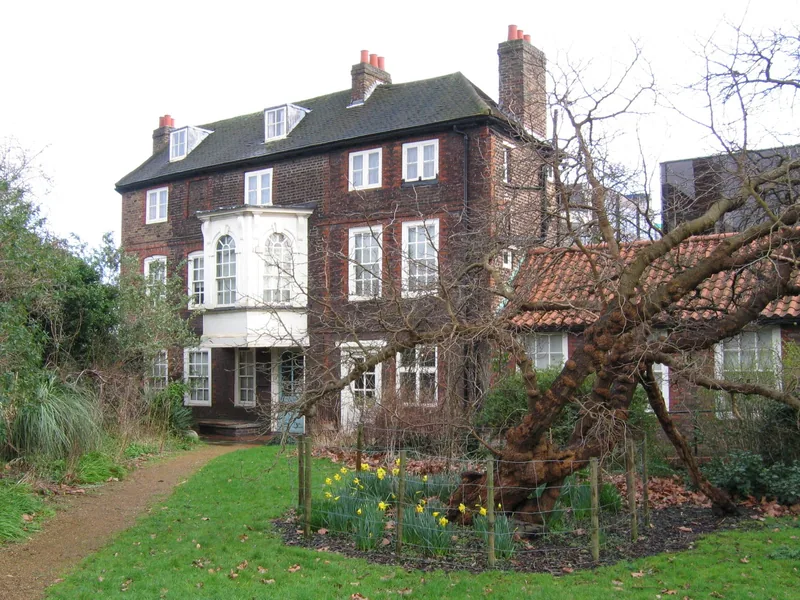
The house was built between 1713 and 1717. Hogarth bought it in 1749 as a summer retreat from his house in Leicester Fields, now Leicester Square, and used it until his death in 1764. Today it holds a large collection of his prints, a few rooms of the family's life, and a walled garden with an old mulberry tree that the museum calls Hogarth's own. Hounslow Council runs it. You need about forty minutes inside, which is why it works best as half of a free afternoon with Chiswick House next door.
Our round-up of London's smallest house museums gives it one paragraph among a dozen, and the Chiswick and Kew guide sets it in the neighbourhood. This page is about the house itself: what is in it, how to reach it on foot from the Tube, and what to pair it with.
Hogarth's House at a glance
- Admission
- Free, no booking needed
- Open
- Tuesday to Sunday, noon to 5pm, last entry 4:45pm (checked November 2026)
- Bank holiday Mondays
- The visit page says the May and August bank holiday Mondays; the footer on the same site says bank holiday Mondays in general
- Closed
- Mondays, Christmas Eve, Christmas Day, Boxing Day, New Year's Day, Good Friday and Easter Sunday
- Address
- Hogarth Lane, Great West Road, London W4 2QN
- Nearest Tube
- Turnham Green (District line), about 16 to 20 minutes on foot
- Time needed
- About 40 minutes, house and garden
- Listing
- Grade I, with its garden wall and gate (Historic England 1358340)
A house of 1713 that became Hogarth's in 1749
The house is older than its famous owner's time in it. It went up between 1713 and 1717 as a modest brick house in what was then a village on the Thames, among orchards. Hogarth was already successful when he bought it in 1749, and he used it as a country place: London's art world, his printing business and his main house stayed in Leicester Fields, a few miles east.
Historic England's list entry describes a house of brown brick with red dressings, three storeys and an attic, five windows wide, and a central wooden bay with three arched windows. Hogarth had a painting room above the coach house at the bottom of the garden; the coach house has gone. After his death in 1764 his widow Jane and her cousin Mary Lewis stayed on and ran a business selling prints of his work from here. Mary inherited the house and lived in it until 1808.
The house has been open to the public since 1904. It was badly damaged by a bomb in the Second World War, and the list entry records that the bay was repaired by the Society for the Protection of Ancient Buildings. A refurbishment in 2011 renewed the displays, and in 2020 a lottery-funded project rebuilt the garden and added a new single-storey learning room, the Weston Studio, beside the house.
The roundabout on the other side of the garden wall
Nobody arriving here for the first time is ready for the setting. The Great West Road (the A4) and the road to Kew and Richmond (the A316) meet at the Hogarth Roundabout, and the house sits on its corner, behind its old wall, with lorries passing all day. The entrance is on Hogarth Lane, a short side road off the junction.
The road arrived in the twentieth century. In Hogarth's time this was a house among orchards, with a lane down to the village and the church. Inside the rooms, with the windows closed, the traffic drops to a low hum; in the garden you hear it all the time.
Arriving on foot means walking along the pavement of a main road for the last stretch, whichever way you come. There are pavements the whole way, but it is a noisy, unlovely walk. If you are coming from Chiswick House, the museum warns that you must leave the park and walk along the pavement beside the Great West Road to reach the gate.
What hangs in the rooms: prints, not paintings
Hogarth made his name and his money from engravings. He painted a story in a series of pictures, then engraved and sold the series as prints, so that many people could own copies. He called these "modern moral subjects", and said of them: "my picture was my stage." A Rake's Progress, Marriage A-la-Mode, Beer Street and Gin Lane all reached their public this way.
It is the prints that fill this house. For most of its life as a museum it has shown a collection of his engravings, hung in the rooms where he lived, and the museum describes it today as "a large collection of his work". A free digital guide on the Bloomberg Connects phone app describes the house, the people who lived here and the works on display; download it before you arrive, because the rooms have little space for long labels.
The museum's own pages pick out what drove the work. Hogarth campaigned against cruelty to animals and against the gin trade, and Beer Street and Gin Lane were made as part of a campaign to change the gin laws. He was a founding governor of the Foundling Hospital, the children's charity whose art collection is now the Foundling Museum in Bloomsbury. He also pushed for the 1735 law that gave engravers copyright in their own designs, which is why that act is often called Hogarth's Act.
The famous Hogarth paintings are in central London, not in Chiswick. The original paintings of A Rake's Progress hang in Sir John Soane's Museum, and Marriage A-la-Mode is in the National Gallery. Both are free. Chiswick has the engravings made from them, in the house where he lived.
The mulberry tree and the graves of Dick the drake and Pompey
The garden is the other half of the visit, and the part most people remember. Its old brick wall is listed Grade I together with the house. The 2020 project rebuilt the plot as what the museum calls an exhibition garden, with planting that recalls its different uses over three centuries, a hazel nut walk and benches in the sun. The old mulberry tree stands at its centre, and in late summer it still fruits.
In one corner are two small memorial stones for family pets. The originals were lost, and the stones you see now were re-carved from a Victorian engraving made around 1850 and paid for by a public appeal. The museum's research identifies one as the grave of a pet drake called Dick, who died in 1760 aged eleven; its carving may be Hogarth's own design. The other is for a dog called Pompey, who lived until 1790, long after Hogarth, and was probably the pet of the women who kept the house going after his death.
Hogarth's dogs, usually pugs, appear in his paintings, and he painted himself with his pug Trump. The little graves are the kind of domestic detail the big galleries cannot give you.
Walking from Turnham Green, and the buses that stop closer
The nearest Tube station is Turnham Green on the District line. TfL's journey planner gives about 45 minutes from Embankment, with a walk of around 16 minutes and 1.2 kilometres from Turnham Green to the house; the museum itself says about 20 minutes. Use a District line train, not the Piccadilly, which usually runs through Turnham Green without stopping; our District and Circle line guide explains the branches.
Stamford Brook, the next station east, looks closer on a map of the A4, but TfL puts the walk from there at about 24 minutes, so it is the worse choice. Chiswick station, on the South Western Railway line from Waterloo, is about 25 minutes away on foot according to the museum.
The quickest final approach is by bus. Routes 190 (Hammersmith to Richmond) and 209 (Hammersmith to Barnes) stop on Burlington Lane, west of the roundabout, about five minutes' walk from the gate. From Hammersmith, which has the District, Piccadilly and Hammersmith & City lines, either bus is an easy connection.
Drivers can collect a ticket at reception for two hours of free parking in bays beside the house, which belong to a neighbouring estate and cannot be used after 5pm. Chiswick House's car park, about 200 metres west on the A4, is the alternative.
Forty minutes inside, and who will find it hard
The house is small and there are no guided tours: the museum says the rooms are too small for them, during opening hours or out of hours. You walk round at your own pace. Groups of six or more can book an exclusive visit outside opening hours for £8.50 a head (checked November 2026); during normal hours, larger groups are asked to tell the museum in advance.
Access to the site is step-free through the double gates and the new lobby, and the ground floor, the Weston Studio and the garden are level. The first floor is reached only by a narrow staircase of twelve steps with low headroom, and there is no lift, so a wheelchair user will see half the house. There is one accessible toilet, in the lobby. The shop takes cards only.
For children, the satirical prints are busy and full of animals and small dramas, which helps. They are also about drink, debt, disease and death, so look first if your children are young.
A free afternoon in Chiswick: the house, the park and the tomb
The obvious pairing is Chiswick House and its gardens, which start a few hundred metres west along the A4. The gardens are free every day; the villa charges and opens on fewer days, so check before you plan around it. Hogarth's House opens at noon, so the order is simple: gardens in the morning, Hogarth's House after lunch.
The third stop is Hogarth's grave. He is buried in the churchyard of St Nicholas, the old parish church at the river end of Church Street, about a 12-minute walk from the house according to TfL. The chest tomb stands about eight metres south of the church's south aisle and is listed in its own right. Historic England describes a limestone tomb restored in 1856, topped by a carved flaming urn, with a palette and brushes, a book and a mask on its plinth, and an epitaph by the actor David Garrick (the list entry misprints his first name as Daniel).
From the church, Chiswick Mall runs east along the river, and the Thames Path continues towards Hammersmith. Our guide to Hammersmith and Barnes picks up from there. For more houses on this side of London, the Jacobean Boston Manor House and the museum in Gunnersbury Park are both a short bus ride north.
Evenings, festivals and the Hogarth Prize
The house runs a small programme of ticketed evening talks and storytelling events, usually for adults and priced at around £12 (November 2026), and these sell separately from the free daytime visit. In September it takes part in Heritage Open Days and the Open House festival, and it has hosted events for the Chiswick Book Festival.
In 2026 the house launched the Hogarth Prize, an open competition for artists across the UK. Its summer exhibition of shortlisted work ran in the house from late July to early September; whether it repeats is for the museum to announce, so check its What's On page if you are visiting in summer. For other free collections in the city, see our list of free museums in London.
Frequently asked questions
Is Hogarth's House free?
Yes. Entry to the house and garden is free and you do not need to book. Some evening talks and special events charge, and group visits outside opening hours cost £8.50 a head with a minimum of six people.
When is Hogarth's House open?
From noon to 5pm, Tuesday to Sunday, with last entry at 4:45pm. It is closed on Mondays except some bank holiday Mondays, and on Christmas Eve, Christmas Day, Boxing Day, New Year's Day, Good Friday and Easter Sunday.
How do I get to Hogarth's House by Tube?
Take the District line to Turnham Green and walk south for about 16 to 20 minutes to the Hogarth Roundabout. Buses 190 and 209 from Hammersmith stop on Burlington Lane, about five minutes from the house, which is easier if you do not want the walk.
Are Hogarth's paintings at Hogarth's House?
Mainly his prints. Hogarth sold his famous series as engravings, and those are what the house displays. The original paintings of A Rake's Progress are at Sir John Soane's Museum, and Marriage A-la-Mode is at the National Gallery, both free to visit.
Where is William Hogarth buried?
In the churchyard of St Nicholas, Chiswick, at the river end of Church Street, about 12 minutes' walk from his house. The chest tomb with its carved urn and Garrick's epitaph stands just south of the church and is listed Grade II.
Sources
- Hogarth's House, London Borough of Hounslow - Visit us (opening hours, closures, getting here, access) (checked November 2026)
- Hogarth's House - Welcome to Hogarth's House (checked November 2026)
- Hogarth's House - William Hogarth (checked November 2026)
- Hogarth's House - Hogarth family pet memorials (checked November 2026)
- Historic England - Hogarth's House, wall and gate, list entry 1358340 (checked November 2026)
- Historic England - Hogarth Memorial, Church of St Nicholas, list entry 1260811 (checked November 2026)
- Transport for London - Journey planner (checked November 2026)