
The Queen's House is free, open every day from 10am to 5pm except 24 to 26 December, and needs no booking. Allow forty-five minutes rather than the fifteen most itineraries give it: there are more than 450 works of art inside, including the Armada Portrait of Elizabeth I and the largest painting Turner ever made.
It is the white building between the National Maritime Museum and the river in Greenwich, three minutes from the maritime museum's front door and about ten minutes' walk from Cutty Sark DLR station. Anne of Denmark, wife of James I, commissioned it in 1616 as a garden retreat; Inigo Jones designed it; and it became the first fully classical building in England. Alongside the red-brick Tudor palace that then stood next to it, people simply called it the White House.
What it is now is an art gallery in a historic house, run by Royal Museums Greenwich. That is the useful way to think about it. You are not touring furnished royal rooms. You are walking through a sequence of light, square, almost empty spaces with very good paintings on the walls.
Visiting the Queen's House
- Price
- Free, including the tours and the audio guides
- Days and hours
- Daily 10am to 5pm; closed 24, 25 and 26 December. Last entry is given as 4.15pm
- Booking
- Recommended but not required; you can normally walk in
- How long
- 30 minutes for the four things people come for; 45 to 60 minutes to do it properly
- Nearest stations
- Cutty Sark DLR, Greenwich (rail and DLR), Maze Hill (rail), Greenwich Pier
- Watch for
- Individual rooms close for private events on set dates, sometimes including the Great Hall and the Tulip Stairs
The Tulip Stairs: the thing people actually come for
The spiral staircase off the Great Hall was the first unsupported spiral staircase built in Britain. There is no central column. Each step is bedded into the wall and rests on the one below, so the whole thing appears to hang in the air, and the wrought-iron balustrade curls up through the middle of the void.
Stand underneath it and look straight up: that is the photograph. The name is a small puzzle worth solving on the spot, because the flowers worked into the ironwork are usually identified as lilies rather than tulips. Look closely at the pattern before you decide.
The staircase is narrow and there is no queue system. It is a working route between floors, so the photograph is easiest in the first half-hour after opening or in the last hour before closing, and hardest between 11am and 2pm on a weekend.
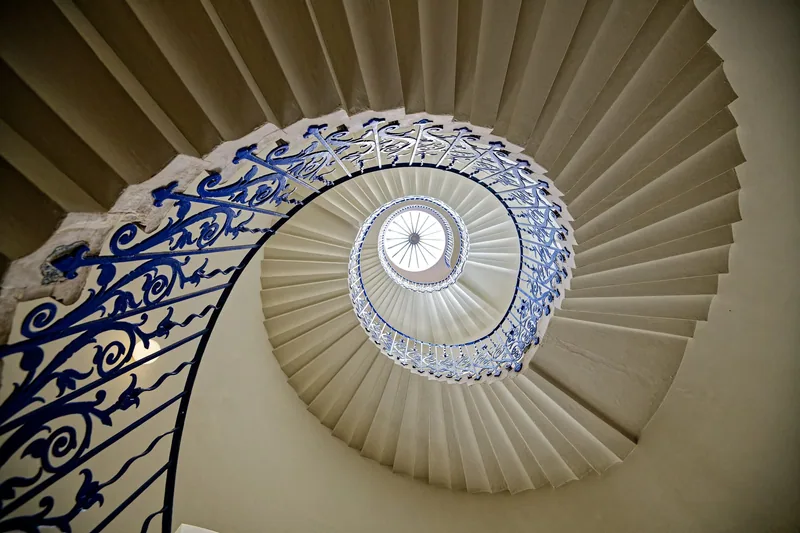
Photo: Tilman2007 · CC BY-SA 4.0 · Wikimedia Commons · resized
The Great Hall, and the geometry you are standing in
The Great Hall is a perfect cube: as tall as it is wide and long, with a balcony running round at first-floor level and a patterned marble floor of black and white squares set as a geometric design. Jones took the idea from the villas he had studied in Italy and dropped it into a Stuart royal park, which is why architectural historians treat this building as a turning point rather than a curiosity.
If the classical-London thread interests you, the Banqueting House in Whitehall is the other surviving Inigo Jones interior in London, and it opens on far fewer days than this one. Seeing both is the clearest way to understand what changed in English building between 1616 and 1622.
The Armada Portrait of Elizabeth I
The Armada Portrait hangs permanently in the Queen's Presence Chamber. It commemorates the failed Spanish invasion of the summer of 1588: the queen's hand rests on a globe, and the sea battle and the wrecking storm appear in two panels behind her. It is one of the most reproduced images of any English monarch.
The house was not built until after Elizabeth died, but she was born in Greenwich and spent a great deal of her reign here, as did Henry VIII and Mary I. That is the link the museum draws, and it is a fair one.
Turner's Battle of Trafalgar, and how it got in
J.M.W. Turner's The Battle of Trafalgar is the largest painting he ever made: more than three metres wide and two metres high. It was installed here in October 2025, and because of its size the canvas had to be craned up and manoeuvred in through a window, with the frame reassembled inside.
Its companion object is next door. The coat Nelson was wearing when he was shot at Trafalgar is in the Nelson, Navy, Nation gallery at the maritime museum, a three-minute walk away. Seeing the coat and then the painting, in that order, is the single best free half-hour in Greenwich. If Turner is the reason you came to London, Tate Britain holds the national Turner collection and is a different kind of visit altogether.
The other 450 works, and what changes each year
Beyond the four highlights there are seascapes, royal portraits and contemporary commissions spread through the house: Canaletto, Gainsborough, L.S. Lowry, Tania Kovats, Leah Gordon, Alberta Whittle and Richard Wright among more than 450 works on display. Jacqueline Bishop's ceramic tea service, The Keeper of All The Secrets, and Maisie Maud Broadhead's photographic portraits staged as 17th-century paintings are the two contemporary pieces most visitors stop at.
The hang is not fixed. New displays go in each year, drawing on new acquisitions and commissions, and the house runs talks and exhibitions around single paintings, such as a rediscovered Artemisia Gentileschi Susanna and the Elders. If you came last year, there will be something different this year, which is unusual for a free site of this size.
Tours, character actors and the audio guide
Guided tours and talks by the house's own guides are included in the free entry and run to a published programme. On Sundays, costumed character actors appear at 12pm, 1pm, 2pm and 3pm, performing as people connected to the house; that is free too, and it is the single best reason to bring children here rather than leaving them in the playground next door.
There is a free downloadable map and a set of audio guides that run on your own phone through the Smartify app, so bring headphones. There is no café and no shop café in the building: the nearest food is two minutes away in the maritime museum, or in the covered market in the town centre.
The dates when rooms are shut
This is the one thing that catches people out. The house earns money from private hire, and Royal Museums Greenwich publishes a closure table showing which rooms go dark and when. The Great Hall, the Tulip Stairs, the Orangery, the South Parlours and the Undercroft (which holds the toilets) are the areas most often affected, usually from mid-afternoon.
Two blocks matter for a 2026 visit. All four Greenwich sites closed at 3.30pm on 7 October 2026 for a staff event. And from 9 November 2026 to 3 January 2027 the Orangery and South Parlours are given over to Santa's Grotto all day. The Armada Portrait normally stays accessible whatever else is closed.
Check the closure table before travelling for the staircase. On several autumn 2026 dates the Tulip Stairs and Great Hall shut from as early as 11.30am, and nothing on the front page of the website tells you that.
Christmas here, and the ice rink outside
From 18 November 2026 to 3 January 2027 an open-air ice rink runs in front of the house, 10am to 9pm, with a viewing area beside a seasonal café and sessions set aside for toddlers, students and SEND families. Skating is ticketed; walking round the outside of it is not. Our guide to ice skating in London compares it with the other seasonal rinks, and Christmas in London covers the wider season.
The combination of a lit building, a rink and a free art gallery is genuinely good value on a December afternoon, and it is one of the few Christmas attractions in London where the thing you look at costs nothing.
How it fits a day in Greenwich
The Queen's House is the shortest of the four Greenwich sites and should not be first. Do the timed, paid things first, then this, then the hill. A workable order: the ship, then the Painted Hall at the Old Royal Naval College, then the maritime museum, then forty-five minutes here, then up through Greenwich Park to the terrace for the view.
One date changes that plan. The Royal Observatory closed on 2 November 2026 for rebuilding; the Meridian Courtyard is due back in summer 2027, so for now the two free sites and the ship in dry dock are what Greenwich has. Our five-day itinerary gives the area a day, and the free things to do in London lists what else costs nothing nearby.
Frequently asked questions
Is the Queen's House in Greenwich free?
Yes. Entry is free, and so are the guided tours, the audio guides and the special displays inside. Royal Museums Greenwich recommends booking a free timed ticket online to guarantee entry, but says you can normally turn up on the day and walk in.
How long does the Queen's House take?
Thirty minutes covers the Tulip Stairs, the Great Hall, the Armada Portrait and the Turner. Forty-five minutes to an hour lets you walk every room and read the labels. It is the quickest of the four Greenwich sites, which is why it is worth visiting even on a tight day.
Can I photograph the Tulip Stairs?
Yes, and most visitors do. The stairs are narrow and in constant use, so come in the first half-hour after opening or the last hour before closing. Check the published closure table first: the staircase and Great Hall are shut for private events on a number of dates each autumn.
Where is the Armada Portrait of Elizabeth I kept?
In the Queen's Presence Chamber inside the Queen's House, on permanent display. It normally stays open to visitors even on dates when other rooms in the house are closed for events.
Is the Queen's House suitable for children?
It is a quiet art gallery rather than a hands-on museum, so on its own it suits older children better. The Sunday costumed performances at 12pm, 1pm, 2pm and 3pm change that, and the children's gallery and outdoor playground at the maritime museum are three minutes away.
Sources
- Royal Museums Greenwich - Queen's House, plan your visit (checked September 2026)
- Royal Museums Greenwich - Highlights of the Queen's House (checked September 2026)
- Royal Museums Greenwich - Queen's House closures (checked September 2026)
- Royal Museums Greenwich - Opening times (checked September 2026)
- Royal Museums Greenwich - The Queen's House Ice Rink (checked September 2026)
- Royal Observatory Greenwich - Transformation project and closure (checked September 2026)