
The National Maritime Museum in Greenwich is free, open every day from 10am to 5pm, and you do not need to book. Ninety minutes is enough for the four galleries that matter; a whole afternoon is easy to fill.
It sits at the bottom of the hill in Greenwich Park, a seven-minute walk from Cutty Sark DLR station and about three minutes from the Queen's House. Royal Museums Greenwich runs four sites here. Two of them charge (the Royal Observatory and the ship Cutty Sark) and two are free: this museum and the Queen's House next door. Our guide to the Observatory and Cutty Sark covers the paid pair and the Greenwich Day Pass.
One date changes how you should plan. The Royal Observatory closes on 2 November 2026 for rebuilding and is not due to reopen until summer 2027. From that date the National Maritime Museum stops being the thing you fit around a timed ticket and becomes the main reason to come to Greenwich at all.
National Maritime Museum: the practical frame
- Price
- Free. Paid special exhibitions and experiences are extra
- Days and hours
- Open daily, 10am to 5pm. The museum's visitor panel gives a last entry of 4.15pm
- Booking
- Not needed. Free timed tickets exist if you want guaranteed entry
- Nearest station
- Cutty Sark for Maritime Greenwich (DLR), about 7 minutes on foot
- How long
- 1 to 2 hours for the museum's own self-guided gallery route; 3 hours with children
- Closed
- All Royal Museums Greenwich sites close early on some dates (3.30pm on 7 October 2026)
What ninety minutes actually buys you
The museum publishes its own self-guided route and says it takes one to two hours. It starts in Ocean Court and ends in Atlantic Worlds, taking in ten gallery stops on three levels. That route is the honest answer to "how long does it take", and it is aimed at adults rather than families.
If you have less than that, the building rewards ruthlessness. Go to Ocean Court, then up to Nelson, Navy, Nation on Level 2, then Polar Worlds across the landing, then back down to Maritime London on Level 0. That is four rooms, roughly an hour, and it covers the objects people travel for.
What to leave out depends on who you are. Sea Things is a room of small personal objects and works best if you like reading labels. Forgotten Fighters, on the First World War at sea, is a single quiet gallery that is easy to skip and easy to love. Traders, on the East India Company, is the one most visitors walk past and the one that explains the most.
Start at the top and work down, not the other way round. Level 2 holds Nelson, Polar Worlds and the Tudor and Stuart galleries. Coming down through the building means you finish near the café and the exit rather than climbing back up to them.
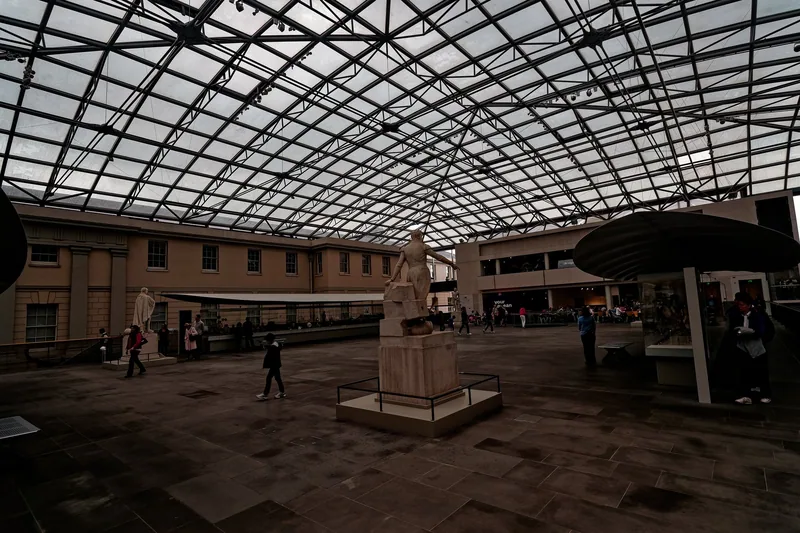
Photo: Txllxt TxllxT · CC BY-SA 4.0 · Wikimedia Commons · resized
Ocean Court, the lighthouse lens and the map on the floor
Ocean Court is the big covered space at the centre of the museum and it is where the largest objects live: a lighthouse optic powerful enough to be seen 17 miles out, and the stern of a ship that fought at Trafalgar. Children tend to run straight through it. Slow them down for the Ocean Map, a floor-level view of the world drawn around water rather than around countries, which is genuinely disorientating the first time you stand on it.
This is also the point where you decide whether to pick up an audio guide. The museum's guides run on the free Smartify app on your own phone, so bring headphones. There are also daily guided gallery tours led by staff, included in the free entry.
Nelson's coat, and the gallery built around it
Nelson, Navy, Nation on Level 2 is the gallery with the object most people come for: the undress coat Nelson was wearing when he was shot at Trafalgar, bullet hole and all. The gallery around it is about the 18th-century navy as a social institution, not just a fighting force, and it is better than the single famous object suggests.
The companion piece is not here. Turner's enormous painting of the Battle of Trafalgar now hangs in the Queen's House, where it was installed in October 2025 by crane through a window. Seeing the coat and then walking three minutes to see the painting is the best thirty minutes in Greenwich, and both are free.
Polar Worlds, Pacific Encounters and the galleries worth the stairs
Polar Worlds, also on Level 2, covers Arctic and Antarctic exploration and how people survived in it. Pacific Encounters on Level 1 tells the story of European arrival in the Pacific from the point of view of the island communities who were already there, using the Māori term Te-Moananui-a-Kiwa for the ocean. Tudor and Stuart Seafarers, more than 130 objects on Level 2, links Britain's rise as a sea power to the wealth that paid for it.
Maritime London on Level 0 is the gallery that explains the city you are visiting: three hundred years of the Thames as a working river, from sailing barges to container ships. If you are also going to the museum in the old sugar warehouse at West India Quay, read Maritime London first and the Docklands galleries second. They fit together in that order.
Atlantic Worlds, and what "under review" means here
Atlantic Worlds opened in 2007 to mark two hundred years since the abolition of the transatlantic slave trade. The museum says the gallery is currently undergoing a review, and in the meantime points visitors to a Freedom Fighters audio guide that covers stories inside it. The museum also holds an annual commemoration on 23 August for UNESCO's International Slavery Remembrance Day.
That is worth knowing before you walk in expecting a finished statement. If this is the subject you have come for, the Docklands site has a permanent gallery devoted to it and is the stronger visit at the moment.
With children: AHOY!, The Cove and the timings that matter
Two spaces here are built for children. AHOY! is the indoor children's gallery, aimed at under-sevens. The Cove is an outdoor sea-themed playground beside the museum, and it closes earlier than the museum does: 10am to 4.30pm. Plan around that rather than saving it for the end of the day.
The practical advantage of this museum over the ones in South Kensington is space. There is room for a pushchair, the galleries are wide, and the park is immediately outside. Our wider guide to London's best playgrounds puts The Cove in context, and Greenwich Park itself has the boating pond and a second playground five minutes uphill.
Astronomers Take Over, and the planetarium that moved down the hill
The Peter Harrison Planetarium at the Royal Observatory is closed for refurbishment. In its place the museum runs Astronomers Take Over, an eight-zone staffed space where you talk to the Observatory's own astronomy team, aim a lander at a Martian crater and walk through a "galaxy box". It is not free.
| Ticket (September 2026) | Adult | Child |
|---|---|---|
| Experience only | £8 | £8 |
| Experience plus a 30-minute planetarium show | £18 | £16 |
| Members, experience only | £6 | £6 |
| Members, experience plus planetarium | £14 | £12 |
The planetarium show happens at the museum, not at the Observatory, and the museum describes the room as more intimate than the one on the hill. Dates and times vary, so the booking calendar is the only reliable guide. The other paid thing in the building in 2026 is the ZWO Astronomy Photographer of the Year exhibition, at £12 for an adult.
Cafés, toilets and the library upstairs
There are two cafés. The Parkside Café on the ground floor is the bigger one, with indoor and outdoor seating and a view into the park; the Ocean Court Café on the first floor sits beside the Ocean Map and does coffee, sandwiches and a cream tea. Neither is behind a ticket barrier, which is the whole point of a free museum, and our round-up of the best museum and gallery cafés explains why that matters more than the menu. For a proper lunch, eating in Greenwich town is better value and five minutes away.
The Caird Library and Archive, inside the museum, is the largest maritime library and archive collection in the world. It is open Tuesday to Friday, 10am to 4.45pm, and you need a Reader's Ticket registered in advance. Casual visitors cannot simply wander in, which catches people out.
Getting there, and how it fits the rest of Greenwich
The DLR is the simplest way in: Cutty Sark for Maritime Greenwich, then a walk through the old town. Every DLR station is step-free, and our DLR and Overground guide explains the fares. Arriving by river is slower and better: the Uber Boat river bus stops at Greenwich Pier, four minutes from the museum, and river fares sit outside the daily cap. The foot tunnel under the Thames brings you in from the Isle of Dogs on foot.
Half a day here works like this: museum first, Queen's House second, then the Painted Hall at the Old Royal Naval College, then the hill. Our five-day London itinerary gives Greenwich its own day. If it rains, this building and the Queen's House between them will absorb three hours without you going outside, which is more than most entries on our list of things to do on a wet day.
Some autumn dates close every Greenwich site early. All four Royal Museums Greenwich sites closed at 3.30pm on 7 October 2026 for a staff event, and the Queen's House loses individual rooms to private hire on several dates. Check the site closure pages before a long journey.
Is it worth the trip if you only have three days?
Honestly, the museum alone is not a reason to spend half a day travelling. Greenwich as a whole is, and the museum is the best free part of it. If your list already includes the British Museum and the two Tates, and you have three days, this is the one to cut. If you have five days, or if you are travelling with children, or if the weather has collapsed, it earns the journey. Our wider list of London's free museums sets out the competition, and Greenwich or Richmond for a day out answers the other version of the question.
Frequently asked questions
Is the National Maritime Museum really free?
Yes. Entry to all the permanent galleries is free and no booking is required, although free timed tickets are available if you want a guaranteed entry slot at a busy time. Special exhibitions and the Astronomers Take Over experience are charged separately, and donations are invited but optional.
How long should I allow for the National Maritime Museum?
The museum's own self-guided route through ten galleries is quoted as one to two hours. An hour covers Ocean Court, the Nelson gallery, Polar Worlds and Maritime London. With children who will use AHOY! and The Cove playground, allow three hours, and remember the playground shuts at 4.30pm.
Do I need to book the National Maritime Museum in advance?
No. The museum states that you do not need to book, and tickets are available at the admissions desk on the day. Booking a free timed ticket online only guarantees entry and gets you emailed updates. The Queen's House works the same way.
Can I combine it with the Royal Observatory?
Until 2 November 2026, yes: the Observatory is a 15-minute uphill walk and charges £24 for an adult, or £38 for a Day Pass that also covers Cutty Sark. After that date the Observatory closes for rebuilding until summer 2027, so the free sites and the ship are what remain.
Where is the Nelson uniform from Trafalgar?
In the Nelson, Navy, Nation gallery on Level 2. Turner's painting of the same battle is not in this building: it hangs in the Queen's House, three minutes' walk away and also free.
Sources
- Royal Museums Greenwich - Plan your visit (checked September 2026)
- Royal Museums Greenwich - Opening times (checked September 2026)
- Royal Museums Greenwich - Tickets and prices (checked September 2026)
- National Maritime Museum - Gallery guide (checked September 2026)
- Royal Museums Greenwich - Astronomers Take Over (checked September 2026)
- Royal Observatory Greenwich - Transformation project and closure (checked September 2026)