
Albert Bridge has been closed to motor traffic since 7 February 2026, when a routine inspection found a crack in a cast-iron component at one of its abutments. It is open to people on foot and on bikes, which is how most visitors use it anyway, and Kensington and Chelsea council says it will reopen to vehicles some time in 2027 without giving a date. Walking across takes about four minutes.
It is the prettiest bridge in London and the most fragile. Painted in pale pinks, greens and blues, strung with lights, propped in the middle and posted with signs asking soldiers to break step, it has spent most of its life being repaired or threatened with demolition. It is one of only two central London road bridges never replaced; the other is Tower Bridge.
Our walking guide to London's bridges covers the central crossings as a route. This page is about this one: what it is made of, and why it keeps breaking.
Albert Bridge: the position in September 2026
- Open to
- Pedestrians and cyclists. Closed to all motor traffic since 7 February 2026
- Reopening
- The council says 2027; no definitive date as of 21 September 2026
- Driving diversion
- Chelsea Bridge to the east or Battersea Bridge to the west
- Built
- 1871-73, to designs by Rowland Mason Ordish; opened 23 August 1873
- Listed
- Grade II*, list entry 1358138, first listed 15 April 1969
- Size
- 241 m long, central span 139 m, 12 m wide (Historic England)
- Weight limit
- 3 tonnes gross for goods vehicles, camera enforced
- Connects
- Chelsea Embankment to Albert Bridge Road and Battersea Park
Why it is shut, and what is being done
The crack is in a cast-iron component in the north-eastern abutment, the structure at the Chelsea end anchoring the bridge to the ground. Cast iron cannot be welded back together like steel, and a part more than 150 years old cannot be bought. The council's engineers have had to survey the bridge, build a computer model of how it moves, and design a bespoke replacement.
The sequence, from the council's own project page:
- 7 February 2026: closed to motor vehicles after the inspection.
- March 2026: the council's leadership team agrees to a full repair and to freeing the seized axle in the joint, thought to have caused the damage.
- 8 to 10 April 2026: closed to pedestrians and cyclists too for two days, after sensors picked up unexpected movement on a day when the temperature reached 25 degrees. Engineers concluded the pattern was not an additional risk.
- By 17 April 2026: a temporary prop installed to support the weakened component and reduce the chance of further closures on foot.
- From 29 June 2026: grit blasting of the rocker bearings in the northern abutment chambers, the first physical stage of the repair.
- August 2026: repainting of the internal walls and parapets, in the existing colour scheme.
- Autumn 2026: the council awaits the result of a bid to the Department for Transport's new Structures Fund, having committed up to £8.5 million whether or not it succeeds.
Because the bridge is shut anyway, the council is bringing forward work it would have done later: a new road surface, refurbishment of the four toll booths, measures to stop components seizing, and LED lighting.
Do not plan to drive across Albert Bridge, and do not trust a satnav that offers it. The closure has been in place since February 2026 and the council will not name a reopening date. Motor traffic has to use Chelsea Bridge or Battersea Bridge, and both are busier than usual as a result. Walking or cycling across is unaffected, but the council has closed the bridge to pedestrians at short notice once already, in April 2026.
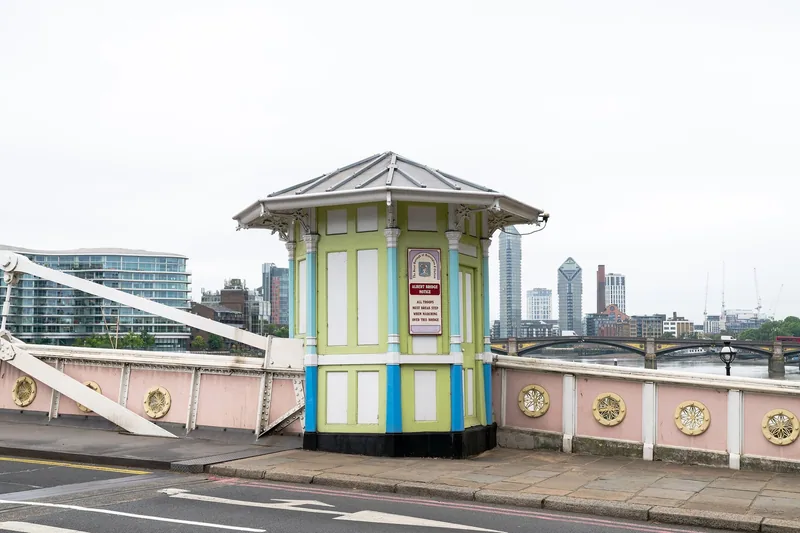
Photo: Tilman2007 · CC BY-SA 4.0 · Wikimedia Commons · resized
What the bridge actually is
Most descriptions call it a suspension bridge. Historic England's list entry is more precise, and the precision is the interesting part: it is a combined suspension and cable-stayed bridge, and that combination was the point of it.
Rowland Mason Ordish patented the system. Four cylindrical cast-iron piers rise out of the river and carry paired cast-iron towers, placed outside the roadway and joined at the top by a girder and an arch. Light suspension cables, originally wire steel rope, take the weight of sixteen flat wrought-iron diagonal stays, which fan down and support the deck through steel tie-rods. A pure suspension bridge hangs its deck from vertical rods; a cable-stayed bridge holds it on inclined stays. Ordish used both, because the stays give rigidity a shallow suspension bridge does not have.
The four piers were one-piece tapering cast-iron cylinders filled with masonry and concrete, and at the time the largest cylindrical iron castings ever made, ten tons each. They were only possible because they could be floated down the river from the foundry at Battersea.
Ordish was not a minor figure. Historic England's entry lists his other work: the train shed roof at St Pancras, the roof of the Royal Albert Hall, the Chapter House roof at Westminster Abbey, Holborn Viaduct. He built a bridge on the same patent system in Prague, and began as a draughtsman on the Great Exhibition building, later working on its re-erection at Sydenham as the Crystal Palace.
Things to look at while you are on it
- The towers. Gothic, with a central cast-iron cylinder on an eight-pointed star base, ringed by eight small columns and capped with a lantern housing the cable. The girder between each pair has ornamental cresting, with floriated tracery in the spandrels of the arch below.
- The parapet panels, each with an open roundel in the same tracery pattern.
- The four toll booths, one each side of the roadway at each end: octagonal, timber-panelled, with engaged cast-iron columns, dog-tooth capitals and overhanging leaded roofs.
- The bronze plaques at each end, which say the bridge opened in 1874. It opened to traffic on 23 August 1873. They have been wrong for over 150 years.
- The sixteen lamp standards along the deck: octagonal cast iron, originally gas, with crown finials.
- At the Chelsea end, the roadway continues as a small bridge over the Embankment footpath, with cast-iron balustraded staircases down either side.
The Trembling Lady, and the signs about breaking step
Soon after it was built the bridge got the nickname the Trembling Lady, because of the way it moved under a load. The signs are still there, fixed over the hatches where tolls were collected: All troops must break step when marching over this bridge. The council says they were aimed at soldiers from the nearby Chelsea Barracks.
The physics is real. Soldiers marching in step deliver a rhythmic load at a single frequency, and a light bridge with little damping will take it up. The same effect, arriving by accident rather than by drill, shut the Millennium Bridge two days after it opened in 2000. Albert Bridge got a warning sign; the Millennium Bridge got 37 dampers.
The lights, and a number we cannot verify
Albert Bridge lit at night is the picture everybody takes, and it is the reason the bridge survives. Historic England records that the lights were first added in 1951, for the Festival of Britain. Sir John Betjeman, campaigning to save the bridge in 1957, wrote that "shining with electric lights, grey and airy against the London sky, it is one of the beauties of the London river", and the campaign worked.
You will read almost everywhere that the bridge carries four thousand bulbs. We could not find that figure on any official source: not in the statutory list entry, and not on the council's pages. What the council does say is that the lighting is being replaced with LEDs during the present closure. Whatever the old count was, it is about to stop being true.
Strengthened twice, nearly demolished twice
The Albert Bridge Company was set up in 1863 to build a toll bridge between Chelsea and Battersea. Parliament refused the Act at first, possibly after lobbying by the owners of the timber Battersea Bridge, who feared losing tolls; it came in 1864 once compensation had been agreed. The tolls were then a failure, and the Metropolitan Board of Works took the bridge over in 1879 and freed it.
Then the strengthening, which is where the commonly repeated story goes wrong. Eleven years after it was built, an inspection found the iron rods already badly corroded. From 1884 to 1887 Sir Joseph Bazalgette replaced the rusting steel cables with steel link chains and laid a new timber deck. Ordish had specified chains in the first place and had been overruled by the owners on cost.
The piers in the middle came much later and for a different reason. In 1973 the Greater London Council carried out extensive strengthening which included installing two additional circular piers, joined by a transverse steel beam, under the middle of the bridge, and renewing the decking. The bridge was refurbished again in 2010 to 2011. So: cables replaced in the 1880s because they were rusting; two props added in the 1970s to carry modern traffic. Not one pier, and not the same episode.
Demolition was proposed twice. In 1926 the Royal Commission on Cross River Traffic in London concluded that Albert Bridge should be pulled down; the Great Depression saved it. Thirty years later the threat returned, and public opinion with Betjeman at the front of it saw it off.
The weight limit, and the cameras
A three-tonne weight restriction has applied since 2012, originally policed by width-restriction posts that simply made it awkward for a wide vehicle to get on. Since 11 January 2024 it has been enforced by camera at the north end.
| Item | Detail |
|---|---|
| Limit | 3 tonnes maximum gross weight, also called revenue weight |
| Who can be fined | Goods vehicles only. The council cannot enforce weight limits against other vehicles, but asks everyone over 3 tonnes to use another route |
| Penalty | £130, reduced to £65 if paid within 14 days |
| Notices issued | 37,954 between January 2024 and May 2025 |
| Checking your vehicle | Use the DVLA record of revenue weight, which the council says is more reliable than a log book |
In July 2025 the council amended the traffic order so that the three-tonne ban applies only to goods vehicles rather than all vehicles; one objection was received. None of this matters while the bridge is shut to motors, and all of it will matter again when it reopens. Our guide to the Congestion Charge and ULEZ covers the other charges here.
Nearly 40,000 penalties in sixteen months tells you how much unsuitable traffic used to cross, and it explains the council's tone: with Hammersmith Bridge out of action upstream for years, Kensington and Chelsea has watched what happens to a borough that loses a Victorian crossing.
Walking across it, and what is at each end
Go at dusk, when the lights come on and the towers are lit from below. By day the bridge is prettier than the view from it. There is a footway on each side and, with no cars on it in 2026, an unusually quiet deck.
The Chelsea end lands you on Chelsea Embankment at the foot of Oakley Street. Chelsea Physic Garden is five minutes east, the Carlyles' House in Cheyne Row three minutes west, and the King's Road ten minutes north. Our guide to Chelsea has the rest. Cadogan Pier, just downstream, is a river bus stop but is not step-free; see our guide to the Uber Boat River Bus.
The Battersea end drops you at the north-west corner of Battersea Park, the best reason to cross: you arrive on the riverside promenade with the Peace Pagoda in front of you. Fifteen minutes east is Battersea Power Station; our guide to Battersea and Nine Elms covers that side.
Sloane Square, on the District and Circle lines, is about fifteen minutes from the Chelsea end, and Battersea Power Station on the Northern line about fifteen from the other. There is no station closer, which is part of the bridge's charm and all of its inconvenience.
On screen
The council lists Sliding Doors, Love Actually, Absolute Beginners, Bridget Jones's Baby, A Clockwork Orange, Doctor Who, The Sweeney and Poirot. It is a short list for such a photogenic structure, and the reason is the weight limit: a film crew cannot easily get heavy vehicles on to it.
Frequently asked questions
Is Albert Bridge open?
To pedestrians and cyclists, yes. To motor vehicles, no: it has been closed to them since 7 February 2026 after a crack was found in a cast-iron component at the north-eastern abutment. Kensington and Chelsea council says it intends to reopen the bridge to traffic in 2027 but has not published a date.
Why does Albert Bridge have a sign telling soldiers to break step?
Because a light bridge can take up the rhythm of feet moving in unison, and the bridge was nicknamed the Trembling Lady soon after it was built in 1873. The council says the signs, fixed to the toll booths, were aimed at troops from the nearby Chelsea Barracks. The same crowd effect closed the Millennium Bridge in 2000.
How many lights are on Albert Bridge?
No official source gives a number. Historic England records that the lighting was first installed in 1951 for the Festival of Britain, and there are sixteen historic lamp standards along the deck. The figure of four thousand bulbs is widely repeated but does not appear on the council's or Historic England's pages, and the lighting is being replaced with LEDs during the current closure.
Why does Albert Bridge have piers in the middle?
Two concrete piers, joined by a steel beam, were added beneath the centre span by the Greater London Council in 1973 as part of strengthening for modern traffic. They are not related to the earlier problem with the cables, which Sir Joseph Bazalgette dealt with between 1884 and 1887 by replacing the corroded steel rope with steel link chains.
What is the weight limit on Albert Bridge?
Three tonnes maximum gross weight, enforced since January 2024 by a camera at the north end. The penalty is £130, halved to £65 if paid within 14 days, and can only be issued to goods vehicles. The council issued nearly 38,000 notices in the first sixteen months.
Sources
- Royal Borough of Kensington and Chelsea - Albert Bridge repairs: closure, programme and monthly progress updates (checked September 2026)
- Royal Borough of Kensington and Chelsea - Albert Bridge gets fresh coat of paint as part of refurbishment works, 21 August 2026 (checked September 2026)
- Royal Borough of Kensington and Chelsea - Albert Bridge reopens to pedestrians and cyclists, 10 April 2026 (checked September 2026)
- Royal Borough of Kensington and Chelsea - Enforcing the weight restriction to protect Albert Bridge for the future (checked September 2026)
- Royal Borough of Kensington and Chelsea - Albert Bridge closure for essential maintenance, with penalty notice figures and deck panel details (checked September 2026)
- Royal Borough of Kensington and Chelsea - Albert Bridge weight restriction amendment consultation and outcome (checked September 2026)
- Historic England - Albert Bridge including tollbooths, lamp standards and stairs, list entry 1358138, Grade II* (Internet Archive copy, 31 December 2025) (checked September 2026)