
Hammersmith Bridge has been closed to cars, buses and lorries since 2019. It is open on foot, and boats pass underneath. Crossing takes about ten minutes, faster than any way round: Transport for London's own journey planner tells you to get off the bus at one end, walk over, and get back on at the other.
The bridge is a Grade II* listed suspension bridge of 1887 by Sir Joseph Bazalgette, painted dark green and gold, standing on the foundations of an older bridge. It is shut because the cast-iron pedestals carrying its suspension chains were found to be cracking, and because fixing a Victorian cast-iron structure is slow, expensive and disputed.
For the walk itself and what there is at each end, see our guide to Hammersmith and Barnes. This page is about the closure: what is broken, what you can cross, how long the detour takes, and when anything might change.
Hammersmith Bridge: the position in September 2026
- Open to
- Pedestrians, and river traffic beneath. Closed to all motor traffic
- Cyclists
- TfL says people cycling and riding electric scooters must dismount and walk across while stabilisation work continues. The council's account of the April 2025 redecking describes cycle lanes. See below
- Cost to cross
- Free
- Crossing time
- About 8 to 12 minutes on foot
- Shut since
- April 2019 to motor traffic; August 2020 to everything; reopened on foot July 2021
- Reopening to vehicles
- No date. TfL says reinstating bus links is its priority and a long-term strengthening plan is "in development"
- Owner
- Hammersmith and Fulham Council, supported by TfL
- Listed
- Grade II*, twice over: list entries 1079819 (Hammersmith side, 1970) and 1080793 (Barnes side, 1983)
- Size
- 250.5 m long, 13.1 m wide, 8.2 m carriageway
The one thing to check before you set off
Two official sources say different things about bicycles, and both were live on 28 September 2026.
Transport for London's page says: "While the work is going on, people cycling and riding electric scooters must dismount and walk across the bridge." Hammersmith and Fulham Council's own account of the £2.9 million redecking completed in April 2025 describes the reopened carriageway as having three separate lanes, one for cyclists heading north, one for cyclists heading south and a two-way pedestrian path, with the outer footways kept for pedestrians only.
Both can be true at different moments, because the council has closed and reopened parts of the deck several times. What is not in doubt is that walking across is always allowed and that no motor vehicle is. If you are cycling, plan on walking your bike. Our notes on cycling in London and e-scooters and e-bikes cover the wider rules.
The bridge has a crowd limit as well as a weight limit. The council says it monitors how many people are walking and cycling across at one time, to prevent overloading the structure. On Boat Race day and at other big events, expect the bridge to be managed or closed for periods. Do not treat it as a guaranteed crossing on a busy afternoon.
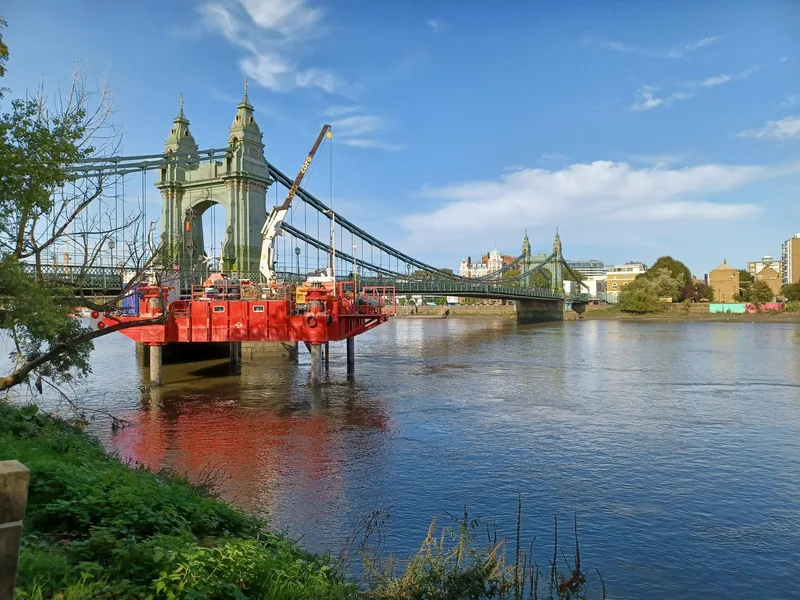
Photo: Simon Burchell · CC BY-SA 4.0 · Wikimedia Commons · resized
What is actually broken
Four cast-iron pedestals at the corners of the bridge carry the suspension system, and an investigation commissioned by the council found fractures in them. In the council's own words, these placed the bridge "at risk of catastrophic collapse". That is why the closure in August 2020 was total, including to pedestrians and boats.
Cast iron is strong in compression and brittle in tension, it cannot be welded, and a 138-year-old casting cannot be ordered from a catalogue. The repair had to be invented. What the engineers did, in what the council calls Phase 1:
- Strengthened all four cast-iron pedestals with fibre-reinforced concrete, after trialling the method off site on a replica of a fractured pedestal.
- Built custom steel frameworks to hold the structure up during the lift. The steel came in 29 giant sheets and was cut into 1,220 bespoke pieces.
- Jacked the bridge off its original Victorian bearings hydraulically and replaced the seized bearings with modern rubber ones, so the bridge can move as the temperature changes.
- Drilled twelve holes, some 50 metres deep, around the 200-year-old pier foundations in the river and on the bank.
A separate problem is the hangers: the 172 vertical rods along both sides connecting the deck to the suspension chains, which are old and overstressed. Steel rods have been fitted temporarily to take the load off them while a permanent repair is designed, and the joints are being greased in the meantime. The Department for Transport has granted the council £4.7 million for that work.
The council is blunt about the result: even after Phase 1, the bridge "remains 'sub-standard' and will still require monitoring and significant maintenance to keep it open".
The timeline, in order
| When | What happened |
|---|---|
| April 2019 | Closed to motor traffic after cracking was identified |
| August 2020 | Closed to everything, including pedestrians and river traffic |
| July 2021 | Reopened to foot, cycle and river traffic after investigations and a temperature control monitoring system was installed |
| 28 February 2022 | Phase 1 stabilisation starts on site, to a Mott MacDonald design |
| May 2023 | Four temporary and four permanent steel frames installed for the pedestals |
| April 2025 | Main carriageway reopened with new decking after a £2.9 million project funded by the Department for Transport. Over 1,000 deck and footway panels replaced |
| September 2026 | Still closed to motor traffic |
One detail from the delays is worth repeating because it is so improbable: the stabilisation work was held up in part by damage done to the bridge's working gantry by a boat carrying football fans.
The money, and why a toll is being talked about
Hammersmith and Fulham Council says it spent £48 million on restoring and keeping the bridge safe between August 2020 and April 2025, which is a very large number for one borough.
The government has told the council to pay a third of the total repair bill, a share that would more usually fall on the Department for Transport or regional government. The council's published position is that it can only fund that share and the continuing maintenance through a toll or road user charge, arguing that the people who benefit from driving over it should pay. No such charge exists or has been agreed. If it happens, it would be the first toll on a central London Thames bridge since the Victorian bridge companies were bought out.
What happens next: a bridge inside the bridge
Phase 2 is the part that would let cars and buses back. The council commissioned Foster and Partners and the engineers COWI to design a temporary double-decker truss fitted inside the existing structure, so that traffic runs on the truss while the Victorian bridge is restored around it, with pedestrians, cyclists and boats continuing throughout.
It needs planning permission and listed building consent from two boroughs, Hammersmith and Fulham on the north bank and Richmond upon Thames on the south, because the bridge is listed separately on each side. If approved, the design would be a reference for a contractor chosen by the council, and geotechnical investigation of the pier foundations has already been done for the procurement.
None of this has a published completion date. Treat any date you read elsewhere with suspicion; the council and TfL have both stopped giving them.
Getting across, and how long the detour really takes
Walking is the fast option, and TfL's own journey planner agrees. Asked for a journey from Hammersmith Bus Station to Barnes Pond at 11am on a weekday in October 2026, it offered:
- 16 minutes: the 209 bus to Hammersmith Bridge Road, walk across the bridge to Lonsdale Road, then the 209 again to Barnes Pond.
- 21 minutes: start at Lonsdale Road on the Barnes side and take the 209 or the 419 into the village.
- 39 minutes: walk the whole way from Hammersmith.
In other words the bus network is organised around the walk. The 209's published route from Hammersmith to Barnes Pond goes the long way round, through Hammersmith Bridge Road, the Hogarth Roundabout, Chiswick, Mortlake and Barnes Bridge: 26 stops for a journey under a mile in a straight line. The 33 starts and ends at Lonsdale Road, on the Barnes side; the 72 terminates at Hammersmith Bridge Road, on the Hammersmith side. Our guide to London buses explains how to read a route cut in half like this.
For the far bank the alternative is the train: Barnes and Barnes Bridge are both on South Western Railway from Waterloo, and Barnes is step-free. Our guide to the District and Circle lines covers the two Hammersmith stations, which are on opposite sides of the road and not connected.
If you are driving
The nearest crossings are Putney Bridge, about a mile and a half downstream, and Chiswick Bridge, about two miles upstream. In practice that is a detour of three to five miles depending on where you start, and both alternatives carry traffic that would otherwise use Hammersmith. Several bus services were rerouted the same way. For the charges that apply in this part of London, see our guide to the Congestion Charge and ULEZ.
What you are looking at while you cross
The list entry is unusually descriptive and repays reading while you are on the deck.
The bridge is 250.5 metres long and 13.1 metres wide, carrying an 8.2-metre carriageway formed from wrought-iron girders, with wrought-iron parapets and mild steel chain links. The towers are a skeletal wrought-iron frame clad in ornamental cast iron, gilded in places. The decorative iron blocks carrying the walkway sit on squat clustered Doric columns on stone piers in the river. The abutments and piers are concrete faced in Portland stone and cast iron, and the road deck dates from 1973 to 1976.
The colours are not a modern choice: Historic England records that dark green and gold is the scheme Bazalgette intended, as shown on his own drawings. Look at the towers for the heraldry, the detail almost nobody notices: the Royal Arms of the United Kingdom, the arms of Guildford as county town of Surrey and Colchester as county town of Essex, and the crests of Kent and of the cities of London and Westminster.
The bridge was begun for the Metropolitan Board of Works in 1884 and opened by the Prince of Wales on 18 June 1887, at a cost of £71,500.
There was a bridge here before, and its foundations are still in use
The pier foundations belong to an earlier crossing: the original Hammersmith Bridge of 1824 to 1827, designed by William Tierney Clark, which was the first iron suspension bridge to span the Thames. Thomas Telford declared it highly satisfactory. By the 1850s there were doubts, and the reason was the Boat Race: crowds running from side to side made the deck sway alarmingly, and by the 1870s up to 12,000 people were packing on to it. A temporary bridge was in use from 1884 until Bazalgette's structure was finished.
One more piece of its history explains the weight limit it has carried for a quarter of a century: in June 2000 the bridge was the target of a terrorist bomb attack, and after the repairs it reopened subject to a weight restriction.
Standing on it, and Boat Race day
A major road bridge with no traffic on it is a rare thing, worth ten minutes on its own. Mid-span on a weekday afternoon you can hear the river. Downstream are the towers of Fulham and the Harrods Depository; upstream the river bends away towards Chiswick.
The bridge sits roughly a third of the way along the Championship Course, and the Boat Race passes beneath it. Be realistic: the bridge has a managed capacity and 30,000 people want to be on this stretch of river at the same minute. The towpath either side is the better bet.
The Barnes side is also the way to the WWT London Wetland Centre, which is quiet precisely because the bridge is shut to cars: walk the towpath from Hammersmith in about 25 minutes, or take the 209 or 33 from the Barnes end. Our guide to riverside pubs on the Thames covers this reach and the Thames Path runs along both banks. Upstream, Richmond Bridge and the upper Thames crossings are next, and our bridges guide has the central ones.
Frequently asked questions
Can you walk across Hammersmith Bridge?
Yes. The bridge is open to pedestrians and has been since July 2021, and it is free. It takes about ten minutes to cross. Motor vehicles have not been allowed on it since 2019. Cyclists should be prepared to dismount: Transport for London's page says people cycling and using electric scooters must walk across while work continues.
Why is Hammersmith Bridge closed?
Because the four cast-iron pedestals that carry its suspension chains were found to be fracturing, which the council said put the bridge at risk of catastrophic collapse. Cast iron cannot be welded and the components are 138 years old, so each repair has had to be designed and trialled from scratch. The 172 hangers connecting the deck to the chains are also overstressed.
When will Hammersmith Bridge reopen to cars?
No date has been published. Transport for London says it is supporting the council to find a way to reopen the bridge and that restoring bus links is the priority, and that a long-term strengthening plan is in development. The council's Phase 2 proposal is a temporary double-decker truss inside the existing structure, which needs planning permission and listed building consent from two boroughs.
How long is the detour around Hammersmith Bridge?
For drivers, three to five miles, via Putney Bridge downstream or Chiswick Bridge upstream. For anyone on foot or by bus it is shorter to cross: TfL's journey planner offers a bus, a walk over the bridge and another bus from Hammersmith to Barnes village in about 16 minutes, against 39 minutes walking the whole way.
Who owns Hammersmith Bridge?
Hammersmith and Fulham Council, which is carrying out the work. Transport for London is supporting it, and the Department for Transport has funded parts of the repair, including £2.9 million for the new decking and £4.7 million for the hangers. The council says it has spent £48 million on the bridge since August 2020.
Sources
- Transport for London - Hammersmith Bridge: current status, the dismount rule and next steps (checked September 2026)
- Hammersmith and Fulham Council - Hammersmith Bridge: stabilisation, redecking, hangers, costs and the Phase 2 truss proposal (Internet Archive copy, 17 April 2025; the live pages return 404 to automated requests) (checked September 2026)
- Historic England - Hammersmith Bridge, list entry 1079819, Grade II*, Hammersmith and Fulham (Internet Archive copy, 31 December 2025) (checked September 2026)
- Historic England - Hammersmith Bridge, list entry 1080793, Grade II*, Richmond upon Thames (Internet Archive copy, 1 February 2026) (checked September 2026)
- Transport for London Journey Planner data - Hammersmith Bus Station to Barnes Pond, journey options and durations (checked September 2026)