
The Millennium Bridge is a free footbridge between St Paul's Cathedral and Tate Modern, open all day and all night, and it takes about four minutes to cross. It opened on 10 June 2000, swayed alarmingly under the crowd, and shut two days later. It stayed shut for twenty months while 37 dampers were fitted underneath, and reopened on 22 February 2002.
That story is why people know the bridge, and why they get it wrong. The sway was not a design fault peculiar to this bridge, and it was not dangerous: it was a crowd effect recorded before, on conventional bridges, and never properly measured. The Millennium Bridge is the reason it now gets checked for.
Our walking guide to the bridges of London covers all the central crossings in order and puts this one in its place in the row. This page is about the bridge itself: the numbers, the engineering, and the practical business of walking across it.
The Millennium Bridge at a glance
- Price
- Free. Pedestrians only; no cycling
- Open
- Always. No gates, no closing time
- Length
- City Bridge Foundation says 325 m long and 4 m wide, 10.8 m above the Thames at high tide. The engineers give 333 m overall in three spans: north 81 m, centre 144 m, south 108 m
- Crossing time
- Three to five minutes
- Opened
- 10 June 2000; closed 12 June 2000; reopened 22 February 2002
- Designers
- Foster and Partners, Arup, and the sculptor Sir Anthony Caro
- Owner
- City Bridge Foundation, from the day it reopened
- Nearest stations
- North: St Paul's or Mansion House. South: Blackfriars or Southwark
What happened on 10 June 2000
The Queen dedicated the finished bridge on 9 May 2000. The public opening was the following month, on a Saturday.
Two official accounts give different crowd figures. City Bridge Foundation, which owns the bridge, says around 90,000 people crossed on the opening day. The engineers' own paper, published by the Royal Academy of Engineering the following year, says up to 100,000, with up to 2,000 on the bridge at any one moment.
When large groups were on it, the bridge moved sideways more than anyone expected. The movement came and went: it built up when the deck was full and died away when numbers dropped or people stopped walking. It was self-limiting, because beyond a certain point walkers had trouble staying upright and grabbed the handrail, which stopped them driving it further. There was no vertical problem at all.
Access was restricted on the Sunday, and the bridge closed indefinitely on the Monday evening, 12 June, for a full investigation.
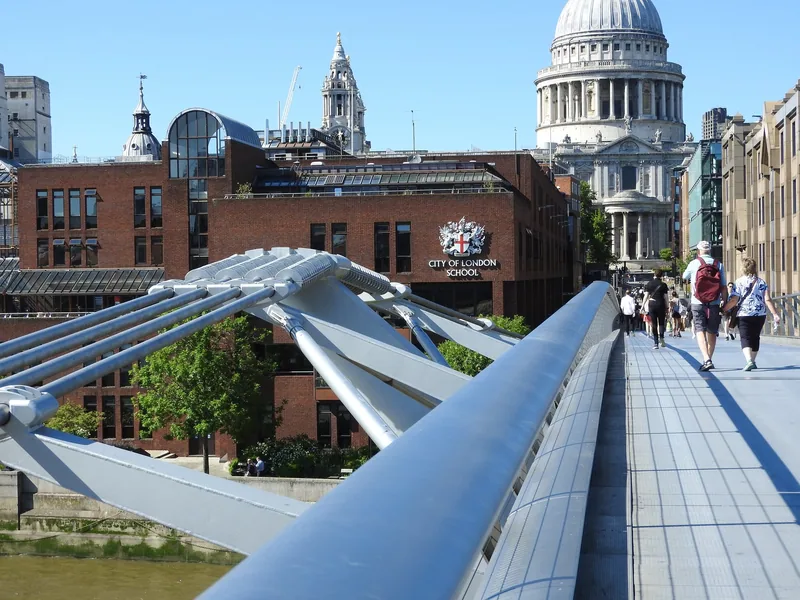
Photo: ClemRutter · CC BY-SA 4.0 · Wikimedia Commons · resized
Synchronous lateral excitation, in plain words
The effect has a name, and it is worth knowing because it explains why the fix took so long.
Something small starts the deck moving sideways: enough people happening to step in time, for a moment. Once it is moving, walking in time with the sway is more comfortable than fighting it, so people fall into step with the bridge without deciding to. Their sideways push then arrives at exactly the frequency the bridge wants to move at, and in the direction that increases the movement. More movement means more people syncing, which means more force, which means more movement.
The crucial finding from the crowd tests, run on the empty deck with 100 volunteers in July 2000 and in laboratories at Imperial College and Southampton, was that pedestrians behave as negative dampers: they eat into the bridge's own ability to absorb movement. Below a critical number of people nothing happens at all and the deck looks perfectly stiff; one person over that number and the motion grows quickly. That is why the bridge passed every test and then failed in public.
The engineers also found no lower limit to the frequencies affected: the lower the frequency, the more damping is needed. On opening day the worst movement was on the south span at 0.77 Hz and in the first sideways mode of the centre span at 0.49 Hz; the north span, at 1.05 Hz, misbehaved least. Any footbridge with a sideways frequency below about 1.3 Hz, the upper limit of a normal walking pace, can do this, and the engineers found that a box-girder road bridge in Auckland had done the same under a crowd of demonstrators in 1975 without anybody writing it up properly.
The nickname is unfair but permanent. Londoners still call it the wobbly bridge, and it has not wobbled since February 2002. The deck now carries dampers designed for two people per square metre across the whole length, which is more crowded than it ever was on opening day, when the peak was about 1.3 to 1.5 people per square metre.
How it was fixed
There were only two real options: make the bridge much stiffer, or make it absorb movement. Stiffening would have meant raising the centre span's sideways frequency roughly threefold, which needs about nine times the stiffness in theory and more than ten times in practice once you allow for the weight of the strengthening. On a bridge whose whole point was that it had no towers and almost no visible structure, that was the wrong answer.
So they added damping. Thirty-seven fluid viscous dampers were installed, most under the deck on top of the transverse arms, one every 16 metres. Each connects to the apex of a steel V-brace, called a chevron, sitting on roller bearings so it can slide; the far ends are fixed to the neighbouring arms, so the sideways movement across 16 metres of deck is fed into a single damper. Where possible the dampers are anchored to something that does not move at all, such as the piers or the ground. A pair sits each side of the approach ramp at the south abutment.
Tuned mass dampers were also fitted in pairs on the transverse arms, aimed at up-and-down movement. The engineers were explicit that they had seen no evidence of a vertical problem and were fitting these as insurance, because other researchers believed the effect existed.
None of this is hidden. Look over the handrail as you cross and you can see the chevrons and the dampers under the walkway. It is the most visible piece of remedial engineering on any London bridge.
Walking it: direction, timing and where to stand
Walk it south to north if you can. The line of the bridge points almost exactly at the dome of St Paul's Cathedral, and the deliberate absence of towers means nothing interrupts it. Foster's original sketch was for a blade of light on the axis of St Paul's, and keeping the view clear was the reason the bridge has no conventional suspension towers at all.
North to south gives you the brick chimney of Tate Modern ahead, a duller composition, but with the low afternoon sun behind you.
The best place to stand is the middle of the centre span, facing downstream and east: Tower Bridge and the towers of the City are in one frame. Facing upstream you get Blackfriars station stretched across the water and the Charing Cross bridges beyond. Both ends have steps and a ramp, and the deck is level and wide.
What it is like at different times
- Before 9am is the best of it: almost empty, with the light on the dome from the east.
- Lunchtime on a weekday is a commuting route as well as a tourist one, and busy in both directions.
- Saturday afternoon is the worst. Tate Modern and the Globe empty on to the same 4-metre walkway.
- After dark the handrail is lit from below, which is the effect the name refers to, and the dome is floodlit. It is the quietest good view in central London after about 10pm.
- In wind it is exposed and cold, with no shelter anywhere on it, and in heavy rain the aluminium deck is slippery.
Look down as well as up. The artist Ben Wilson has painted dozens of tiny pictures on flattened chewing gum stuck to the walkway; children will find them faster than you will. Our guide to Harry Potter locations in London covers the other reason families stop halfway across.
Who owns it, and the bundle of straw
The bridge was paid for by the Millennium Commission out of National Lottery money, after a 1996 competition run by the Millennium Bridge Trust with Southwark Council, the Royal Institute of British Architects and the Financial Times; over 200 entries were submitted. Southwark Council project-managed the construction, and City Bridge Foundation, the charity formerly called Bridge House Estates, put in extra money to make the bridge fully accessible and took over ownership on 22 February 2002, the day it reopened.
That charity maintains five Thames crossings: Tower Bridge, London Bridge, Southwark Bridge, Blackfriars Bridge and this one. It spends about £30 million a year on them and says it does so at no cost to the taxpayer.
The maintenance throws up the occasional oddity. When the membrane between the aluminium deck and the steel structure was replaced in October 2023, a bundle of straw was hung from the bridge as a warning to river traffic, because that is what the Port of London's Thames byelaws require. It made the international news.
On screen, and one world record
Death Eaters twist the bridge apart in the opening minutes of Harry Potter and the Half-Blood Prince, which is the appearance most visitors have in mind. It has also turned up in Guardians of the Galaxy and Run Fatboy Run. The record is better: in April 2007, 600 people bounced on space hoppers on the bridge simultaneously for 60 seconds, setting a world record for the largest hop. The dampers held.
Getting there, and the closures to watch
On the north bank, St Paul's on the Central line is about eight minutes' walk through the churchyard and down Peter's Hill; Mansion House on the District and Circle lines is about the same. Blackfriars, which has entrances on both banks of the river, is five minutes from the south end, and Southwark on the Jubilee line is about ten. Our notes on walking in London explain why crossing on foot here beats going round by train, and the Thames Path runs along both approaches.
Both ends are step-free by ramp, and the deck has no steps along it. This was deliberate: the accessibility of the crossing is what City Bridge Foundation's extra funding paid for.
Closures are rare and are published: in September 2026 the owner listed no major works on the Millennium Bridge. Check the same page before an event day, because the five bridges are sometimes shut for races: Tower Bridge closed to vehicles for the Big Half in September 2026 while staying open to pedestrians.
What to do at each end
North: the cathedral, then five minutes into the City of London, where the Monument and the Wren churches are. South: Tate Modern, free, with toilets and a café, and Shakespeare's Globe a few steps east. The stretch is covered in our guide to the South Bank, and the bridge is on the route in our one-day itinerary. For the view rather than the crossing, see our list of the best free viewpoints in London; the middle of this bridge is on it.
Frequently asked questions
Is the Millennium Bridge free to cross?
Yes. It is a public footbridge, free at all times, with no gates and no closing hour. It is for pedestrians only, and both ends are step-free by ramp.
Why did the Millennium Bridge wobble?
Because of synchronous lateral excitation. A crowd starts the deck moving sideways, walkers instinctively fall into step with the sway, and their footfalls then push it at exactly the frequency that increases the movement. The engineers found pedestrians act as negative dampers, cancelling out the bridge's own damping once a critical number of people are on it. Any footbridge with a sideways frequency below about 1.3 Hz can behave the same way.
How was the Millennium Bridge fixed?
By adding damping rather than stiffness. Thirty-seven fluid viscous dampers were fitted, most of them beneath the deck every 16 metres, connected to sliding steel chevrons, with tuned mass dampers in pairs on the transverse arms as a precaution against vertical movement. The bridge reopened on 22 February 2002 and has not moved noticeably since.
How long is the Millennium Bridge and how long does it take to walk?
Three to five minutes at a normal pace. City Bridge Foundation gives the length as 325 metres and the width as 4 metres; the engineers' account gives 333 metres overall in three spans of 81, 144 and 108 metres. Either way it is a short crossing that most people spend longer on than they planned, because of the view.
Which direction should I walk across the Millennium Bridge?
From Tate Modern towards St Paul's. The bridge was aligned on the dome and has no towers to interrupt the view, so walking north gives you the framed shot of the cathedral. Walking south gives you Tate Modern's chimney instead, which is less rewarding.
Sources
- City Bridge Foundation - Our bridges: the Millennium Bridge, its designers, funding and transfer date (checked September 2026)
- City Bridge Foundation - 25 facts for 25 years: dimensions, opening day, the straw bundle and the space hoppers (checked September 2026)
- City Bridge Foundation - Bridge works and closures (checked September 2026)
- Royal Academy of Engineering, Ingenia issue 9 - Tony Fitzpatrick and Roger Ridsdill Smith, Stabilising the London Millennium Bridge (checked September 2026)