
Two bishops' houses sit on the Thames in London. Fulham Palace, the historic country home of the Bishops of London, is free, open every day and easy to walk into. Lambeth Palace, the London home of the Archbishop of Canterbury, is not: regular guided tours are suspended, the gardens are closed for works, and the only reliable free way into the precinct in 2026 is the Library's exhibition gallery next door.
If you have read that Lambeth Palace can be booked weeks ahead for a tour, that was true until recently and is not true now. We set out what is actually open below, because the difference between the two places is the whole point of this page.
Both are worth the journey for different reasons. Fulham is a half-day in a walled garden with a small free museum attached. Lambeth is an hour of medieval brick, a free exhibition of extraordinary books, and a view across the river to Parliament.
The two palaces compared
- Fulham Palace
- Free, no charge for house or garden; museum and historic rooms daily 10.30am to 5pm, last entry 4.30pm
- Fulham gardens
- Botanic garden 7am to 6pm; walled garden 10.15am to 4.15pm
- Fulham cafe
- Daily, 9.30am to 4pm
- Lambeth Palace
- No regular guided tours at present; summer open days only, hosted by charities
- Lambeth Palace gardens
- Closed for works; occasional openings, such as the National Garden Scheme day each May
- Lambeth Palace Library
- Free exhibition gallery, Monday to Friday 9.30am to 5pm, Thursdays to 7.15pm
- Fulham station
- Putney Bridge (District line), 15 minutes through Bishop's Park; no lift
- Lambeth station
- Westminster or Lambeth North; buses stop outside the gate
Fulham Palace: free, daily and much bigger than it looks
The Bishops of London used this site as a country residence for a very long time, and gave it up only in the 20th century. What survives is a Tudor courtyard of red brick, a great hall, a chapel, a Georgian range, a small museum and a large walled garden, all on the river at the western end of Bishop's Park.
Entry to the house and the garden is free. The museum and the historic rooms open daily from 10.30am to 5pm, with last entry at 4.30pm, and you are asked to book a free timed slot for the museum, which takes a minute online. Donations are welcome, and membership starts at £35 a year if you expect to come back.
The gardens work on different hours. The botanic garden is open from 7am to 6pm, which makes it one of the earliest open green spaces in west London. The walled garden, which is the best part, opens from 10.15am to 4.15pm. The cafe runs from 9.30am to 4pm every day.
Fulham Palace pays for itself by hiring out rooms, so check the closures page first. It is an independent charity with no government funding, and private events regularly shut parts of the site for a day. Recent examples: the chapel, great hall and Tudor courtyard closed for a Sunday in September 2026, and the museum and shop closed on two Mondays in September and October. The website lists them in advance.
When a partial closure is in force, the grounds and garden shut while the museum, shop and cafe stay open, and everyone comes and goes through the main entrance on Bishop's Avenue because the back gates are locked. If you are coming specifically for the garden, that is the day to avoid.
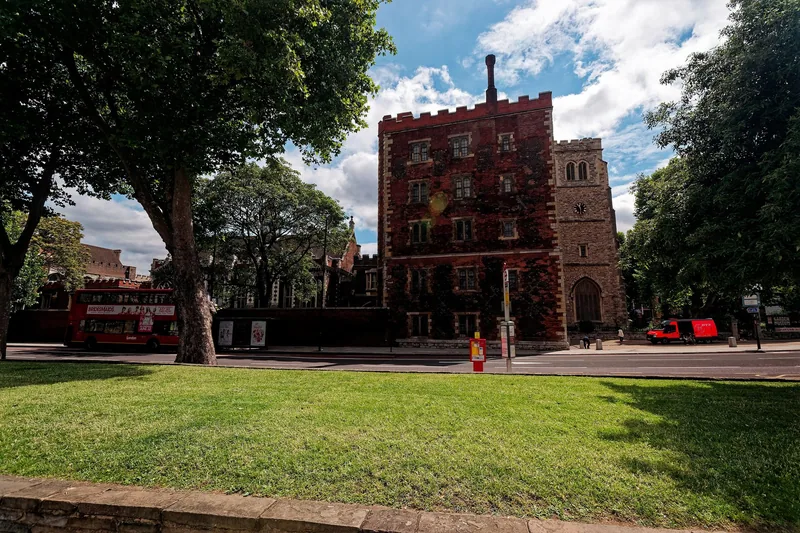
Photo: Txllxt TxllxT · CC BY-SA 4.0 · Wikimedia Commons · resized
The Fulham walk that has changed
The riverside route from Putney Bridge station is closed until 2027. Willow Bank and a section of the Thames Path are shut, and so is the underpass. The signed diversion takes you out of the station, left then immediately right, to the end of Ranelagh Gardens, right into Fulham High Street, left into Gonville Street past the Premier Inn, across the busy Putney Bridge Approach on the pedestrian crossing, then left towards the river and through the stone gateway into Bishop's Park. Allow fifteen minutes and a little patience.
Putney Bridge station is on the District line and has no lift, which matters if you are carrying a case or using a pushchair. The alternative is Putney station, fifteen minutes from Waterloo, then either a twenty-five minute walk down Putney High Street and across the bridge, or the 14, 424 or 430 bus from opposite the station to the Putney Bridge Station stop on the bridge itself. From the bridge, steps lead down to the Thames Path and it is ten minutes through the park; for step-free access use the street beside the steps.
Our guides to step-free transport in London and the Thames Path cover the wider picture.
Lambeth Palace: what is actually open in 2026
Lambeth Palace stands on the south bank between Westminster Bridge and Lambeth Bridge, directly opposite Parliament, behind a red-brick Tudor gatehouse that most people photograph without knowing what it is. It is a working residence and office for the Archbishop of Canterbury, not a museum.
As of September 2026 the position is this:
- Regular guided tours are suspended. The Palace says it is recruiting volunteers and intends to resume a regular programme later in 2026. Announcements go on its own website and social media accounts.
- Summer open days do run. These are called HOPE Days, and they are self-guided visits to the Great Hall, Chapel, Guard Room and other historic spaces, hosted by a partner charity. Recent hosts have included Help Musicians, the Mothers' Union, The Passage and Arts for Dementia. Tickets are bought through the charity rather than from the Palace, and proceeds go to the charity's work.
- The gardens are closed. Ongoing works mean the garden is no longer included in the open days at all.
- Concerts are held in the Great Hall from time to time, run with St Martin's Voices; see our guide to St Martin-in-the-Fields, whose choir they are.
HOPE Day tickets sell quickly and there is only limited availability on the day, so if the dates are announced for a period when you are in London, book immediately rather than deciding later.
The Library, which is the free way in
Beside the Palace stands its Library, in a purpose-built home of its own, and this is where a visitor can walk in without a ticket, a tour or a charity booking. The Library holds the archives of the Archbishops of Canterbury and one of the oldest public library collections in the country, and it mounts free exhibitions in a gallery open to anyone.
The current exhibition, Across Continents, Across Centuries, runs from 21 September to 17 December 2026 and draws on travel-related material in the collections. Opening hours are Monday to Friday from 9.30am to 5pm, with late opening until 7.15pm on Thursdays, plus three Saturdays: 3 October, 7 November and 5 December, from 10am to 5pm. Last entry is half an hour before closing. Entry is completely free.
The gallery is fully accessible for wheelchair users and visitors with mobility difficulties, and stools are available. If you want to see the collections properly rather than an exhibition, the reading room opens on Monday, Wednesday and Friday from 10am to 5pm, with last entry at 4.40pm, and readers are strongly advised to register and order material at least two working days in advance. The Library also runs its own tours, separately from the Palace.
Search carefully for the Library online. The address ending lambethpalacelibrary.org no longer belongs to the Library and now serves unrelated commercial content. The genuine site is at lambethpalacelibrary.info. This is a common problem with institutions that have changed domain, and it is worth checking that a page looks like what it claims to be before you act on anything it says.
The gardens, and when you might get in
Lambeth Palace garden covers just over ten acres and is one of the oldest gardens in England. Two full-time gardeners and a team of volunteers run it organically, with no chemical pesticides or herbicides, encouraging lacewings and ladybirds against aphids, birds against leaf miners and, by their own account, several hundred toads against the slugs. Longer grass and log piles are left deliberately as habitat.
It is not part of the summer open days any more. The realistic chance of seeing it is the National Garden Scheme day, which the Palace has held annually in May, or another announced special event. Watch the Palace's own channels if it matters to you.
Fulham's gardens, by contrast, are open almost every day for nothing, and include a botanic garden planted in a tradition that goes back to the bishops' own collecting. If plant history is the reason you are reading this, Fulham is the visit to make, alongside the Chelsea Physic Garden across the river.
Doing both, and what is next door
These two are eight kilometres apart, so treat them as separate half-days rather than one trip.
At Lambeth, the obvious pairing is the Garden Museum, which occupies the former church of St Mary at Lambeth immediately beside the Palace gates and has a cafe and a churchyard garden. Ten minutes further south is Imperial War Museum London, also free. Across Lambeth Bridge you are at the Palace of Westminster, and Westminster Cathedral is fifteen minutes beyond it. Our guide to the South Bank covers the riverside walk north.
At Fulham, Bishop's Park itself is the attraction after the Palace: a long riverside park with an avenue of planes, running down to Craven Cottage. Hammersmith and Barnes are upstream, and the London Wetland Centre is twenty minutes away across the river.
If you are collecting buildings called palaces, our guides to Buckingham Palace, Kensington Palace and Eltham Palace cover the royal ones, and Alexandra Palace the Victorian one that never had a monarch in it. In September, the Open House Festival sometimes opens buildings in both precincts that are otherwise shut, and it is free.
Frequently asked questions
Is Fulham Palace free to visit?
Yes. The house, the museum, the historic rooms and the gardens are all free, though you are asked to book a free timed ticket for the museum. The museum and historic rooms open daily from 10.30am to 5pm with last entry at 4.30pm, and the botanic garden from 7am to 6pm.
Can you visit Lambeth Palace?
Only at limited times. The Palace is not currently running a regular programme of guided tours and says it intends to resume them later in 2026. Summer HOPE open days, hosted by partner charities, are ticketed through the charity concerned. The Palace gardens are closed for works.
How do I see inside the Lambeth Palace precinct for free?
Through Lambeth Palace Library, which is next to the Palace and mounts free exhibitions in a public gallery. The current one runs from 21 September to 17 December 2026, Monday to Friday 9.30am to 5pm, with late opening on Thursdays and three Saturday openings. Entry is free and the gallery is step-free.
How do you get to Fulham Palace?
Take the District line to Putney Bridge and allow fifteen minutes on foot. The riverside route is closed until 2027, so follow the signed diversion via Ranelagh Gardens, Fulham High Street and Gonville Street. Putney Bridge station has no lift; Putney station plus the 14, 424 or 430 bus is the step-free alternative.
Which is better, Fulham Palace or Lambeth Palace?
For a visitor in 2026, Fulham, by a wide margin. It is free, open every day, has a garden, a museum and a cafe, and nothing needs booking. Lambeth is the more historically significant building but is open to the public only on scattered charity open days, with its gardens closed.
Sources
- Fulham Palace - Opening times and closures (checked September 2026)
- Fulham Palace - Getting here (checked September 2026)
- Archbishop of Canterbury - Lambeth Palace tours and open days (checked September 2026)
- Archbishop of Canterbury - Lambeth Palace Gardens (checked September 2026)
- Lambeth Palace Library - Across Continents, Across Centuries (checked September 2026)