
The best thing in Poplar is free and open every day except Christmas Day, from 7am to 7pm: Trinity Buoy Wharf, a small yard at the mouth of the River Lea holding London's only lighthouse, a stack of shipping-container studios and a view straight across to the O2. It is at 64 Orchard Place, E14 0JW, about ten minutes' walk from East India on the DLR or Canning Town on the Jubilee line.
Poplar and Blackwall sit directly under the towers of Canary Wharf, which is the reason almost nobody stops here. This was the working half of the docks: Blackwall is where the East India Company's ships came home, Poplar is where the people who unloaded them lived, and the Blackwall Tunnel under the Thames was dug in the 1890s to take the traffic that the docks generated.
Almost everything was bombed, and almost everything was rebuilt in the 1950s as an exhibition of how post-war Britain thought people should live. That is what makes the area worth a morning: a Festival of Britain housing estate with its own market square, two churches that survived, and a lighthouse in a boatyard. Our guide to the Isle of Dogs covers the peninsula immediately south, and Canary Wharf the towers in between.
Poplar and Blackwall at a glance
- Where
- East London, E14, in the borough of Tower Hamlets, between Canary Wharf and the River Lea
- Stations
- All Saints, Langdon Park, Poplar, Blackwall and East India on the DLR; Canning Town on the Jubilee line and DLR
- Step-free
- All of them. Every DLR station is step-free from street to train
- Trinity Buoy Wharf
- Free. Open daily except Christmas Day, 7am to 7pm
- Chrisp Street Market
- Monday to Saturday, 8am to 6pm
- Free parking
- One hour in marked bays at Chrisp Street on market days, booked through RingGo
- Time needed
- Half a day, more if you walk the river
- Best for
- Post-war architecture, docks history, a lighthouse, a market with no visitors in it
Trinity Buoy Wharf and London's only lighthouse
Trinity Buoy Wharf is the point where the River Lea meets the Thames, and it was Trinity House's workshop: the place where buoys were built and repaired and where lighthouse keepers were trained. The lighthouse at the end of the wharf was built for experiments rather than for navigation, and Michael Faraday is associated with the site through his work on lighthouse illumination.
The wharf now works as a centre for arts and small businesses. Studios are stacked in painted shipping containers, there is a lightship moored alongside, and the lighthouse holds a long-duration sound installation. It is open to the public every day except Christmas Day, from 7am to 7pm, and it costs nothing to walk in.
Getting there takes a little care. From East India DLR, use the stairs to the south exit rather than the station footbridge, turn left and follow the blue signs past the East India Dock nature reserve down to Orchard Place. From Canning Town on the Jubilee line, leave by the first exit on the left after the barriers and cross the red pedestrian bridge through City Island. Either walk takes about ten minutes. Bus 277 stops at the Town Hall by East India station, and the D3 from Canary Wharf stops in Orchard Place itself.
The boat from North Greenwich Pier to Trinity Buoy Wharf is not running. The wharf's own designated service is out of action until further notice, so do not plan to arrive by river. Walk from East India or Canning Town instead. There is no public parking on the site either, which makes the DLR the sensible answer.
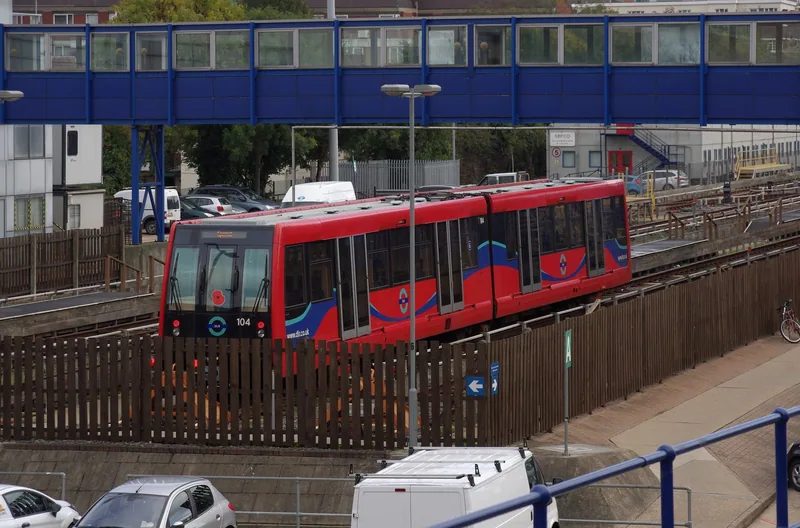
Photo: mattbuck (category) · CC BY-SA 4.0 · Wikimedia Commons · resized
Chrisp Street: Britain's first pedestrian shopping precinct
Chrisp Street Market sits in a pedestrianised square in the middle of Poplar and trades Monday to Saturday from 8am to 6pm. Tower Hamlets Council traces the market itself to Victorian times, but the square is post-war: it was laid out in the early 1950s as part of the Lansbury Estate, the housing built as the Festival of Britain's exhibition of live architecture, and it is generally described as the first purpose-built pedestrian shopping precinct in Britain.
The clock tower in the middle is the landmark, and the estate around it is the reason architects come: low brick terraces, a market square, a school and two churches, all laid out together as a demonstration of how a bombed district could be rebuilt as a neighbourhood rather than as a road scheme.
The market is a working one. Fruit and vegetable stalls are the strength, with clothing, linens and household goods around them, and cafes and eating places in the square including pie and mash. There is nothing here for a souvenir hunter and no reason at all to come on a Sunday, when it is shut. Our guide to London markets by day of the week sets out which markets do run on a Sunday.
Two churches, and which one is Georgian
Poplar has two significant churches and they are frequently confused, including in print.
St Matthias Old Church, on Woodstock Terrace behind the Chrisp Street area, is the older and the more remarkable: it was built in the middle of the seventeenth century as the East India Company's own chapel for Poplar, which makes it one of the oldest surviving buildings in Docklands. It was refaced in Victorian Gothic in the nineteenth century, so the outside looks two centuries younger than the inside, and its timber columns are said to have come from ships' masts. It is no longer a parish church and is used as a community building, so access depends on what is on.
All Saints Poplar, on Newby Place, is the Georgian one: a stone church of the 1820s with a portico and a tall spire, built when Poplar became a parish in its own right, standing in its own churchyard with the rectory beside it. It is the working Church of England parish church and the building the description "a Georgian chapel" actually fits.
Between them they tell the area's story in two buildings: a company chapel for a trading monopoly, and a parish church for the town that monopoly created. If you want more of London's overlooked churches, our guide to All Hallows and the City churches covers the ones nearest the Tower.
Blackwall, the tunnel and the docks that are gone
Blackwall was where deep-water ships moored before the docks were dug, and where the East India Company's ships were fitted out and repaired. The East India Docks opened in 1806; almost nothing of them survives above ground except the dock basin at the northern end, which is now a nature reserve with a bird sanctuary, free to walk into and on the route between East India station and Trinity Buoy Wharf.
The Blackwall Tunnel runs under the Thames here. The original northbound bore opened in 1897 and the southbound in 1967, and a charge now applies in both directions, introduced alongside the Silvertown Tunnel next door. The charges rose on 21 September 2026, and the detail that matters is this: without Auto Pay there is no off-peak rate at all, so a car pays the peak figure at every charging hour. Our page on driving in London has the current rates.
For a visitor on foot, the tunnel matters only as a reason the traffic is what it is. If you want to cross the river here without a car, the options are the Jubilee line from Canning Town, the DLR from Poplar towards Greenwich, or the cable car from Royal Victoria, and our guide to the Woolwich Ferry and the foot tunnels covers the free crossings further east and west.
Balfron Tower, and the architecture people come for
Balfron Tower stands beside the northern approach to the Blackwall Tunnel: a tall concrete slab with its lifts and services in a separate shaft joined to the flats by walkways. Ernő Goldfinger designed it, moved into one of the flats himself for a while in order to canvass his tenants' opinions, and went on to build the better-known Trellick Tower in north Kensington to much the same plan.
It has been refurbished and sold as private flats, which was controversial locally and remains so. There is no public access, so this is architecture from the pavement. Our guide to brutalist London places it beside the Barbican and the South Bank and explains what to look for.
Around it, Poplar High Street and the streets north of the DLR hold a run of 1950s and 1960s estates that are more interesting than they look, and Poplar Recreation Ground holds a memorial to the children killed in 1917 when a bomb hit their school, which is one of the quieter and harder things in east London to stand in front of.
Getting around, and why the DLR is the answer
Five DLR stations serve this small area: All Saints for Chrisp Street and All Saints Poplar, Langdon Park for the northern estates, Poplar for interchange, Blackwall for the tunnel approach, and East India for Trinity Buoy Wharf. Every DLR station in London is step-free from street to train, and staff ride the trains rather than staffing the stations.
That makes Poplar unusually easy to visit in a wheelchair or with a pushchair, which is not true of most of east London. The one thing to know is that DLR fares are Tube fares and the same daily caps apply, as our guide to the DLR and the London Overground explains.
Buses are the better answer along East India Dock Road. If you are coming for an event at the arena across the river, our guide to getting to The O2 covers the routes, including the one bus that runs round the clock, and the O2 is close enough to see from the wharf.
Is it worth the journey
Come if
- Post-war British architecture and housing interest you
- You want a lighthouse, a lightship and a container yard, for nothing
- You are already going to Canary Wharf and want something with people in it
- Step-free travel matters: every station here is step-free
- Docks and shipping history is your subject
Skip it if
- You are here on a Sunday and came for the market
- You want museums; the docks museum is at West India Quay, not here
- You have a short trip and have not seen central London
- You expected the East End of the guidebooks, which is further west
The museum that tells this story properly is London Museum Docklands at West India Quay, three minutes on the DLR, free and open daily. Going the other way, the London Marathon route runs through the area on race day, which is the one day of the year when Poplar has crowds in it.
Frequently asked questions
Is there a lighthouse in London?
Yes, at Trinity Buoy Wharf in Poplar, where the River Lea meets the Thames. It was built for experimental work rather than navigation and it is the only lighthouse in London. The site is free and open every day except Christmas Day, from 7am to 7pm.
How do you get to Trinity Buoy Wharf?
Walk about ten minutes from East India on the DLR, using the station's south exit and following the blue signs, or from Canning Town on the Jubilee line, across the red footbridge through City Island. Bus 277 and the D3 from Canary Wharf also serve it. The boat service from North Greenwich Pier is out of action until further notice.
Is Chrisp Street Market open on Sunday?
No. It trades Monday to Saturday from 8am to 6pm. The square is a public space and you can walk through it at any time, but the stalls are not there on a Sunday.
Can you go inside Balfron Tower?
No. It was refurbished and sold as private flats, so there is no public access and no viewing platform. You can look at it from the street beside the Blackwall Tunnel approach, which is how most people photograph it.
Is Poplar worth visiting?
For half a day, if architecture, the docks or free curiosities appeal, and it is unusually easy to get around because every station is step-free. It has no major museum and no restaurant district, so it works best as a morning attached to Canary Wharf or Greenwich rather than as a day of its own.
Sources
- Trinity Buoy Wharf - Visit, opening hours and directions (checked September 2026)
- London Borough of Tower Hamlets - Markets in Tower Hamlets (checked September 2026)
- Transport for London - Paying the Blackwall and Silvertown tunnel charges (checked September 2026)
- Transport for London - Docklands Light Railway (checked September 2026)