
You cannot walk into the Crystal Palace Subway whenever you like. It opens on a handful of announced open days a year, entry is free, the timed slots are booked in advance and they sell out. Turning up on a random Tuesday gets you a locked gate.
The subway is a pedestrian tunnel under Crystal Palace Parade in south-east London, built in 1865 so that railway passengers could reach the Crystal Palace without crossing the road. The palace burnt down in 1936 and the station that fed the tunnel was demolished in the 1960s. The tunnel stayed, and it is the most elaborate thing left from the whole Sydenham enterprise: a low, wide hall of red and cream brickwork with fan vaults springing from squat octagonal columns.
Our guide to Crystal Palace Park covers the terraces, the maze and the rest of the site. This page is about the tunnel itself, and above all about how to be standing in it on a day when the gate is open.
The Crystal Palace Subway in short
- Cost
- Free. Timed tickets must be booked in advance; Crystal Palace Park members walk up without booking
- When
- Announced open days only, a few times a year, published on the park's What's On listings
- Opened
- 1865, designed by Charles Barry Junior
- Protection
- Listed Grade II* on 27 September 1972, entry amended 23 March 2018 (list entry 1385457)
- Entrance
- Top of the steps and ramp off Crystal Palace Parade, beside the bus station
- Step-free?
- No. Two flights of stairs, handrails on both sides
- How long
- 20 to 40 minutes, depending on how much you want to photograph
How the open days work, and why they sell out
Crystal Palace Park Trust, which runs the park, opens the subway for self-guided visits on days it announces in advance. Entry costs nothing. You book a slot, and the slots run every fifteen minutes through the day, which keeps the space from filling up and means the timing is real rather than advisory.
The September 2026 open day ran from 10:00 to 17:00 with last admission at 16:30, and it was showing as sold out well before the day. That is the pattern to plan around: the tickets are free, so they go, and the release is not on a fixed weekly cycle like the Sky Garden's Monday drop. Watch the park's listings and book the moment a date appears.
Park members are the exception. Membership gives walk-up access with no booking on open days, which is the only reliable way in if you are deciding at short notice. Staff and volunteers are on hand inside to answer questions, but there is no guided tour and no commentary.
The Friends of Crystal Palace Subway web address no longer belongs to them. The domain cpsubway.org.uk, which Historic England's own list entry cites as a source and which the Trust still links to for photographs, now resolves to a domain-sale page in Thai. Do not follow it. Everything you need comes from the park's own listings.
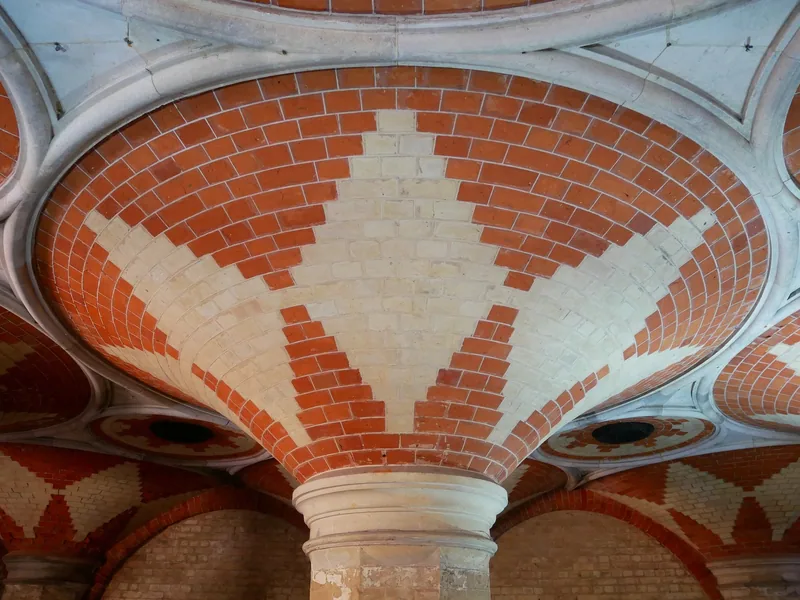
Photo: Doyle of London · CC BY-SA 4.0 · Wikimedia Commons · resized
What Charles Barry Junior actually built
The statutory list entry is unusually generous about the fabric, and it repays reading before you go, because you will otherwise walk through the best part in ninety seconds.
The main tunnel has three parallel rows of five octagonal columns in cream brick, with moulded stone capitals and stone mouldings at the base. Half-octagonal responds stand against oblong piers at either end and along the walls. From every column a circular fan vault rises, worked in red and cream brick laid to form diamonds, with a stone moulding defining each vault and roundels of patterned brickwork between them. A cast-iron gas light fitting survives at the centre.
The only part of the structure that was ever meant to be seen from outside is the north-west face, in cream brick with four wide segmental arches lined in red, and a stone-paved terrace laid in a diamond pattern with star shapes at the sides. Some of that paving has been repaired in concrete, which you will spot.
On the other side is the vestibule, which once had a glass and iron roof. That roof is gone. Four staircases led out of it: two rising for visitors entering the palace, two for those leaving, separated by a wall so that the crowds never met.
The station that vanished, and why the tunnel points nowhere
Two railways served the palace. Crystal Palace Low Level station, which opened in 1854, is still there and still busy. The High Level station, designed by Charles Barry Junior and opened in 1865 on the west side of Crystal Palace Parade, is not: it closed in 1954 and was cleared in the 1960s.
The subway was built as the High Level station's front door. First-class passengers came off the platforms, crossed under the road through the brickwork, and climbed into the central transept of the palace. Take away the station at one end and the palace at the other, and what is left is a magnificent piece of engineering joining a car park to a hillside. That is a large part of its charm.
Air-raid shelter, then something less official
The tunnel had two afterlives. In the Second World War it served as an air-raid shelter, and the evidence is still in the floor: an L-shaped porcelain channel in the northern corner, noted in the list entry as a remnant of that use.
Later, and less formally, it was used for illegal raves, which the Trust cheerfully includes in its own account of the place. Neither phase did the brickwork much good, and both are part of why the restoration was needed.
What the 2024 restoration changed
The first phase of a major restoration project finished in September 2024, in time for the tunnel's 160th anniversary the following year. It put a new roof over the East Courtyard and carried out extensive repairs to the walls, floor, steps and entrances. The work was funded with help from the National Lottery Heritage Fund.
The practical effect for a visitor is that the space is now dry, lit and safe enough to admit the public in numbers, which it was not for decades. Phase one is the phase you are looking at; more is intended.
Finding the entrance, which is not where you expect
The way in is at the top of the steps and ramp leading off Crystal Palace Parade, next to the bus station. It is not inside the park, and it is not signposted from the dinosaurs end. If you are coming up from the lower part of the park you have a long climb.
Crystal Palace station is the nearest railway station and the Trust puts the walk at about fifteen minutes, with a steep hill in it. That hill is not a formality. Trains reach Crystal Palace on the London Overground's Windrush line and on Southern services, and buses stop at the bus station right beside the entrance, which makes a bus the easier arrival if you are coming from anywhere in south London.
Arrive by bus and you are twenty metres from the door. The Crystal Palace bus station sits directly beside the subway entrance at the top of the Parade, so a bus removes the hill entirely. Our guide to London buses and night buses explains how the fares and the Hopper work.
Access, and the things that are not there
The Trust is blunt about this, and so are we. There is no step-free access to the subway. You reach it by two flights of stairs with handrails on both sides. The floor inside is uneven. The light shifts from bright to dim as you move through, which matters if you have limited vision or find that disorienting. There is no seating anywhere in the space.
There are no public toilets on site; a portable toilet is usually provided on open days and nothing else. Food and drink are not allowed inside. Well-behaved dogs on leads are welcome, which is unusual for a heritage interior. Children of any age can come, and must be supervised throughout.
If step-free matters, our guides to accessible London and step-free transport will help you plan the rest of the day, but the tunnel itself cannot be reached on wheels.
What to build around it, given you have a slot
Half an hour in a tunnel is not a day out. The good news is that the slot lands you at the top of one of the best free parks in south London, at its highest point.
From the entrance you can walk straight into the park and down the terraces past the sphinxes, then on to the Crystal Palace Dinosaurs at the far southern end, which is the other reason people make this journey. Allow a good hour for the walk down and back up, and remember that the return is uphill. The Crystal Palace Triangle above the park has the cafés and the second-hand shops, and the Horniman Museum is two stops away at Forest Hill.
If open-days-only architecture is your sort of thing, the Open House Festival in September opens several hundred London buildings on the same principle, and the subway has appeared in its programme. Our round-up of free things to do in London has more that costs nothing, and our page on Tower Subway and London's other lost tunnels covers the underground spaces you cannot get into at all.
Frequently asked questions
Is the Crystal Palace Subway free to visit?
Yes. Entry on an open day costs nothing at all, and there is no donation gate. You do need a booked timed ticket, released through the park's own listings, because the number of people inside at once is limited to fifteen-minute intakes. Members of Crystal Palace Park can walk up without booking.
How often does the Crystal Palace Subway open to the public?
A few times a year rather than monthly, and the dates are announced individually rather than published as a season. The park's What's On listings are the only reliable place to see them, and there is usually no calendar beyond the next announced day, so it is worth checking every few weeks if you are planning around it.
Is the Crystal Palace Subway wheelchair accessible?
No. Access is by two flights of stairs with handrails on either side, and there is no lift, ramp or alternative route. The floor inside is uneven and there is no seating. The park itself is hilly but largely walkable, so the terraces above the subway are a better target if stairs are a problem.
Which station is closest to the Crystal Palace Subway?
Crystal Palace, on the Windrush line of the London Overground and on Southern services. The park trust puts the walk at about fifteen minutes and warns that it includes a steep hill. A bus to Crystal Palace bus station drops you beside the entrance at the top of the Parade and avoids the climb.
What grade is the Crystal Palace Subway listed at?
Grade II*, first listed on 27 September 1972 with the entry amended in March 2018. The list entry covers the subway, the vestibule, the terrace and the stairs together, and unusually it sits in two boroughs at once, Bromley and Southwark, because the borough boundary runs along Crystal Palace Parade above it.
Sources
- Historic England - Subway, Vestibule, Terrace and Stairs to the Crystal Palace, list entry 1385457 (checked September 2026)
- Crystal Palace Park Trust - Subway (checked September 2026)
- Crystal Palace Park Trust - Subway open day listing (checked September 2026)
- Historic England - Crystal Palace Subway restoration revealed (checked September 2026)
- Historic England - Crystal Palace Park, registered park and garden 1000373 (checked September 2026)