
Cleopatra's Needle is an ancient Egyptian obelisk standing on the pavement of the Victoria Embankment, between Embankment and Temple stations. It is free, it is outdoors, and you can touch it. The twenty-minute walk it sits on is one of the best short walks in London, because everything you are standing on - road, gardens, pavement and railway - was river until the 1860s.
The obelisk is far older than the city around it. It was cut in Egypt more than three thousand years ago, long before there was a settlement on this bend of the Thames, and it was put up here in 1878. Its twin stands in Central Park in New York. Two bronze sphinxes flank it, facing inwards rather than outwards, which is not how sphinxes are usually placed and is the first thing an Egyptologist will tell you about it.
What makes the walk worth doing is the layering. Within a few hundred metres you can see how much river was taken away, what was buried under the new ground, and the marks left on the stonework by a bomb. None of it costs anything and none of it needs booking.
The Embankment walk at a glance
- Cost
- Free, all of it
- Length
- About 1.5 km from Westminster Bridge to Temple; twenty to thirty minutes at a walking pace
- Obelisk
- On the river side of Victoria Embankment, roughly opposite the Golden Jubilee Bridges
- Victoria Embankment Gardens
- Villiers Street WC2N 6NJ; open every day from 8am, closing varies with the season
- Stations
- Embankment (District, Circle, Northern, Bakerloo) at the western end; Temple (District, Circle) at the eastern end
- Pier
- Embankment Pier, served by river bus routes RB1, RB2 and RB6
- Best time
- Early morning, or an hour before sunset for the light on the river
The gate that shows how much river was taken
Start with the one object that makes everything else make sense. At the western corner of Victoria Embankment Gardens stands the York Water Gate, built in 1626 as the Duke of Buckingham's private entrance to the Thames. Boats came up to its steps.
The gate has never been moved. Westminster City Council, which looks after the gardens, puts it plainly: the gate is still in its original position, and the water is now some hundred metres away. Everything between the gate and the river - the gardens, the four lanes of the Embankment, the wide pavement, the parapet - is made ground, built out into the Thames in the 1860s and finished as a public promenade. Stand at the gate and look towards the water and you are looking across a hundred metres of nineteenth-century engineering.
The water gate is the free exhibit almost nobody photographs. It is in the north-west corner of the gardens, below the modern pavement level, which is the other clue: the new embankment was built higher than the old shoreline. Go down to it before you walk out to the obelisk, not after, and the rest of the walk explains itself.
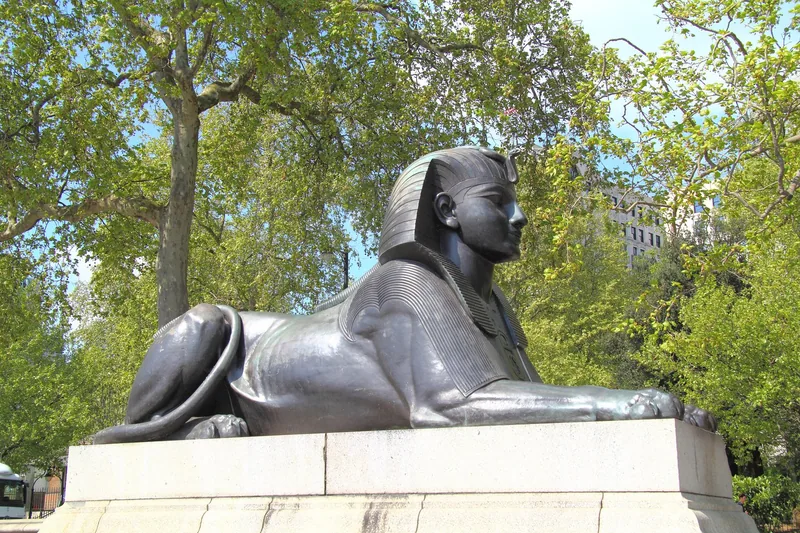
Photo: Djehouty · CC BY-SA 4.0 · Wikimedia Commons · resized
What is buried under the road
The Embankment was not built to give Londoners a riverside walk. It was built to hold a sewer. Joseph Bazalgette's interceptory drainage scheme, begun after the Thames became intolerable in the 1850s, needed a large low-level sewer to run west to east along the north bank, and reclaiming a strip of river was the cheapest way to lay it.
Having built the box, the engineers filled it. The same works carried the underground railway that is now the District and Circle lines - which is why your train from Westminster to Blackfriars runs in a straight line just inland of the river wall - and a service subway for pipes and cables. The gardens and the road were what was left on top. Our guide to the District and Circle lines covers the railway; Crossness Pumping Station in south-east London is where the sewage was pumped out at the far end of the same system, and it is open on a handful of days a year.
The obelisk itself, and what to look for
The obelisk is a single shaft of pink granite, cut in Egypt for a pharaoh of the fifteenth century BC and inscribed again some centuries later, so the hieroglyphs on it belong to two different periods. It has nothing whatever to do with Cleopatra; the name attached itself in Britain and stuck.
Two things repay a close look. The bronze sphinxes are Victorian additions rather than Egyptian, and they face in towards the obelisk instead of out at the road. And the pedestal carries inscriptions recording how the shaft got here: it was floated from Egypt inside a purpose-built iron cylinder, towed behind a steamer, and was very nearly lost in a storm in the Bay of Biscay on the way, with lives lost from the crew sent to help.
Allow ten minutes. There is nothing to go inside, no guide and no interpretation panel worth the name, and in summer the pavement here is a cycling and running route as well as a footpath.
The scars on the sphinx
Look at the base of one sphinx and at the pedestal beneath the obelisk and you will find the bronze torn and the granite pitted. The damage was done by a bomb that fell on the Embankment during a German air raid in the First World War, and it was never made good. There is no reconstruction, no explanatory display and no fuss about it; the marks are simply there, at the height of your hand, on a monument that had already been standing for three thousand years when they were made.
It is the single most affecting thing on the walk, and the easiest to miss. If you are walking the riverside for the war memorials rather than the engineering, the Royal Air Force Memorial is a few minutes west along the same pavement, and the Cenotaph is five minutes inland up Richmond Terrace.
Victoria Embankment Gardens: deckchairs and a bandstand
The gardens behind the road are part of a chain of public spaces created along the new embankment, designed by Alexander McKenzie and officially opened in 1875. They are narrow, formal and much better than they look from the gate: Westminster rates the Tropical Border here as one of the finest in London in high summer, and there are specimen trees and unusual shrubs through the rest of the year.
There is a bandstand with a programme of summer events, and deckchairs to sit in while you listen. Among the statues are John Stuart Mill, the social reformer William Edward Forster, a memorial to Robert Burns, and Lady Henry Somerset's memorial in the form of a girl holding a begging bowl. The gardens have level access throughout, which the riverside pavement does not entirely manage because of the steps down to the water gate.
Two hundred metres east, Somerset House has an entrance on the Embankment through its Great Arch, which is the quickest way up into the courtyard from this walk - but it shuts earlier in the evening than the Strand entrance, so check before you rely on it.
The walk, west to east
| Stage | Minutes | What you pass |
|---|---|---|
| Westminster Bridge to Embankment station | 8 | The Royal Air Force Memorial, the view back to Parliament, Whitehall Gardens |
| Embankment station to the obelisk | 4 | Victoria Embankment Gardens, the York Water Gate, Embankment Pier |
| The obelisk to Waterloo Bridge | 5 | The widest stretch of pavement and the best downstream view of the City |
| Waterloo Bridge to Temple station | 6 | Somerset House's river front and the Great Arch, then Temple Gardens |
Going on eastwards, the Embankment runs to Blackfriars and then into the City. Our guide to the bridges of London covers the crossings in order, and the Thames Path and London's walking routes sets this stretch in the longer riverside walk. On the other side of the water, the walk continues as described in our guide to the South Bank.
The days the road is closed
Victoria Embankment is a main route, so it gets shut for events more often than almost any street in London, and the closures are the reason to check a date before you come.
- The London Marathon. Miles 25 and 26 run along the Embankment, so the road is closed and the pavements are packed. It is a good place to watch and a poor place to sightsee: see watching the London Marathon.
- The Lord Mayor's Show. The procession returns along Victoria Embankment in the early afternoon, and the organisers recommend it as the best spot for wheelchair users. Details are in our guide to the Lord Mayor's Show.
- Pride in London. The gardens host the festival's family area, which means the gardens rather than the road are the busy part. Our Pride in London guide has the layout.
- New Year's Eve. The fireworks are ticket-only and the viewing areas are along this part of the river, so ordinary access here changes for the evening of 31 December. Prices and the on-sale date for 2026/27 had not been announced in September 2026: see New Year's Eve in London.
Getting there, including by boat
Embankment station sits at the western end and puts you on four lines: District, Circle, Northern and Bakerloo. Temple, on the District and Circle, is at the eastern end and is the quieter of the two. Charing Cross main line station is three minutes from the obelisk up Villiers Street.
The better arrival is by water. Embankment Pier is beside the gardens and is one of the piers Transport for London manages, served by river bus routes RB1, RB2 and RB6; pay as you go works, though river fares sit outside the daily cap. At weekends RB2 runs non-stop from here to Battersea Power Station in about ten minutes. Our guide to the river bus explains the fares and the route numbers, which are not obvious from the timetable boards.
Frequently asked questions
Is Cleopatra's Needle free to visit?
Yes. It stands on the public pavement of Victoria Embankment and there is no ticket, no barrier and no opening time. Victoria Embankment Gardens behind it open every day from 8am, with closing times that change through the year.
How old is the obelisk, and is it really Cleopatra's?
The shaft was cut in Egypt in the fifteenth century BC and carries inscriptions from more than one period, so it is around three and a half thousand years old. It has no connection with Cleopatra: the name was given to it in Britain. Its twin stands in Central Park, New York.
What caused the damage to the sphinx?
A bomb dropped during a German air raid on London in the First World War exploded close by, and the shrapnel tore the bronze of one sphinx and pitted the granite of the pedestal. The damage was deliberately left unrepaired and is still visible at hand height.
Which station is nearest to Cleopatra's Needle?
Embankment, about four minutes' walk, on the District, Circle, Northern and Bakerloo lines. Temple, on the District and Circle lines, is about six minutes from the other direction and is usually less crowded. Charing Cross is three minutes up Villiers Street.
How long does the Embankment walk take?
Twenty to thirty minutes from Westminster Bridge to Temple at an ordinary pace, or an hour if you stop at the water gate, the obelisk and the gardens. Add another twenty minutes if you carry on east to Blackfriars.
Sources
- Westminster City Council - Victoria Embankment Gardens (history, the York Water Gate, statues, opening) (checked September 2026)
- Transport for London - River services and piers (checked September 2026)
- The Lord Mayor's Show - route and viewing advice (checked September 2026)
- London Marathon Events - route and spectator information (checked September 2026)