
Crossness Pumping Station opens to the public only on published event dates, and you must book before you travel. An adult ticket is £22.50 including Gift Aid, a family of two adults and up to three children is £49.99, and the engine is in steam on just two of the dates now on sale: Sunday 15 November and Sunday 6 December 2026. There is no way to simply turn up: the site sits inside a working Thames Water sewage treatment works in Abbey Wood, and the gate is shut on every other day.
What you are travelling to see is a sewage pumping station built in 1865, and that description does the building no favours at all. Behind a plain brick shell is the Octagon: a room of cast-iron columns, brackets, screens and roundels, painted in reds, greens and golds, wrapped around four of the largest rotative beam engines ever built. The Victorians decorated the machinery that carried away London's sewage as though it were a cathedral, which is how the place got its nickname.
It is also a long way out. Abbey Wood is at the eastern edge of London, the station is a further two kilometres from the platform, and this is not a place to visit on a whim. Plan it, book it, and give it a day.
Crossness Pumping Station: the frame
- Address
- The Old Works, Thames Water STW, Bazalgette Way, London SE2 9AQ
- Open
- Booked event days only. On sale for 2026: Steaming Days 15 November and 6 December; special steampunk weekend 17 and 18 October; guided tours 3, 8, 17 and 22 November and 1 December. Nothing was on sale for 2027 when we checked
- Steaming Day admission
- Adult £22.50 with Gift Aid (£20.37 without); child 5 to 17 £8; under 5s, carers and Museums Association members free
- Family tickets
- £29.99 for one adult and up to three children; £49.99 for two adults and up to three children
- Guided tour
- £22.50 with Gift Aid, about three hours, Tuesdays at 11.30am or Sundays at 12pm on published dates
- Included in the ticket
- The free vintage Routemaster shuttle from Abbey Wood station and rides on the narrow-gauge RANG railway
- Nearest station
- Abbey Wood: Elizabeth line, and Southeastern from Charing Cross, Waterloo East and London Bridge
- Listing
- The engine and boiler house have been Grade I listed since 1980
Turning up without a ticket gets you nothing but a locked gate. Crossness has no drop-in days. The trust is explicit that the site is closed to the public except for its booked events, and the events sell out. Book online before you leave your hotel, and check the date again the night before, because a Victorian steam engine can develop a fault at short notice.
Steaming Day or guided tour: only one has the engine moving
This is the choice that decides whether the journey is worth making, and the two options are genuinely different days out.
On a Steaming Day, the Prince Consort beam engine is in steam and turning. You explore at your own pace, volunteers stand around the site to answer questions, the narrow-gauge railway and the vintage bus run, a film about Crossness is shown on a loop, a display of smaller engines is open, and the learning team puts on a free hands-on craft activity in the boiler house. There is a children's trail from reception. The café and shop are open. Entry is in an AM or a PM session.
On a guided tour, the engine is not running. The tour starts with a talk or film about the sanitation crisis in Victorian London and Joseph Bazalgette's answer to it, then a volunteer takes you round the history, engineering and architecture of the site. It lasts about three hours in total, starting at 11.30am on a Tuesday or 12pm on a Sunday.
If you have one chance, take a Steaming Day. A stationary beam engine is an impressive object; a moving one, with a 47-tonne beam rocking overhead and a 52-tonne flywheel turning, is a different experience entirely. The tour is the better choice if you want the explanation more than the spectacle, or if the Steaming Days do not fit your dates.
Special events, such as the steampunk-themed weekend on 17 and 18 October 2026, add entertainment and stalls but the beam engine is not in steam for them. That is worth knowing before you book, because it is easy to assume any open day is a steaming day.
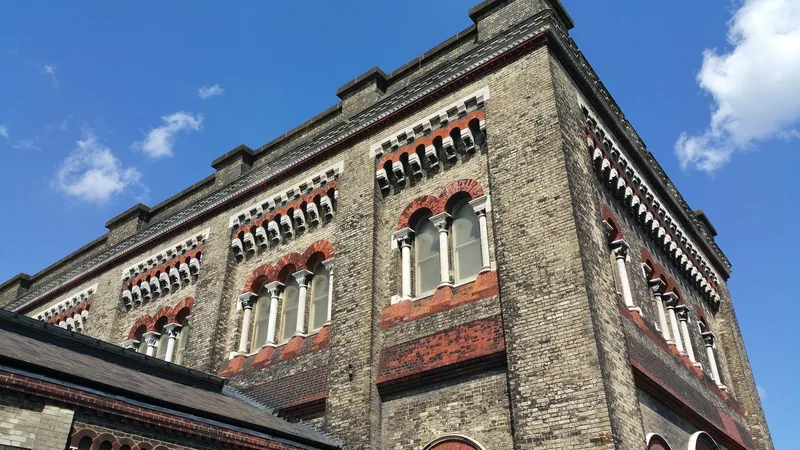
Photo: JRennocks · CC BY 4.0 · Wikimedia Commons · resized
What it costs, for one person and for a family
Crossness prices its tickets two ways. If you are a UK taxpayer and let the trust treat the ticket as a donation under Gift Aid, you pay the higher figure and the trust can reclaim tax on top. If not, you pay the lower one. Both prices are shown at the point of booking.
| Steaming Day ticket | With Gift Aid | Without |
|---|---|---|
| Adult | £22.50 | £20.37 |
| Child, 5 to 17 | £8.00 | — |
| Child under 5 | Free | Free |
| Family: 1 adult, up to 3 children | £29.99 | — |
| Family: 2 adults, up to 3 children | £49.99 | — |
| Registered carer | Free | Free |
| Art Pass holder | £11.25 adult, £4.00 child | — |
Two adults and two children aged 5 to 17 pay £61 booked as individuals, or £49.99 on the two-adult family ticket. The family ticket is not offered as a default at the top of the list, so it is easy to miss. Museums Association members go free, and so does a registered carer accompanying a ticket holder.
Prices were checked on the trust's own booking system in September 2026; it publishes current prices for each date, so confirm at the point of booking.
The vintage bus and the little railway are already paid for. A Steaming Day ticket includes the free Routemaster shuttle between Abbey Wood station and the site and rides on the narrow-gauge RANG railway that runs the last stretch to the buildings. For a family, that turns an awkward two-kilometre approach into two of the better parts of the day.
Getting there from central London
Take the Elizabeth line to Abbey Wood. It runs from Paddington, Bond Street, Tottenham Court Road, Farringdon, Liverpool Street, Whitechapel and Canary Wharf, all stations are step-free, and Abbey Wood is the eastern end of the southern branch. Southeastern trains also reach Abbey Wood from Charing Cross, Waterloo East and London Bridge.
From the platform, the shuttle bus is the way to do the last leg. Come down from the platform to the main concourse, turn right as you leave the building, and take the stairs or lift down; the stop is under the flyover, across from the Abbey Arms. The trust publishes the day's timetable with the event, and buses run in both directions through the middle of the day.
If you would rather walk, the site is between two and 2.7 kilometres from Abbey Wood station depending on the route, through Thamesmead and along the river path. On open days the Thames Path gives access, which makes this a good pairing with a river walk; our guide to the Thames Path and London's walking routes covers the wider network. Minicabs operate from near the station.
Driving is the expensive option and the trust says so itself. Crossness is inside the Ultra Low Emission Zone, so a non-compliant vehicle pays the daily charge, and the Blackwall and Silvertown tunnels are now charged in both directions if you approach from the north. Our guide to the Congestion Charge and ULEZ explains who pays what, and the free ways to cross the Thames covers the Woolwich Ferry and the foot tunnels, which are not charged. The car park is at the end of Bazalgette Way, with a 700-metre walk to the buildings; Blue Badge holders should email or telephone a few days ahead to be parked closer.
Inside the Beam Engine House
The building opened in 1865 with four rotative beam engines, named after the royal family of the day: Victoria, Prince Consort, Albert Edward and Alexandra. They were built as single-cylinder engines by James Watt and Company of Birmingham and rebuilt as triple-expansion engines between 1895 and 1901 by Benjamin Goodfellow of Hyde in Cheshire.
Prince Consort is the one that runs. It was chosen for restoration because it was believed to be the last of the four used, in the local floods of the early 1950s, and therefore the least decayed. Restoring it took volunteers about eighteen years; the beam alone weighs 47 tonnes and the flywheel 52 tonnes, both left broadly in place while everything around them was dismantled. Around a hundred brass oil pots had to be recast because scrap thieves had stripped them from the abandoned building.
It was put back in steam in the early 2000s and restarted by the then Prince of Wales, now King Charles III, alongside Sir Peter Bazalgette. The two are the great-great-grandsons of the Prince of Wales who started the engines in 1865 and of the engineer who designed the place. Restoration of Victoria, the second engine, is still going on, so on any given day you may find volunteers at work on it.
The ornamental ironwork is the reason people photograph the building rather than the engines. It was made by the Butterley Iron Company, and there is nothing restrained about it: screens, brackets, columns and painted panels filling a space that no member of the public was ever meant to see.
Why a sewage works was built here at all
Cholera killed over 6,500 Londoners in 1831 and 1832, more than 14,000 in 1848 and 1849, and over 10,500 in 1853 and 1854. Human waste ran into the gutters and the rivers, and the rivers supplied the drinking water. In June 1858 an exceptionally hot month turned the Thames outside Parliament into what became known as the Great Stink, and Parliament, which had ignored the problem for decades, passed the legislation that let Joseph Bazalgette build his intercepting sewers within eighteen days.
Work started in 1859. Crossness, on the south bank, was finished in 1865: engine house, boiler house, workshops, a 208-foot chimney and a covered reservoir holding 25 million gallons. Abbey Mills, its counterpart north of the river, followed in 1868, and the whole system was complete in 1875. Bazalgette was knighted in 1874 and died in 1891.
The system did not solve everything at once. Until 1888 the reservoirs still discharged untreated sewage into the Thames on the outgoing tide, which is why the sinking of the pleasure steamer Princess Alice in Gallions Reach in September 1878, with over 650 deaths, happened in water that was being fouled at that exact moment. After that, sludge vessels took the waste out to sea instead, a practice that only ended on the last day of 1999.
The beam engines went to standby in 1920, the buildings were redundant by 1953, the chimney came down in 1958, and the engine house was locked up and left to pigeons. Thames Water considered demolition in the early 1980s. A Grade I listing in 1980, pushed for by the Greater London Industrial Archaeological Society, saved it, and a volunteer group formed in 1985 began the restoration. The first public open day was held on 10 May 1986.
How long to allow, and what the day is like
Treat it as a half-day minimum and a full day if you are coming from central London. From Paddington or Liverpool Street, Abbey Wood is around forty to fifty minutes, then the shuttle and railway on top, then two to three hours on site.
The café is modest: pre-packed snacks, tea and coffee in disposable cups, with gluten-free and decaffeinated options. It is not a place to plan lunch around, so bring something if you are fussy. The shop takes cards and cash. Toilets, including accessible facilities and baby changing, are near the exhibition. Well-behaved dogs on leads are welcome, though not in parts of the Beam Engine House, which has pierced metal flooring.
The Great Stink exhibition in the boiler house, opened in 2016, covers the cholera epidemics and the sewer scheme, and it is the part to send children to if the machinery is not holding them. Our guide to London with children has more days out of this kind.
Access, stairs and what you can see without them
The trust has tried to balance a Grade I listed structure against getting people round it. All parts of the site and all the buildings can be reached without using steps. Inside the Beam Engine House, though, the first floor and the basement are reached only by steep, narrow stairs, so the upper beam floor is shown on closed-circuit television for anyone who cannot manage them.
That is an honest compromise rather than a full solution, and it is worth weighing before booking. Our guide to accessible London sets out what to expect from older attractions generally.
Is it worth the journey?
Yes, on a Steaming Day, if you have any interest at all in engineering, Victorian London or the reasons cities stopped dying of cholera. It is one of the very few places where you can watch machinery of that scale working rather than standing still, and the decoration is genuinely strange. It is a poor choice for a first trip to London, for anyone short of time, or for a wet day with small children.
If Crossness is closed when you are here, three other places cover related ground and open far more often. The Kirkaldy Testing Museum in Southwark has a Victorian testing machine run by volunteers on limited days. The Brunel Museum and the Thames Tunnel at Rotherhithe covers the first tunnel under a navigable river. The Thames Barrier downstream at Woolwich is the twentieth-century answer to a different water problem, and it is the nearest of the three to Abbey Wood.
Crossness also takes part in the Totally Thames festival in September and, in some years, the Open House Festival, both of which add dates to the calendar. For the full picture of what will be in the new galleries covering London's own history, see the London Museum, and for other places of this size and oddity, our list of London's best small museums.
Frequently asked questions
Can you visit Crossness Pumping Station any day?
No. Crossness opens only for booked Steaming Days, guided tours, special events and private group visits, on a small number of published dates. The trust states that the site cannot be accessed at any other time, because it sits inside a working sewage treatment works. Tickets must be bought in advance.
How much does Crossness cost?
On a Steaming Day an adult ticket is £22.50 including Gift Aid, or £20.37 without. Children aged 5 to 17 pay £8, under-5s and registered carers go free, and a family of two adults and up to three children is £49.99. A guided tour is £22.50 with Gift Aid. Check current prices when booking.
How do you get to Crossness from central London?
Take the Elizabeth line or a Southeastern train to Abbey Wood, then the free vintage Routemaster shuttle that is included in the ticket, followed by the narrow-gauge railway to the buildings. Walking from the station takes between two and 2.7 kilometres depending on the route. Driving involves ULEZ and, from the north, tunnel charges.
Will the beam engine be running when I visit?
Only on a Steaming Day. The Prince Consort engine is in steam on those dates and stationary on guided tours and special event days, including the October steampunk weekend. If seeing the engine move is the point of your visit, check which type of day you are booking.
Is Crossness suitable for children?
On Steaming Days, yes. There is a children's trail from reception, a free hands-on craft activity run by the learning team in the boiler house, the narrow-gauge railway and the vintage bus. Children under 5 enter free and the family tickets are good value. The three-hour guided tours suit older children and adults better.
Sources
- Crossness Engines Trust - ticketing portal: dates, sessions and prices (checked September 2026)
- Crossness Engines Trust - Visit Us: ways to visit, facilities, access and getting here (checked September 2026)
- Crossness Engines Trust - History and timeline (checked September 2026)
- Crossness Engines Trust - The Beam Engine House and Prince Consort (checked September 2026)
- Transport for London - Ultra Low Emission Zone (checked September 2026)