
Chiswick House is a small neo-Palladian villa in west London with 65 acres of gardens around it. The gardens are free and open every day from 7am until dusk. The villa costs £13.50 for an adult and opens Thursday to Sunday. The glasshouse behind it holds a camellia collection that is probably the largest of its kind in Britain.
Lord Burlington built the villa in the 1720s as a place to show off his art and his ideas rather than to live in, working with the designer William Kent. Between them they imported a style from Italy, applied it to a London suburb, and changed British architecture for a century. The garden they laid out around it did the same for gardening.
For a visitor the practical point is the split: an excellent free park that you can use like any other London green space, and a small paid house that takes about an hour. Plenty of local people come every week and have never been inside.
Chiswick House and Gardens at a glance
- Gardens
- Free, every day, 7am until dusk; 65 acres
- House
- Thursday to Sunday; last entry 3pm
- Adult ticket
- £13.50 (September 2026)
- Child, 5 to 17
- £6.50; under-5s free
- Family
- £29.50 for two adults and up to three children; £18.50 for one adult and three children
- Included
- Explorer map and audio guide, in adult and children's versions
- Kitchen Garden
- Free; Thursday to Sunday 10.30am to 3.30pm
- Nearest station
- Chiswick (South Western Railway), 13 minutes to the Burlington Lane Gate
Why the gardens matter more than the house
Chiswick is usually described as the first English landscape garden, and the claim holds up better here than in most places that make it. Before Chiswick, grand English gardens followed the French model: symmetry, straight axes, everything under control. Kent and Burlington broke the axis, curved the paths, hid the boundaries and made the whole thing look, at least at a glance, like accidental countryside.
Everything that followed, from Capability Brown to every municipal park in Britain, descends from experiments made on this ground. Walking it is therefore more interesting than walking a prettier garden, because you can see the argument being worked out: a straight avenue here, an informal lake there, classical temples and obelisks set as punctuation.
The Trust that runs it keeps the whole thing free. There are more than 1,600 trees, and the grounds act as a piece of working nature rather than a display, with an open Kitchen Garden at the centre where visitors are invited to wander and taste what is growing. A produce cart sells what has been picked on Thursdays and Saturdays from 11am.
Free, every day, from seven in the morning. Very little in London opens at 7am. If you are staying in west London and want an hour outdoors before the city wakes up, this is the best option for miles, and the cafe opens early enough to follow it with coffee. See our list of free things to do in London for more in the same spirit.
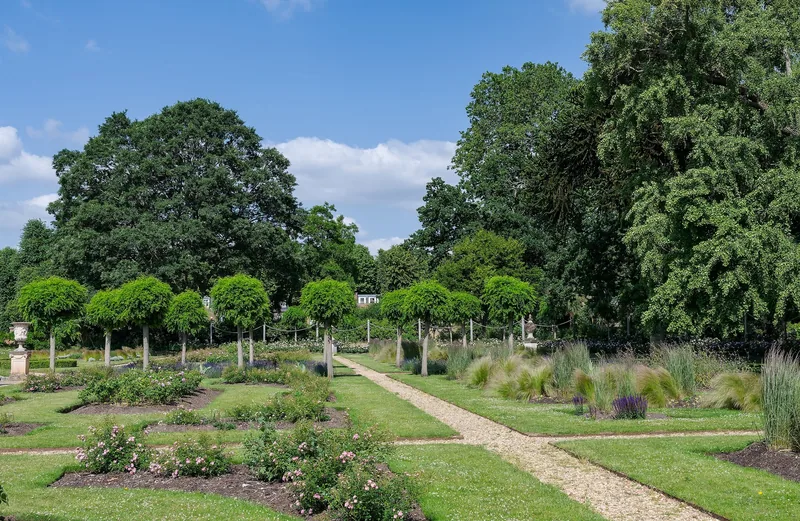
Photo: Tilman2007 · CC BY-SA 4.0 · Wikimedia Commons · resized
The Conservatory and the camellias
Behind the villa runs a glasshouse 330 feet long, designed by Samuel Ware and completed in 1813 for the 6th Duke of Devonshire. It is Grade I listed and it is the earliest large glasshouse in the country, the direct ancestor of Decimus Burton's palm house at Kew and of Paxton's Crystal Palace.
It was built for hot-house fruit. In 1828 the fruit was replaced with a fashionable and expensive new import from China: camellias, bought from Chandler and Buckingham of Vauxhall at between three and five guineas each, which was about five weeks' wages for an ordinary earner. They were kept in pots at first and planted into the beds around 1855.
Several of the original forty varieties still survive, which makes the heritage collection probably the largest in Britain and possibly the largest outside China and Japan. Among them are four of the first camellias ever introduced into Europe. The collection nearly died out in the 20th century, was rescued by the International Camellia Society from 1994, and passed into the Trust's care in 2007.
Come in late winter if you want the camellias in flower. The Conservatory blooms from roughly February into March, and the Trust runs a free camellia show at the peak, which is an unusual reason to be in a London garden in February. Check the current year's dates before you travel, because they move with the weather. Our guide to London in February covers what else is on.
The house: what £13.50 buys
The villa is small, and that is deliberate: Burlington lived in the older house next door and used this one for entertaining and for displaying his collection. The interior is a sequence of formal rooms decorated by Kent, with a domed saloon at the centre and a gallery running along the garden front. An hour is plenty.
| Ticket | Price (September 2026) |
|---|---|
| Adult | £13.50 |
| Child, 5 to 17 | £6.50 |
| Child under 5 | Free |
| Family, 2 adults and up to 3 children | £29.50 |
| Family, 1 adult and up to 3 children | £18.50 |
| English Heritage member | Free, on production of a card |
The ticket includes an explorer map and an audio guide, with a separate children's version. Last entry is 3pm and the house opens Thursday to Sunday, so a Monday visit means gardens only. The house is occasionally closed for private hire, and the Trust publishes planned closures, which is worth two minutes of checking before a long journey.
Tick the Gift Aid box and your day ticket becomes a year pass. The Trust upgrades Gift Aid tickets to an Annual Pass giving free entry to the house for twelve months from the date of your visit, issued at the ticket desk. If you live anywhere in west London, or are in town for a fortnight, this turns £13.50 into an unusually good deal.
Eating, and what is new on the site
The cafe is open daily and run by Colicci, with coffee, cakes from its own bakery and sourdough pizzas from an in-house oven. It is set among the trees rather than in the house, which makes it a genuine park cafe rather than a museum one.
The Trust has also converted old sheds, stables and outbuildings into artists' and makers' studios, which opened in May 2025 with the first residents arriving that summer. There are regular community open days when you can meet the artists and join free creative workshops for all ages, and a new Learning Hub and Yard alongside them.
The seasonal shop inside the house closes over the winter and reopens in spring, so do not count on buying anything there out of season. Profits from both the shop and the cafe go back into the gardens, which is how a 65-acre site stays free to enter. Roughly three-quarters of the Trust's funding comes from visitors and supporters rather than from the state.
How long to allow: an hour for the house with the audio guide, and anything from forty minutes to a whole afternoon for the gardens, depending on whether you walk the outer paths or stay near the lake. A family with young children will find the open lawns and the Kitchen Garden easier going than the villa.
Getting there
Chiswick station, on South Western Railway from Waterloo, is a thirteen-minute walk from the Burlington Lane Gate and is the easiest arrival. On the Underground, take the District line to Turnham Green, making sure the train is going to Ealing Broadway or Richmond, and then either walk for twenty minutes or take the E3 bus to the Chiswick House stop. Our Underground guide explains how the District line branches work, which is the part that catches people out.
Three local bus routes stop near the gates. There are bike racks at the entrances and by the house and cafe, and cycling is allowed on the tarmac paths at the edge of the gardens but not on the grass or the walking paths inside them.
Drivers can use the public car park just off the westbound A4, signed with a brown tourist board. It is a five to ten minute walk from there to the house along uneven gravel paths, which is worth knowing if you have a pushchair. Coaches cannot park inside the gardens and are asked to set down on the A316 before the Hogarth roundabout.
What is next door
Chiswick sits on the river between Hammersmith and Kew, and the walk down to the Thames from the gardens takes about ten minutes. Our guide to Chiswick and Kew covers the area, and the riverside pubs along Chiswick Mall are in our guide to riverside pubs on the Thames. Hammersmith and Barnes are the next stretch downstream.
Kew Gardens is fifteen minutes away by train and is a completely different proposition: much larger, ticketed, and botanical rather than architectural. Doing both in one day is possible but hard work; we would take Chiswick in the morning and Kew from lunchtime, or split them.
For the architecture rather than the planting, Banqueting House in Whitehall is the building Burlington was arguing back to, and Somerset House shows what the same ideas became on a civic scale. Upstream, Strawberry Hill House is the Gothic rebellion against all of it, and Ham House and Marble Hill complete the run of Thames-side houses.
For gardens with the same sense of being a collection rather than a display, see the Chelsea Physic Garden and London's secret gardens. With children, the open lawns and the Kitchen Garden make this an easy afternoon: see London with children.
Frequently asked questions
Are the gardens at Chiswick House free?
Yes. The 65-acre gardens are free for everyone, every day, from 7am until dusk, and so is the working Kitchen Garden, which opens Thursday to Sunday from 10.30am to 3.30pm. Only the villa itself charges, at £13.50 for an adult (September 2026).
When is Chiswick House open?
The house opens Thursday to Sunday, with last entry at 3pm, and is occasionally closed for private hire. The gardens and the cafe are open every day. Check the Trust's planned closures page before travelling if the house is the reason for your visit.
When do the camellias flower at Chiswick House?
From roughly February into March in the Grade I listed Conservatory, with a free camellia show at the peak. Exact dates shift with the weather and are announced each year. Some of the plants descend from the original forty varieties brought in from China in 1828.
How do you get to Chiswick House by public transport?
Chiswick station on South Western Railway is a thirteen-minute walk to the Burlington Lane Gate. On the Underground, take the District line to Turnham Green towards Ealing Broadway or Richmond, then walk for twenty minutes or take the E3 bus to the Chiswick House stop.
Is the Chiswick House ticket good value?
Yes, if you add Gift Aid. The Trust upgrades a Gift Aid ticket to an Annual Pass, giving free entry to the house for twelve months from the day of your visit, issued at the ticket desk at no extra cost. Without it, £13.50 buys about an hour in a small but influential building.
Sources
- Chiswick House & Gardens - Opening times and tickets (checked September 2026)
- Chiswick House & Gardens - House admission prices (checked September 2026)
- Chiswick House & Gardens - Getting here (checked September 2026)
- Chiswick House & Gardens - A history of the camellia collection (checked September 2026)
- Chiswick House & Gardens - Eat, drink and shop (checked September 2026)